


As part of the Tax Reform Act of 1986, the kiddie tax was established to prevent parents from shifting their wealth or income-producing assets into their children’s names—all to avoid paying a higher tax rate than the child tax rate. It's specific to children younger than 18 years old, or who are full-time students under age 24. Kiddie tax is also specific to the unearned income or investment type income. For example, interest, dividends, or other unearned income.1 Again, kiddie tax applies to unearned income—not earned income.
When does kiddie tax apply?1
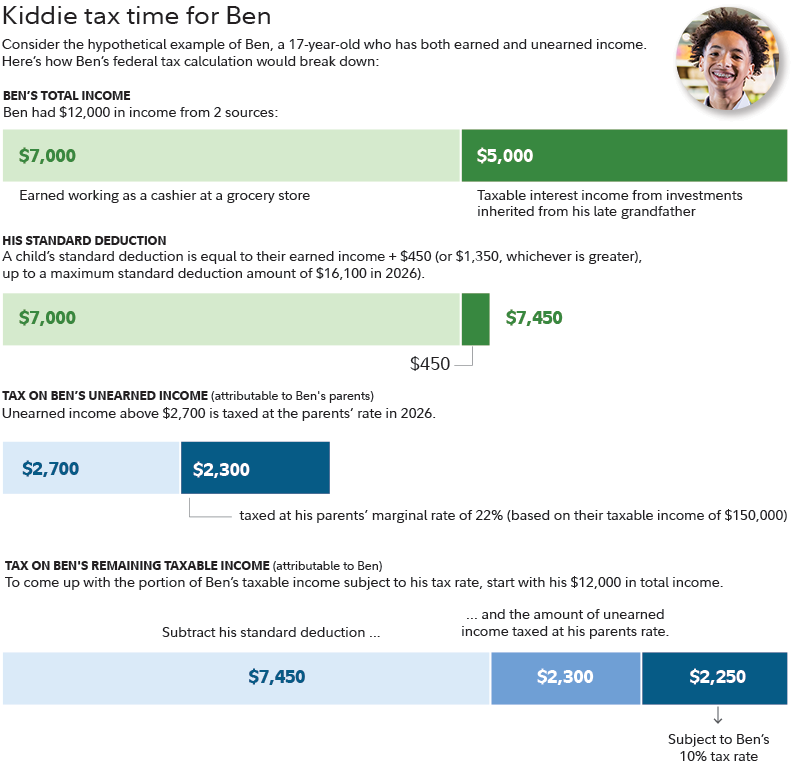
In 2026, the kiddie tax applies or has an unearned income threshold between $1,350 and $2,700. According to the IRS, kiddie tax applies to those who are:
- Younger than 18 at the end of the tax year
- 18 years old at the end of the tax year only if their earned income is less than or equal to half of their support
- Full-time students between the ages 19 and 23 years old, if their earned income is less than or equal to half of their support
In 2026, children and youth who work must file and have their own tax return if they have an earned income that exceeds $16,100.
What tax rate will my child pay?
Again, unearned income between $1,350 and $2,700 will be taxed at the child's rate. For filing, parents report kiddie tax on Form 8615, which is attached to their Form 1040.
Any unearned income from a child that exceeds $2,700 is taxed at the parents' rate. If a child's only income is interest totaling less than $13,500, then parents may opt to report the amount of income your child would otherwise need to report on their own tax return, instead of a separate tax return for their child.2
Again, these rules cover children under the age of 18, and also those under the age of 24 who are full-time students.
Will kiddie tax affect college savings?
If your child has a significant investment portfolio in a custodial account (in the child's name or a child-owned brokerage account like Fidelity's Youth Account) or is the beneficiary of a trust, then they may be subject to kiddie tax.
To clarify with a bit of information about custodial accounts: They allow investments for a minor (under Uniform Gifts to Minors Act (UGMA) or Uniform Transfers to Minors Act (UTMA)) to grow over time, and the earnings are customarily taxed as unearned income. Because there aren’t restrictions on what money in that account can be allocated towards (as long as it’s for the child’s benefit), if your main objective is to put money away for college or education expenses, then there are other college savings options that offer you that choice. You could opt for a 529 plan or a Coverdell Educational Savings Account (ESA), for example. However, if you’re unsure, it’s always wise to consult a tax or financial professional to help you better understand what account is best for you and your family.
How can my child's assets for tax efficacy be managed?
If your child has earned income, you can invest that income (up to $7,500 per year) in a Roth IRA for kids. The same rules apply to a Roth IRA for this age group as for adults. While money is in the Roth IRA, no taxes will be due on any investment earnings. Contributions can always be withdrawn tax and penalty-free. Qualified distributions of earnings are tax-free, assuming conditions are met.3 An added bonus, assets in retirement accounts do not generally count as assets for college financial aid calculations.
As previously mentioned, you may also want to consider using a 529 savings account for educational savings instead of, or in addition to, a custodial account. While money is in the 529 account, earned is not taxed with the kiddie tax. When you take money out for qualified education expenses, those withdrawals are federal income tax-free. You may also get a state tax deduction for your contributions, and the account will be counted as a parental asset (rather than a student asset), which can be beneficial when determining financial aid for college.
Bottom line
Your child's tax situation can be more complicated than you imagine, so consider consulting a tax advisor or financial professional to figure out your responsibilities and the best strategies to help address kiddie tax.