


On paper, financial planning is pretty straightforward, but in reality, it can get complicated. Not because of math or complexity but because our emotions get involved. When the markets get rocky, it's easy to let doubt about your investment plan creep in.
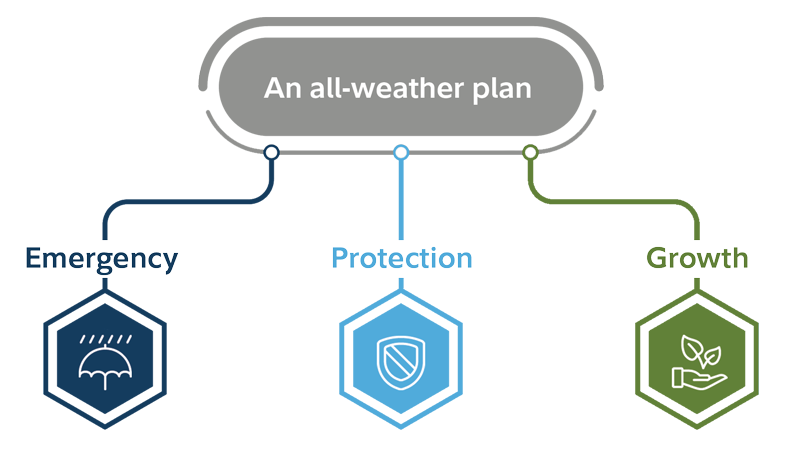
The good news is that there are ways to work around some of the roadblocks to investing that your brain may be putting in your way. Consider thinking about your financial picture in terms of 3 broad categories: emergencies, protection, and growth potential. These 3 building blocks work together to help make sure you have money for unexpected expenses, insurance to protect your income and home, and growth potential to reach your planning goals. The emergency savings would ideally cover any unexpected needs that crop up in the short term, and your protection strategy helps you to feel secure so that your growth assets can get, and stay, invested.
Find out why it's important to stay invested through market ups and downs. Read Fidelity Viewpoints: 6 tips to navigate volatile markets
2 reasons thinking about your financial plan in this way can help
1. It helps to put goals into a manageable perspective. Research suggests that people may be more likely to reach their goals when the goals are achievable. Separating accounts into their respective goals can help make saving and investing feel more manageable and measurable. Aiming to maintain emergency savings of 3-6 months' worth of essential expenses is an example of a goal you might be able to get your arms around more easily. Saving and investing for retirement, on the other hand, requires constant monitoring and maintaining.
2. It keeps goals vivid and specific. Reminding yourself what you’re saving for can help ensure that you don’t lose sight of your goals. Long-term priorities can sometimes take a backseat as daily expenses and income rise and your life situation changes.
Being very precise and intentional about the way you treat your financial goals also helps. If all your money is in one big account, with your daily spending money sloshing around with your short-term goal savings and your emergency savings, things can get fuzzy and you're more likely to dip into cash you planned to save. But once money has been allocated to a specific goal, there's an added level of mental resistance to spending it.
Giving each goal its own space can help keep the significance clear in your mind. It could be a column in the spreadsheet you use to track your progress, an envelope you use for saving, or an account at a financial institution. To make it particularly powerful, consider adding a descriptive, emotionally meaningful label.
As an example, if you have a savings account set up for a down payment on a house, labeling the account something specific and meaningful to you—like "future dog yard" or "where my kids will grow up"—can help you stick to your plan.
Consider creating your goals in Fidelity's Planning SummaryLog In Required. You'll be able to add as many goals as you like, set the time frame, and track your progress.
3 elements of an investment plan: emergency, protection, growth
For illustration only.
A healthy investment plan contains 3 components: liquidity for emergencies, protection for those that you love, and growth potential for the future.
1. Emergency savings: It’s a good idea for everyone to have money set aside for unexpected expenses. Saving enough to cover 3-6 months of essential expenses is a helpful starting point, but keeping too much in cash or other very conservative accounts may make it harder for your money to keep up with inflation. With a thoughtful investment plan that balances access to cash, it can make sense to keep a more modest amount of cash on hand to cover the kinds of unexpected expenses that could pop up in any year—providing the same sense of security as holding a large amount in cash.
Read Fidelity Viewpoints: How much to save for emergencies
2. Protection:
Protection is a critical, yet often overlooked, component of a strong financial plan. It helps safeguard your family, income, and assets through foundational tools like life insurance, as well as long-term care coverage when appropriate, proper asset titling, and beneficiary designations. Protection also extends to managing investment risk by adjusting your asset allocation—such as incorporating more fixed income or fixed-rate investments—to help preserve principal, reduce exposure to market volatility, and create a more stable and predictable income stream in retirement.
Read Fidelity Viewpoints: 2 ways to help balance growth potential and protection and Retirement income strategies
As your life and financial situation scale up in complexity, often as you get older and hopefully become more financially comfortable, the layers of protection you may want could extend to long-term care insurance and tax-efficient inheritance strategies.
Read Fidelity Viewpoints: How long-term care planning can help your loved ones
3. Growth: Once you have accounted for your emergency savings and protected certain aspects of your life, the growth portion of your plan is where you would put your diversified investment strategies for various long-term goals, such as education, a home purchase, retirement, and wealth accumulation. This component is generally the largest piece of your plan.
Growth potential can help your money keep up with inflation and hopefully help you accumulate wealth while staying invested through the up and down markets. The key is to strike a comfortable balance between the level of stock market risk you can live with that also lines up with your time horizon, financial situation, and risk tolerance. That balance then provides the growth potential to strive toward your goals.
Having an emergency savings and the appropriate level of protection in place can help you stay more disciplined with your strategy.
Read Fidelity Viewpoints: How to start investing
Where to go from here
Breaking down your financial life by category and assigning your assets to various financial goals can help you see how the pieces work together. Each part of your plan has an important role to play, and that can help give you peace of mind when the stock market gets choppy. Knowing that you’ve planned for contingencies, and having a cash buffer, can help you stay invested through market ups and downs. It also provides ready cash for unexpected expenses so the rest of your plan can stay on track.
Once you have a solid grasp of how your money fits into these broad categories, you can work to build each one up to fit your needs. For instance, you may feel a little nervous about investing in the stock market, so it could make sense to have a more robust emergency savings so you feel more confident that you can ride out a market downturn and have cash available when you need it. In a similar way, life and disability insurance can help protect your family against a loss of income.
You don't have to do it all alone though. For more help, consider working with a financial professional to build your plan.