
Estimate Time6 min

When bonds go bad

Key takeaways

  • A company or municipality may declare bankruptcy, but that doesn't make its bonds worthless.
  • Bankruptcy laws govern how a bond issuer goes out of business or attempts to reorganize its finances.
  • Faced with bankruptcy, a bondholder can choose to sell their bonds or hold on, anticipating a reorganization.

What does it mean for bondholders when a company that issued their bonds becomes insolvent? The good news is that the US bankruptcy process offers them a variety of rights and protections that may increase the likelihood that they will recover the value of their investment. It's also good to remember that bankruptcy does not necessarily mean the end for a company or the securities it issues.

How bankruptcy works

Chapters 7 and 11 of the Federal bankruptcy laws govern how US companies go out of business or attempt to recover from financial distress.

When a company files for Chapter 7, it ceases operations and its assets are sold to repay creditors and investors.

Chapter 11 bankruptcy allows a company to reorganize in hopes that it may again become profitable. Once a restructuring plan is approved in court, the bankrupt corporation emerges as a newly organized company with less debt.

While either type of bankruptcy often means an investor loses money they had invested in the company's stock, investors holding bonds are more likely to recover at least part of the value of their initial investment.

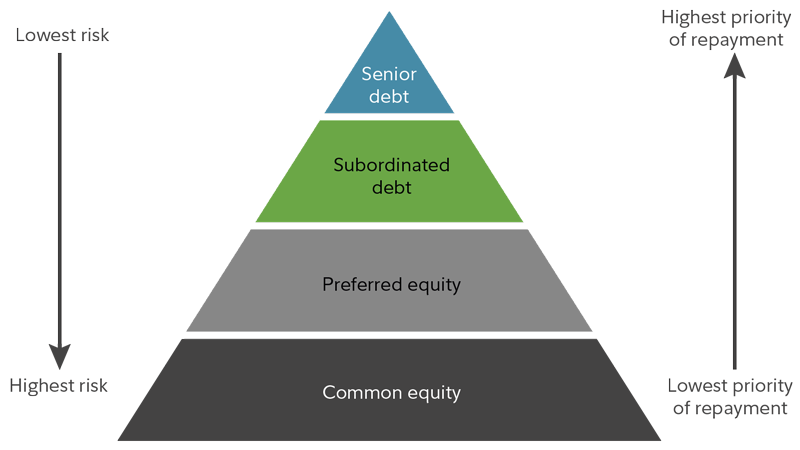
Bankruptcy law sets clear rules for who gets repaid first. Courts rank creditors by priority, from those with the strongest claims to those with the weakest. This order determines both whether investors get paid and how much they may recover.

This hierarchy of repayment typically looks like this:
The data in the chart is described in the text.

As the chart shows, senior debt holders (typically banks) get paid before all others. Bondholders are typically next in line—though their priority can vary depending on the type of bond—and a bankrupt firm may still have enough assets to repay at least part of what they are owed.

But while where you stand in line helps determine when and how much you get repaid for your investment, how you are repaid may vary depending on the company's business, the assets it has, and its path out of bankruptcy. Once a company files for bankruptcy, bondholders typically stop receiving principal and interest payments. When the process is complete, they may receive newly issued bonds, cash, or stock whose value may not equal the value of the bonds they owned.

In a Chapter 7 bankruptcy, bondholders receive cash from a sale of the company's assets, a process that may take years to complete.

Municipal bonds and bankruptcy

Bankruptcy risk isn’t limited to corporations. In rare cases, cities or other local governments can also run into financial distress and seek to restructure their debts.

Rules for municipal bankruptcy differ from corporate bankruptcy and vary by state, but the basic idea is similar: A court oversees a process to sort out claims and determine how creditors will be repaid.

Defaults in the municipal bond market have historically been uncommon. But when they do occur, outcomes can vary widely. Bondholders may recover part of their investment, though the amount—and the timing—depend on the issuer’s finances, the type of bonds involved, and the legal structure backing them.

As with corporate bonds, credit quality, revenue sources, and legal protections all play a role in determining risk.

What to do if faced with rising bankruptcy risk

A default or failure to pay interest to bondholders typically precedes bankruptcy, and a company will show signs of distress before defaulting. Credit rating downgrades, declining earnings, and other events can indicate problems. Bonds of issuers facing difficulties will also typically drop in price as markets become concerned with the issuer's ability to pay interest and principal. Investors should remember that the probability of downgrades and default increases according to how low a bond is rated, and higher-yielding bonds often have low credit ratings.

If you own a bond issued by a company or municipality at risk of default or bankruptcy, you face a choice between holding the defaulted bond through bankruptcy or selling it.

If you hang on, you face uncertainty over how much you will receive, and when you will receive it. If you sell, you'll know the amount you're getting. However, the amount you receive for selling before restructuring is complete can be less than both the amount you paid and also the amount you may receive if you hold on through the end of the bankruptcy.

Investing involves risk and research is an important part of managing risk. Fidelity's website tracks issuer events for corporate bonds and material events for municipal bonds, including downgrades and credit watches. Bondholders can also receive this information through email alerts, which provide opportunity to react to news of a downgrade or negative credit watch should they wish to.

Other useful resources include Fidelity's Yield Table on the bond research page, which can compare 120 yields at a time.

More information is available in the transition rate tableLog In Required, which shows the historical probability that a bond of a given credit rating will be upgraded or downgraded in a year's time. The lower the starting point in terms of credit quality, the higher the probability of further downgrades.

"We strive to provide investors with resources to research bonds and issuers before they invest," says Richard Carter, vice president of fixed income strategy at Fidelity. "It's important to know what you own and why, and to continue to monitor the bond and the credit standing of the issuer while you own it."

Research bonds quickly and easily

Get investment analysis to help you invest in bonds.

More to explore

This information is intended to be educational and is not tailored to the investment needs of any specific investor.

Views expressed are as of the date indicated, based on the information available at that time, and may change based on market or other conditions. Unless otherwise noted, the opinions provided are those of the speaker or author and not necessarily those of Fidelity Investments or its affiliates. Fidelity does not assume any duty to update any of the information.

​As with all your investments through Fidelity, and in connection with your evaluation of the security, you must make your own determination whether an investment in any particular security or securities is consistent with your investment objectives, risk tolerance, and financial situation. Fidelity is not recommending or endorsing this investment by making it available to its customers.

Indexes are unmanaged. It is not possible to invest directly in an index.

Past performance is no guarantee of future results.

In general, the bond market is volatile, and fixed income securities carry interest rate risk. (As interest rates rise, bond prices usually fall, and vice versa. This effect is usually more pronounced for longer-term securities.) Fixed income securities also carry inflation risk, liquidity risk, call risk, and credit and default risks for both issuers and counterparties. Unlike individual bonds, most bond funds do not have a maturity date, so holding them until maturity to avoid losses caused by price volatility is not possible. Any fixed income security sold or redeemed prior to maturity may be subject to loss.

High-yield/non-investment-grade bonds involve greater price volatility and risk of default than investment-grade bonds.

Diversification and asset allocation do not ensure a profit or guarantee against loss.

Interest rate risk - Like all fixed income securities, the market prices of municipal bonds are susceptible to fluctuations in interest rates. If interest rates rise, market prices of existing bonds will decline, despite the lack of change in both the coupon rate and maturity. Bonds with longer maturities are generally more susceptible to changes in interest rates than bonds with shorter maturities.
Call risk - Many municipal bonds carry provisions that allow the issuer to call or redeem the bond prior to the actual maturity date. An issuer will typically call bonds when prevailing interest rates drop, making reinvestment less desirable for the holder. Some municipal bonds, including housing bonds and certificates of participation (COPs), may be callable at any time regardless of the stated call features. In some cases, bond issuers will call bonds to modify an indenture through a new offering. Investors should also be aware of special or extraordinary redemption provisions. These are provisions that give a bond issuer the right to call the bonds due to a one-time occurrence, such as a natural disaster, interruption to a revenue source, unexpended bond proceed, or cancelled projects.
Liquidity risk - The vast majority of municipal bonds are not traded on a regular basis; therefore, the market for a specific municipal bond may not be particularly liquid. This can be attributed to the large number of municipal issuers and variety of securities. With limited exceptions for some large more actively traded issues, the chances of finding a specific municipal bond in the secondary market at any given time are relatively small. According to the Municipal Securities Rulemaking Board (MSRB), it is much more common to identify basic characteristics of a municipal bond in which an investor is interested in investing (e.g., state, creditworthiness, maturity range, interest rate, or yield, market sector, etc.) and then to make a choice from a set of municipal securities that meet those criteria. Selling prior to maturity can present a challenge for municipal bond investors due to the fragmented and thinly traded nature of the market.
Revenue sources risk - With revenue bonds, the interest and principal are dependent on the revenues paid by users of a facility or service, or other dedicated revenues including those from special taxes. In general, the consumer spending that provides the funding or income stream for revenue bond issuers may be more vulnerable to changes in consumer tastes or a general economic downturn than the income stream for general obligation bond issuers. "Essentiality" is a key investor consideration for a project financed with revenue bonds. For example, a facility that delivers fundamental or essential services, such as water and sewer, may be more likely to have dependable revenues through multiple economic cycles. When evaluating revenue bonds, it is important to consider:
The overall economic health of the region or customer base and the impact it might have on the entity's ability to sustain its revenues.
The exact source of the revenues that will service and repay the debt. Is the bond solely dependent upon one source of revenue or is a larger entity standing behind the issue?
The entity's track record of operational effectiveness through multiple economic cycles. Is there a track-record of solid growth attracting more customers or taxpayers from more diverse sources?
The legal provisions that may be in place to protect the bondholder, such as rate covenants and debt service reserve funds.
The competence of financial management of the entity. Has its credit rating been maintained or strengthened over a period of time? How has it weathered previous economic downturns? How much debt does it have? How much of its cash flow is committed to paying down debt vs. investing in new projects or supporting services of value for the community?
Credit and default risk - Credit risk is the risk that the issuer will default or be unable to make required principal or interest payments. Despite the fact that many municipal bonds have high credit ratings, there is a risk of default in any bond investment.
Tax risks - Because tax-exempt interest generated by municipal bonds is usually more beneficial for investors in higher tax brackets, municipal bonds may not be appropriate for all investors, particularly those in lower tax brackets. In addition, if you are subject to the federal alternative minimum tax (AMT), the interest income generated by certain municipal bonds (mainly private activity bonds) may be taxable.
Inflation risks - with all bonds, investors run the risk that inflation will diminish the purchasing power of a municipal bond's principal and interest income.
Repudiation risk - There can be no assurance that bonds validly issued will not be partially or totally repudiated by the issuing state or municipality, should that be deemed reasonable and necessary to serve other important public purposes.
Other risks - Not all risks can be quantified in a bond's prospectus or offering circular. A type of risk called "special event risk," lawsuits or significant legal changes, another community's public works project, unusual weather, an economic downturn, or other events could impact the issuer's ability to meet their financial commitments.

The yield table and associated search results categorize bonds by Moody's and/or Standard & Poor's (S&P) rating. Bonds which are not rated by one or both of Moody's and S&P will be excluded.

Fidelity Brokerage Services LLC, Member NYSE, SIPC, 900 Salem Street, Smithfield, RI 02917

931174.7.0