


The past year was a humbling one for interest-rate prognosticators, who early in 2026 anticipated rate cuts by the Federal Reserve. Instead, the Fed embarked on a rate-hiking cycle in September, with the bond market now expecting one or more additional rate increases over 2027.
Why bond yields look potentially more attractive heading into 2027
The proximate cause of the Fed’s change of direction has been stubborn inflation. Headline inflation has remained above the Fed’s 2% target for nearly 6 years straight, and abruptly started ticking up again in early 2026 as energy-market disruptions began rippling through the economy. Yet another influence on the Fed’s calculus, and a key contributor to rising long-term interest rates, has been a robust economy (inflation-adjusted economic growth in the third quarter of 2026 was over 3.0%). Additionally, the enormous investment requirements of hyperscalers (companies that operate immense cloud-computing networks)—in the trillions of dollars—have undergirded huge incremental demand for debt financing, which has helped to boost interest rates.
“While there has been a confluence of factors driving rates higher, many investors may not fully appreciate the fact that higher rates are also a reflection of the strong growth in the economy,” says Brian Day, co-portfolio manager of Fidelity® Total Bond Fund (
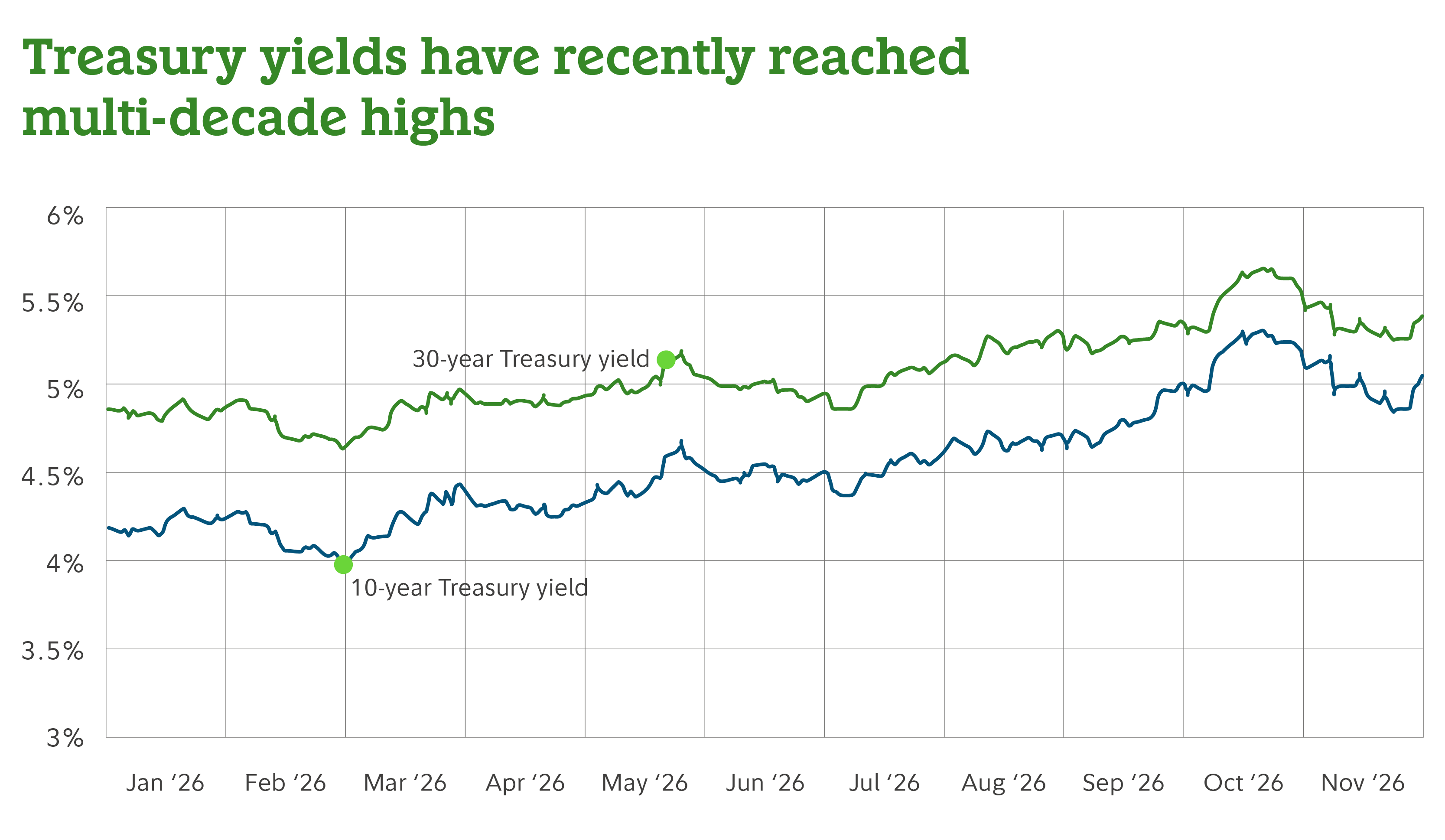
Rising rates can be uncomfortable for bondholders (bond prices fall as interest rates rise). Yet by resetting yields higher, they can also improve the forward-looking income and return potential for bonds. In 2026, these dynamics—falling bond prices but higher yields—dueled it out essentially to a draw, with the Bloomberg US Aggregate Bond Index, a benchmark that tracks investment-grade, fixed-rate taxable bonds, down by about 0.4% in total return terms as of November 20.
What higher interest rates may mean for bond investors
The good news is that after a year of generally rising rates, the set-up for bonds’ return potential in 2027 appears quite attractive. “With rates recently around or even north of 5%, forward-looking scenarios for bonds skew positive, given simple bond math,” says Day, referring to the way that higher starting yields can offset price declines.
What could drive interest rates in 2027?
The year ahead is likely to bring its own share of economic and rate uncertainty (learn more about the economic and market outlook). Aditi Balachandar, a macro research analyst on Fidelity’s fixed income team, generally expects a “shallow tightening cycle” from the Fed, but adds that policymakers’ job may become more complicated in 2027. There are multiple crosscurrents facing the economy, including fading fiscal support and peaking growth and profits, even as a constrained labor supply keeps the job market tight and allows wage pressures and inflation to persist.
How AI investments and government debt could affect the bond market
There are also questions surrounding the capital investment needs for the data center buildout. Day notes that 2026 is likely to go down as a record-breaking year for investment-grade bond issuance—in no small part due to issuance by the hyperscalers. But going forward, “a big question for the bond market remains how much issuance will be required over the next several years, and what does that ultimately mean for credit spreads?” he says. (Credit spreads represent the additional yield investors demand in exchange for investing in bonds with credit and default risk.) The answer may hinge on whether corporations generate sufficient revenues and profits to justify the colossal amounts of capital spending.
There are also investor concerns about the sustainability of the federal government’s fiscal deficit and rising debt burden, and how the Treasury market will respond to the demands of trillions of dollars of new debt issuance and refinancing. David DeBiase, co-portfolio manager of Fidelity® Limited-Term Bond Fund (
Where investors may find opportunity in fixed income
As of late November, 2-year Treasurys yielded around 4.6%, reflecting market expectations of more Fed rate hikes. “I believe the front end of the curve, meaning relatively short maturities, may make a lot of sense for investors who are looking for yield and to move some funds out of cash,” DeBiase says.
Against a backdrop of a potentially more attractive opportunity set, but also continued uncertainty, bond investors may be facing a complex year. Rather than making big bets or seeking big wins, a sounder approach for this environment may be to focus on the role investors need and want bonds to play in their portfolios, and to chart their courses accordingly.
With that in mind, here are 4 approaches to bonds to consider in 2027, designed for investors with different preferences, including portfolio diversification, meeting periodic spending needs, reducing taxes, and hedging the possibility of rising interest rates.
4 fixed-income strategies to consider in 2027
The diversifier
The need
Rising interest rates in 2026 strengthened the potential portfolio-diversifying role of high-quality fixed income. Moreover, even investors with long time horizons generally need an allocation to bonds to help provide ballast in a portfolio—with this allocation typically increasing as a goal nears. “My team thinks that bonds are attractive at recent yield levels,” says Day. “They’ve been offering a lot of value given the level of income you can generate today, and can offer a diversifying balance in the portfolio versus stocks.”
Potential approach
A core bond fund or ETF may provide the type of broad fixed income exposure investors need for diversification. Actively managed funds and ETFs, in particular, may offer investors the chance to benefit from relatively high interest rates, while avoiding parts of the market that offer less value.
With Fidelity® Total Bond Fund and Fidelity Total Bond ETF, for example, managers have been emphasizing Treasurys over corporate bonds, due to the differences they’ve found in risk-reward profiles. Rates on corporate bonds have moved up with increases in Treasury yields, but the spread, or premium, over risk-free Treasurys is extremely narrow by historical standards. “What my team has been really finding attractive recently are Treasurys, the credit-risk-free asset,” says Day. “There hasn’t yet been enough compensation to take on more credit risk, such as with investment-grade corporate bonds.”
Day says his team has also found value in mortgage-backed securities, where spreads have widened recently, and in securitized products including asset-backed securities (ABS) and commercial mortgage-backed securities (CMBS). He notes that investing in these unique, niche markets, which are “not as efficient as the corporate market,” can play to Fidelity’s strengths of wide and deep research and trading resources. For instance, in the ABS market he’s been attracted to aircraft securitizations backed by plane leases; in CMBS, he’s favored single-asset, single-borrower deals such as pools of industrial warehouse buildings.
Key risks
Of course, even with rates relatively high, it is always possible that rates could move even higher due to factors such as rising inflation. Rising rates—and accompanying falling bond prices—would be the chief risk for investors in a broadly diversified core bond fund or ETF.
The coupon clipper
The need
Investors seeking to create a steady stream of income may need more predictability. While money market yields have increased in 2026, staying in such short-term investments may require giving up additional returns potential—plus leave investors exposed to reinvestment risk if rates were to eventually fall.
Potential approach
There’s another strategy to earn more income while generating periodic cash flows to meet necessary expenditures: laddering a fixed income portfolio over a predetermined time horizon. “You can create a bond portfolio where you control when you want the securities to mature,” says Richard Carter, vice president of fixed income brokerage strategy at Fidelity. “You know the timing of the coupons and return of principal.”
Bond ladders are portfolios of bonds that mature at staggered intervals—for example, with bonds maturing every 6 months, staggered over 5 years. Ladders can offer the potential advantages of steady income from coupons and principal, allowing an investor to either meet expenses or to gradually reinvest over a variety of interest rate environments. By stretching some, but not all, of an investor’s money over a longer time horizon, they may allow investors to earn a higher yield than they could on short-term options alone, without locking up too much money for the long term.
Carter says that individual short-term Treasurys and certificates of deposit (CDs) are the principal building blocks many investors use to create a bond ladder, though Fidelity’s tools can also allow investors to build bond ladders using corporate bonds, municipal bonds, and agency bonds. “By taking on this explicit time-commitment risk, investors can capture the higher yields currently available from the upward-sloping shape of the yield curve,” says Carter.
As a hypothetical illustration, using the Fidelity bond ladder tool, an investor could have built a 5-year ladder of call-protected CDs with an average yield of 4.8%, a 5-year ladder of Treasurys with an average yield of 4.8%, or a 5-year ladder of call-protected investment-grade corporate bonds offering an average yield-to-worst of more than 5%—using securities available as of mid-November.1 Carter notes that the additional yield earned by investing in investment-grade corporate bonds rather than Treasurys or CDs has recently been slim, reducing the compensation for taking on credit risk in a bond ladder. (Investors can also compare top rates among the thousands of new-issue and secondary-market fixed income securities available with Fidelity.com.)
Key risks
Interest rates could rise or fall over the term of your bond ladder. Falling rates create reinvestment risk, the risk that you can’t reinvest proceeds from maturing bonds at such an attractive rate. Rising rates may lead to your bond holdings declining in market value, but they do not impact the cash flows received from coupon payments and maturing bonds. Investing in bonds with credit risk, such as corporate bonds, also creates the risk of downgrade or default.
The tax-sensitive investor
The need
Sometimes lost in the investment shuffle is the need for investors to focus on after-tax, rather than pre-tax, income and investment returns. This may be particularly important for investors who hold bonds in a taxable brokerage account, as opposed to a tax-advantaged retirement account such as a traditional or Roth IRA.
Because interest from traditional bonds is taxed as ordinary income, investors in the highest 2027 tax bracket could face a marginal rate of as much as 37% on their coupon income. Those federal taxes alone could reduce a taxable yield of 5% to an after-tax yield of just 3.15%.
Potential approach
Municipal bonds, which pay interest income that is typically free from federal taxation, are a favored asset class for tax-sensitive investors in many environments, and may offer particular appeal for 2027.
Muni bonds—which are issued by state and local public entities—are a high-quality fixed income class whose yields have moved up in 2026 with Treasury rates. Many have recently been priced at a discount to par value, historically an attractive entry point. “Since COVID, the finances of states and a lot of local jurisdictions have improved as a result of federal support and conservative budgeting,” says Cormac Cullen, who co-manages several Fidelity muni funds, including Fidelity® Municipal Income Fund (
The complexity of the muni market can seem daunting to investors, with tens of thousands of muni bonds traded and more issued every month. “We have more structural differences and variation in our opportunity set than the rest of fixed income,” says Cullen. Most munis are issued with embedded call options; liquidity can be poor; many issues seldom trade, and bid-ask spreads can be wide. For this reason, it often makes sense to leave management of a muni bond portfolio in the hands of professional fund managers.
Fidelity’s large team of muni portfolio managers and analysts is able to wade through and analyze specific muni issues, issuers, geographies, and sectors—allowing for a more granular understanding of the risk and reward characteristics of specific bonds. For example, Michael Schmitt, an institutional portfolio manager for US bond strategies at Fidelity, notes that due to the US’s aging demographics, demand for senior living facilities has been growing. Fidelity has a dedicated analyst for munis that finance senior living facilities, Schmitt says, and this analyst has been visiting these facilities around the country to review the operations and meet managers firsthand.
Investors seeking further tax advantages can also consider muni bonds issued in their home state, which may offer interest that is also exempt from state income taxes. Fidelity offers state-specific municipal mutual funds, as well as broader, national muni funds. Investors can also compare top rates on individual municipal bonds available on Fidelity.com.
Key risks
The fiscal health of issuing entities is currently high, so there doesn’t appear to be significant credit risk in the investment-grade muni universe, but munis are still subject to a degree of credit risk. They are also subject to the same interest rate risk as Treasurys and corporate bonds—if rates rise, bond prices will decline.
The investor concerned about rising rates
The need
Inflation and rising interest rates bedevil traditional bonds, since bond prices fall when interest rates rise. “Core inflation has been really persistent, running over 3% year-over-year since 2023,” says DeBiase. “The market is now pricing in several Fed interest rate hikes.” These risks are likely to remain relevant in 2027 as inflation and other sources of interest rate volatility show little sign of ebbing.
Potential approach
One approach in a rising rate environment is to focus on short-term fixed income securities, such as those DeBiase and team generally hold in Fidelity® Limited-Term Bond Fund (
Another is to invest in fixed-income securities that actually benefit from higher rates. An example is floating-rate loans, bank loans whose interest rate is adjusted higher (or lower) with rate movements in the marketplace. “Because these loans are floating rate, if rates rise, fund investors get paid more,” says Eric Mollenhauer, co-manager of Fidelity® Floating Rate High Income Fund (
Mollenhauer believes the economic environment heading into 2027 could be supportive for the asset class. “The US has a healthy economy, and these loans offer decent and potentially increasing yields,” he says. “This makes it an interesting time to be investing in loans.” (Learn more about why floating-rate loans have appeal now.)
Bank loans, also known as leveraged loans, are generally senior secured loans made to below-investment-grade corporate borrowers. Collateralized loan obligations, or CLOs, pool hundreds of these loans and issue securities with different levels of seniority.
AAA-rated CLO securities sit at the top of that capital structure, giving them first claim on cash flows from the underlying loans and substantial protection from losses. Because their interest payments adjust with short-term rates, they generally have low duration and limited sensitivity to interest-rate changes. DeBiase, co-manager of Fidelity® AAA CLO ETF (
Key risks
Loans made to below-investment-grade borrowers entail the risk of downgrades, which can create price volatility, as well as default. DeBiase notes that while focusing on AAA-rated CLO tranches can significantly reduce this credit risk, these products are not interchangeable with money market funds. “Interest rate risk is very low and yields have been good, but what investors potentially have to tolerate is some volatility,” he says.
If the economy were to tumble into a recession, then interest rates would likely decline, implying that yields on floating-rate loans and CLOs would sink, at the same time as credit risk might be rising.
More on the resources mentioned above
The year ahead may be complex, but investors have a number of paths to choose from in navigating it. Investors can visit the fund or ETF summary pages of any of the funds mentioned above to learn more about their objectives and portfolios:
- Fidelity® Total Bond Fund (
) - Fidelity Total Bond ETF (
) - Fidelity® Limited-Term Bond Fund (
) - Fidelity Limited-Term Bond ETF (
) - Fidelity® Municipal Income Fund (
) - Fidelity Municipal Bond Opportunities ETF (
) - Fidelity® Floating Rate High Income Fund (
) - Fidelity® AAA CLO ETF (
)
Investors can also compare top yields of individual bonds available with Fidelity, and explore building a bond ladder or CD ladder. Or, if you’re looking for more support on your investing journey, learn how we can work together.