


Throughout your career, you may change employers multiple times. In fact, 38% of employees between ages 18 and 35 recently said they were looking for new jobs in 2026.2 Each new employer will likely offer new benefits, including new choices for health insurance. And if you enroll in a health savings account (HSA)-eligible health plan, you may end up with a new HSA provider too.
And sometimes you may not need to move to another job to get a new HSA provider. When an employer changes HSA providers, employees typically have 3 options. Some employers arrange a bulk transfer, where employee HSA balances are moved to the new provider as part of an employer-led transition. If that doesn’t happen, or if you prefer a different provider, you can also complete an individual transfer of assets after your new HSA is established. Or you can opt to leave your existing HSA where it is.
In either case, one important thing to know is that your HSA belongs to you—even if the account was opened through your employer. You're free to move or consolidate it.
Consolidating your HSAs can boost your savings by reducing account fees and spare you from having to manage multiple accounts. If you have multiple HSAs and are ready to consolidate them, there are 3 ways to do so: through a cash transfer, a rollover, or an in-kind transfer. You might hear consolidation described in a few different other ways—such as a transfer or trustee-to-trustee transfer. While there are important technical differences (which are explained below), they’re all ways of moving money from one HSA to another.
Here is how each of these works.
Cash transfer
Your new HSA provider works with your current HSA provider to transfer the money from your current account(s) to your new account. This is considered a trustee-to-trustee transfer. You never have to touch the money, but because the transfer is made in cash, you must sell any securities before the transfer.
Advantages
- Moving cash over through a trustee-to-trustee transfer is the easiest form of HSA consolidation.
- There is no limit under the tax laws on the number of times this trustee-to-trustee transfer can occur.
Possible disadvantages
- If any of your HSA savings are invested, selling your holdings won't affect federal taxes but may affect state taxes, depending on where you live.
Account rollover
In this transfer method, you (as the account holder) will be right in the middle of the transfer. You begin by requesting a withdrawal from your current HSA provider—potentially selling assets in the process—which you'll then be responsible for redepositing with your new HSA provider.
Possible disadvantages
- You are allowed to do an HSA rollover using this check-based method only once every 12 months across all HSAs, so if you have multiple accounts to transfer it could take more than one year.
- This method requires more administration. The provider will cut you a check, potentially selling assets in the process, that you can then transfer to your preferred HSA provider.
- If the funds aren't deposited into an HSA within 60 days, they will be considered a taxable distribution subject to both income taxes and a 20% penalty for not using the funds for qualified medical expenses.
In-kind transfer
This approach can be used in conjunction with the cash transfer option described above. It is similar to the cash transfer method, but instead of your current HSA provider transferring cash to the new provider, it directly transfers securities such as your stocks, bonds, or mutual funds.
Advantages
- Similar to a cash transfer, there is no limit under the tax laws on the number of times this trustee-to-trustee transfer can occur.
- An in-kind transfer can be a great option because it allows you to keep your investments.
Possible disadvantages
An in-kind transfer is the least common method of transfer since it isn't always an option. Check your providers' transfer rules to see if they allow it.
Understand potential tax consequences
For the most part, HSA consolidation is tax-free. No tax is owed under the in-kind transfer method. However, under both cash transfer and HSA rollover methods, where investments are potentially sold, capital gains may be generated, and state taxes may be owed depending on where you live. Taxes would not apply to contributions themselves but only to any investment growth or earnings.
For residents of certain states, such as California and New Jersey, HSAs do not receive special state tax treatment. In these states, HSAs are viewed as brokerage accounts and state taxes may be owed on dividends, interest, and capital gains.
HSAs in New Hampshire and Tennessee do not receive special tax treatment, but capital gains are not taxed, so consolidating accounts will not result in additional taxes (although dividends and interest earned thereafter remain taxable).
You can move or consolidate HSAs at any time—even if you’re no longer enrolled in a HSA-eligible health plan. HSA-eligible health plans are required only for making new contributions, not for transferring existing HSA balances.
Be wary of fees
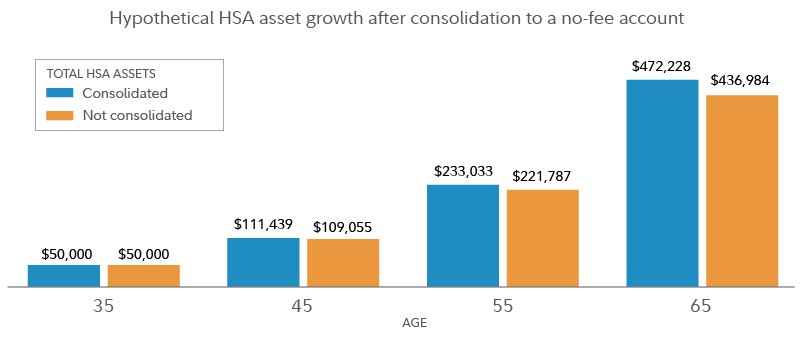
Some HSA providers charge fees to your account, so where you consolidate your HSAs can affect your savings over time. If you consolidate your HSA to an account that doesn't charge fees, your savings may really add up. For example, a 35-year-old saving until age 65 may see nearly $40,000 more in savings by choosing a provider without account fees even if taxes are owed after account consolidation.
Compare HSA providers
When deciding which HSA provider is right for you, you may want to consider the investment options that will be available to you as well as the total fees you may have to pay. Not all HSAs are created equal; for example:
- Investment options: Some HSA providers may give you flexibility, similar to brokerage accounts, and allow you to invest in stocks, bonds, mutual funds, and exchange-traded funds. Others may be more restrictive.
- Fund fees: Commissions, typically one-time fees, and expense ratios, the amount you'll pay to own a fund, may vary across available investment offerings.
- Investment minimums: These vary by provider. Some have minimum balance requirements that may prevent you from being able to invest.
- Account fees: Some HSA providers may also charge separate account fees, including fees to close or transfer your account.
Finally, you may want to continue contributing to the HSA offered by your current employer, even if you consolidate the balance elsewhere, so that you don't miss out on any employer contributions. Review your plan benefits with your employer and account balance minimums with your HSA provider, if applicable.
A simpler way to manage your HSA savings
Whether consolidation makes sense for you depends on your situation. Factors may include fees, investment options, and your employer’s contributions. But when it’s possible, bringing accounts together can make it easier to keep track of your savings, reduce costs, and stay invested in a way that aligns with your long term goals. For some people, especially those nearing retirement, HSA consolidation isn’t just about fees. It’s also about simplicity, bringing older or inactive accounts together at a single firm to make them easier to manage over time.