


Recent market volatility has raised fresh questions about how much longer this extended bull market can run. Even as exceptional earnings growth has powered stocks to record highs this year, investors have grappled with a mounting list of concerns, from higher oil prices and geopolitical tensions to the possibility of higher interest rates.
Of those risks, the specter of rate hikes has remained the one big risk that many investors fear could end this extended bull market.
History, though, suggests those fears may be overstated. That's because rising interest rates have usually coincided with economic growth, which then can translate into rising stock prices.
Stock market outlook: Continued strong earnings growth
An unprecedented wave of capital spending by technology firms on AI development has driven robust earnings growth that could continue. That expansion is expected to sustain continued stock market gains, particularly among semiconductor manufacturers and other technology companies.
Based on my analysis of historical data, there are 3 key themes for investors to consider as they look ahead:
- Potential ongoing resilience in stocks, even if interest rates rise
- Continued strength in the technology sector, particularly chipmakers
- Emerging opportunities beyond the big AI winners
1. The stock market has brushed off inflation and rate hike worries
For investors, recent months have delivered no shortage of reasons to worry. With Middle East tensions pushing oil prices higher and rising inflation still a concern, speculation of a round of Federal Reserve rate hikes has intensified. Still, the stock market has largely looked past those headwinds.
In the market’s biggest June quarter advance since 2020, the S&P 500® Index gained nearly 15% while the tech-heavy Nasdaq Composite Index rose more than 21%.1
It’s my belief that not even Fed interest rate hikes are likely to derail this bull market. The rally can continue because historic levels of capital spending, improving economic indicators, and earnings growth in technology all suggest that investors still have several areas of opportunity.
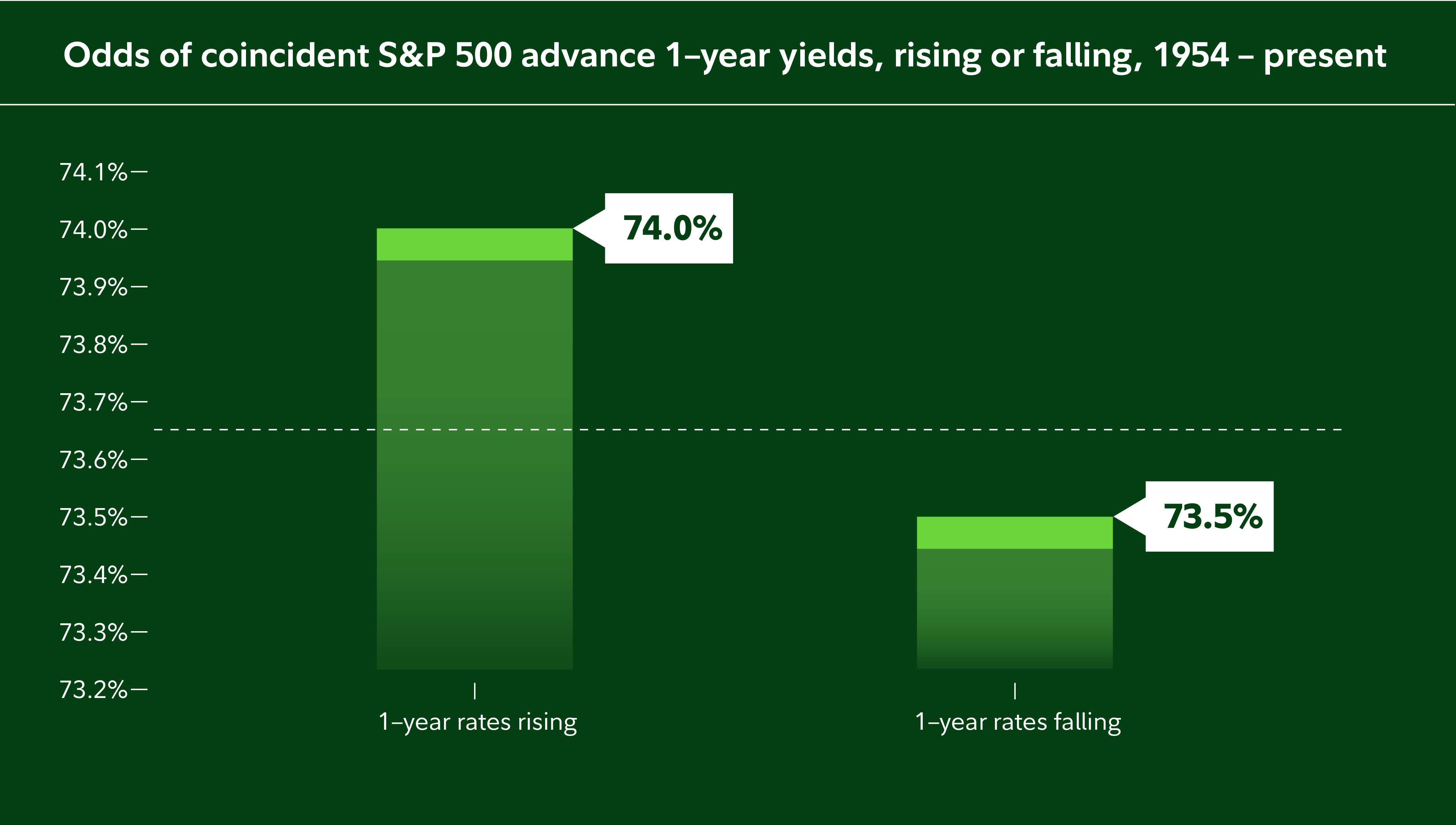
Admittedly, many investors have been concerned that potential Federal Reserve rate hikes could be bad for the market, particularly high-flying technology shares. Still, interest rate increases generally haven’t stopped stocks from advancing. Historically, rate hikes have often reflected economic strength rather than causing economic weakness.
CME FedWatch, which tracks the projected probabilities of Fed rate changes, shows that investors have been readjusting their expectations around future rate changes, with Chair Kevin Warsh hesitant to indicate the Fed's next moves.
In periods of rising rates, strong economic growth tended to support higher corporate profits, which lifted stock prices. Counterintuitively, then, the market usually has a better chance of advancing during periods of rising rates than during periods of falling rates.
Meanwhile, several leading economic indicators have improved. They include a jump in US manufacturers’ orders of core durable goods, which recently experienced a year-over-year percent change in the top fifth of its historical range. These periods of rising demand have often preceded job growth, increased earnings, and market gains over the following 12 months.
2. Technology stocks outlook: Chip stocks may still have room to run
Tech companies have delivered impressive earnings growth, and the trend looks likely to continue. Though some investors worry that higher interest rates could slow the technology sector’s stellar growth, that hasn’t been the case in the past.
On average, since 1977, technology stocks have outperformed the broader market by more than 7 percentage points in the 12 months following periods of strong earnings growth and rising interest rates. This pattern suggests technology may continue to lead.
Despite the recent pullback, semiconductor stocks have been at the center of the current technology rally, as the AI boom fuels surging demand for processors and memory. Chipmaker stocks have experienced exceptionally strong momentum over the past 2 years, outpaced only by their earnings growth. Higher profits have helped keep semiconductor valuations in check despite the sector's rally.
Every previous time semiconductors had similar 2-year momentum and earnings growth, the industry outperformed the market over the next 12 months.
It may be hard to believe after the industry’s recent performance, but at the end of the first quarter, the industry’s valuation relative to the broad market was in the bottom quarter of its historical range. From similar starting points since 1977, semiconductors have beaten the market over the next 12 months more than 75% of the time.2
Another encouraging signal is the surge in business investment, powered by the AI investment boom. Rather than deploying capital to buy back shares or boost dividends, more companies have been spending aggressively on infrastructure projects, such as data centers.
These investments have pushed capital spending as a percentage of sales near its highest level in decades. Historically, comparable levels of business investment have been associated with the highest odds of a stock market advance over the next 12 months.
Read the full report
Get Fidelity's complete Q3 2026 Quarterly Sector and Investment Research Update, from the desk of the director of quantitative market strategy, Denise Chisholm.
3. Energy and steel stocks: Be cautious with oil shares, but steel may have appeal
Climbing oil prices have powered energy stocks to strong gains. Many observers argue that oil prices are likely to remain high due to the lingering effects of the supply shock, sustaining the energy stock rally. Still, history suggests higher-for-longer oil prices may already be reflected in the sector’s valuation—implying it might be difficult for the sector to keep producing market-beating gains.
Energy stock valuations have been higher than those of the broader market, which rarely happens. Since 1990, during periods when the sector’s valuation was at least as high as the market’s, it tended to struggle over the next 12 months, especially when profit margins were already high, as they are today.
By comparison, steel may present a more appealing picture. Profit margins across the industry have been relatively weak, prompting many producers to cut back on production. Historically, those production cuts have often laid the groundwork for stronger pricing and improved profitability as supply tightens. Taken together, this setup has frequently created attractive investment opportunities.
Stock market outlook report takeaways
- As we look ahead to the second half, investors face potential risks, including the potential for rate hikes designed to tame inflation.
- History suggests those risks may not be enough to derail a bull market that’s been fueled by economic and corporate earnings growth.
- Technology stocks, particularly semiconductors, should remain attractive as the sector’s robust earnings growth is likely to continue.
- Among cyclical sectors, steel may offer a more attractive risk-reward profile than energy, where valuations may already reflect expectations for elevated oil and gas prices.
Investors interested in matching investment ideas with these themes can use the Fidelity Stock Screener to search for stocks. Or, to search for mutual funds or ETFs that focus on these themes, investors can use the Fidelity Mutual Fund Research tool or ETF Screener.

Denise Chisholm is director of quantitative market strategy in the Quantitative Research and Investments (QRI) division at Fidelity Investments. Fidelity Investments is a leading provider of investment management, retirement planning, portfolio guidance, brokerage, benefits outsourcing, and other financial products and services to institutions, financial intermediaries, and individuals.
In this role, Ms. Chisholm is focused on historical analysis, its application in diversified portfolio strategies, and ways to combine investment building blocks, such as factors, sectors, and themes. In addition to her research responsibilities, Ms. Chisholm is a popular contributor at various Fidelity client forums, is a LinkedIn 2020 Top Voice, and frequently appears in the media.
Prior to assuming her current position, Ms. Chisholm was a sector strategist focused on sector strategy research, its application in diversified portfolio strategies, and ways to combine sector-based investment vehicles. Ms. Chisholm also held multiple roles within Fidelity, including research analyst on the mega cap research team, research analyst on the international team, and sector specialist.
Previously, Ms. Chisholm performed dual roles as an equity research analyst and director of Independent Research at Ameriprise Financial. In this capacity, she focused on the integration of differentiated research platforms and methodologies. Before joining Fidelity in 1999, Ms. Chisholm served as a cost-of-living consultant for ARINC and as a Department of Defense statistical consultant at MCR Federal. She has been in the financial industry since 1999.
Ms. Chisholm earned her bachelor of arts degree in economics from Boston University.