
Estimate Time5 min

How to open a 529 account

Are you thinking about the different ways to save for education? One option worth looking into is a 529 plan. It’s a tax-smart savings plan designed to help you plan and manage education costs, whether they’re for college, vocational school, or even a public, private, or religious K-12 (up to $10,000 per year—$20,000 beginning in 2026).1

Why you should consider a 529 plan

When you open a 529 account, you’re in control of the money, make investment decisions, and can even change the beneficiary (a person or entity you designate to be the plan recipient) if plans change.2 In some cases, there may be estate tax benefits as well. Just keep an eye on contribution limits so you can maximize your savings.

The big advantage of 529 plans is the potential tax benefits. Any earnings in a 529 plan can grow tax-deferred (meaning you don’t pay taxes on the money as it grows). Then when you use the 529 plan for qualified education expenses, those withdrawals are federal income tax-free.

It’s important to know about the disadvantages of 529 plans. Some states require you to live in that state to qualify for certain state tax advantages. There may also be minimum deposits and lifetime contribution limits. And like any investment, there’s always a risk of loss.

Ready to open a 529 savings plan? We’ll show you how to set up an account with Fidelity so you can start enjoying potential tax benefits while saving for your family’s education.

5 steps to open a 529 plan

1. Determine where the best place to open a 529 plan is for you

Most states (plus Washington, DC) offer 529 plans. You’re not locked into your home state’s option, or even the state where your child will go to school, but you should first check with your home state. Start with researching different plans to find the plan that works best for you and your family.

Some states offer incentives to choose their plans like state income tax benefits (usually up to certain limits). And remember, 529 plans cover more than just tuition. They offer flexible use of the funds that can also help pay for books, supplies, fees, electronics like a computer, and some room and board situations.

2. Gather your information and complete the application

Opening a 529 plan usually means filling out an application. Make it easy by having these details ready:

  • Account owner’s Social Security number or tax ID
  • Beneficiary info (name, address, birthdate, Social Security number)
  • Bank or investment account details (routing and account numbers)
  • A government-issued ID (driver’s license or passport) for identity verification

Having this information helps confirm your identity and makes sure you’re eligible to open the account.

3. Choose your account type

When you open your 529, you’ll need to choose your account type: individual or custodial.

  • Individual accounts are the most common, with the account owner maintaining control of the account, regardless of the beneficiary's age. This is often the choice if you aren't sure the beneficiary will go to college or if you would like the flexibility to change the beneficiary.
  • Custodial accounts are less common; the account transfers over to the beneficiary when they become an adult. Additionally, someone may choose this option if they don't expect the beneficiary to change at any time.

4. Pick your investment strategy and fund your account

You’ll need to pick your investment approach. Most plans offer 2 options:

  • Age-based portfolios: These portfolios automatically adjust to become more conservative as your child gets closer to college. You can set it up and let the plan work for you.
  • Custom portfolios: You choose the investment mix and percentages. This option is good for those who are comfortable with doing more research and monitoring.

Once you’ve chosen your strategy, make your initial deposit. Some plans have minimums, others don’t. There's no minimum to open and no annual account fee when you open a Fidelity-managed 529 account. You can also set up automatic contributions on a schedule that works for you.3

5. Check in regularly

Life gets busy, so set a reminder to review your 529 plan every so often. Look for changes in annual contribution limits and adjust if needed. Automatic contributions and investments can help keep things simple and consistent.

How to open a 529 plan with Fidelity

If you’ve decided that opening a 529 plan with Fidelity is the right move for you, here’s how to get started.

1. Visit Fidelity.com.

2. Select Open an account.

Fidelity.com website header, showing navigation links including Customer Service, Profile, Open an Account, Fidelity Assistant, and Log In.

3. Scroll down the page and choose "529 college savings plans" and select Open an account.

529 college savings plans section on Fidelity.com, highlighting the "Open an account" button and descriptions of 529 college savings plan.

4. Answer Yes or No to the question about whether you’re already a Fidelity customer. Already a Fidelity customer? Just log in and skip ahead to step 7.

Fidelity prompt asking, " Are you already a Fidelity customer?" with Yes and No selection buttons.

5. Fill in the required personal information.
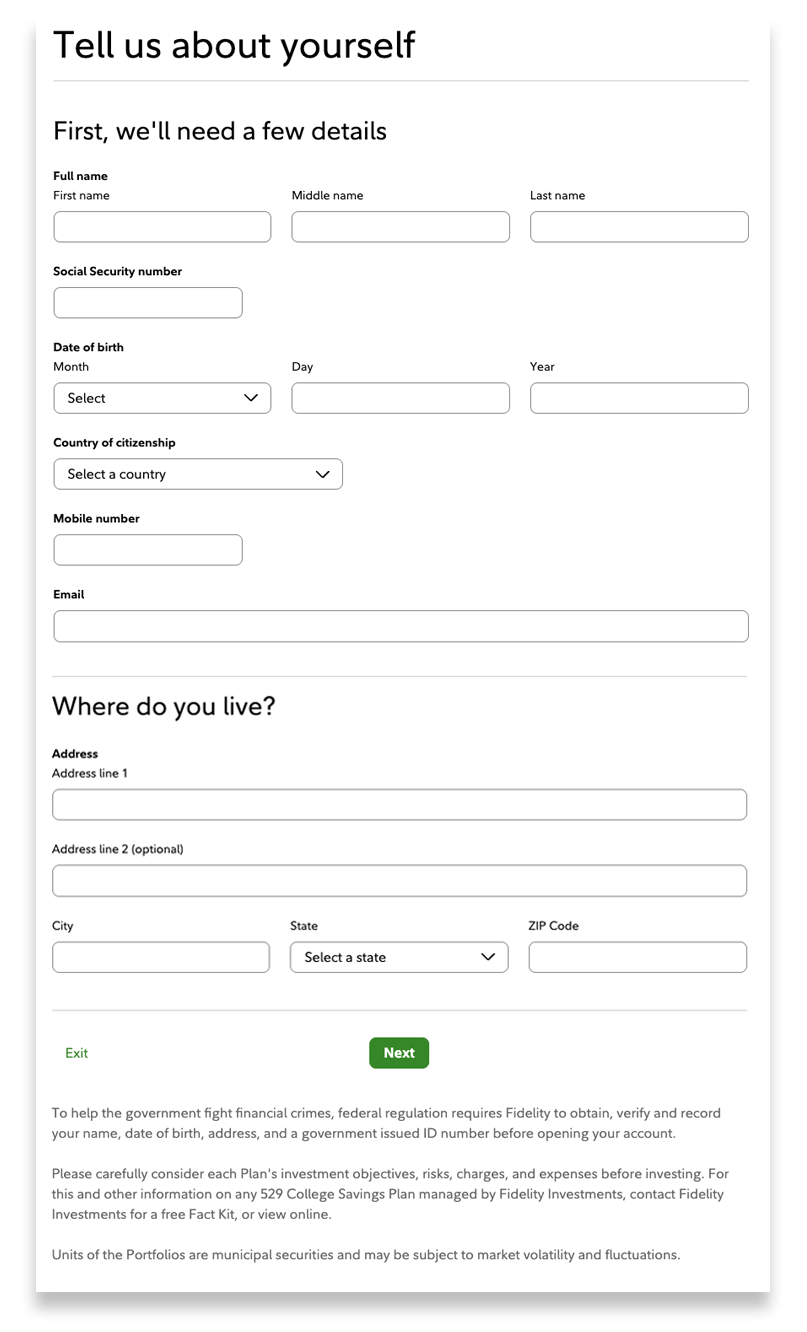
Form requesting personal information including name, Social Security number, date of birth, and contact details.

6. If you’re new, you’ll be asked for some employment information.
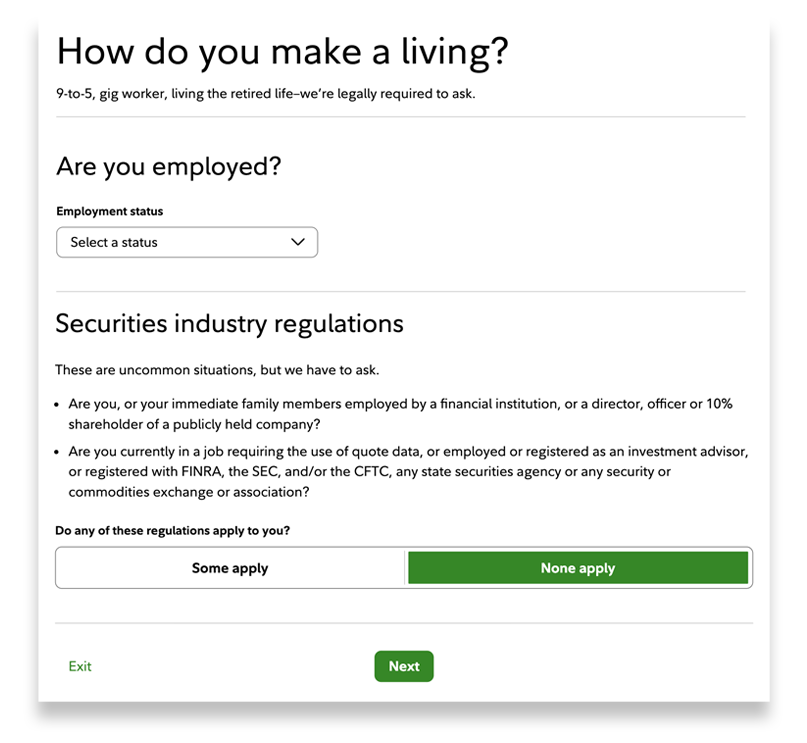
Employment information section, asking about employment status and regulatory disclosures related to the financial industry.

7. Decide what account type you’d like to open: Individual or Custodial.
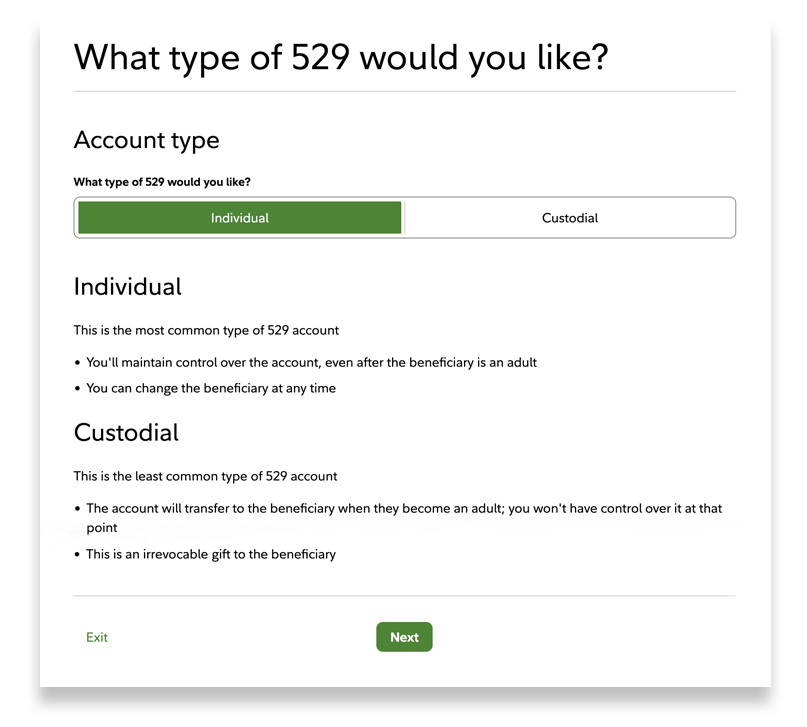
The two 529 account types are displayed, with highlighting the Individual 529 account.

8. Provide the information about the beneficiary.
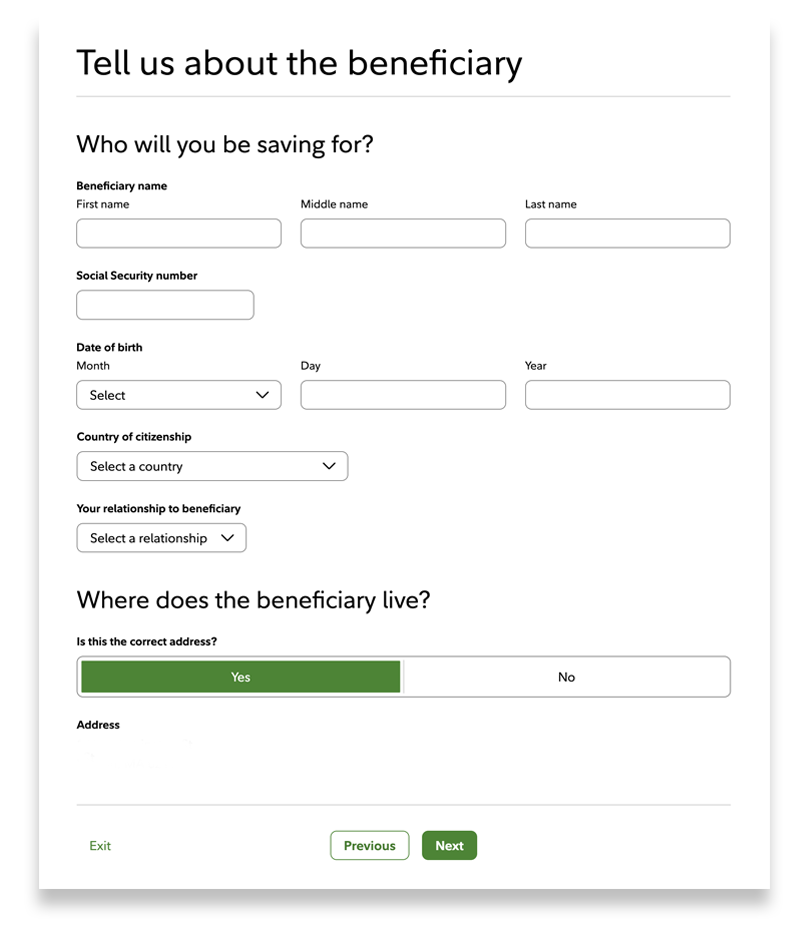
Beneficiary section, that asks personal information about the beneficiary.

9. Choose your 529 plan.
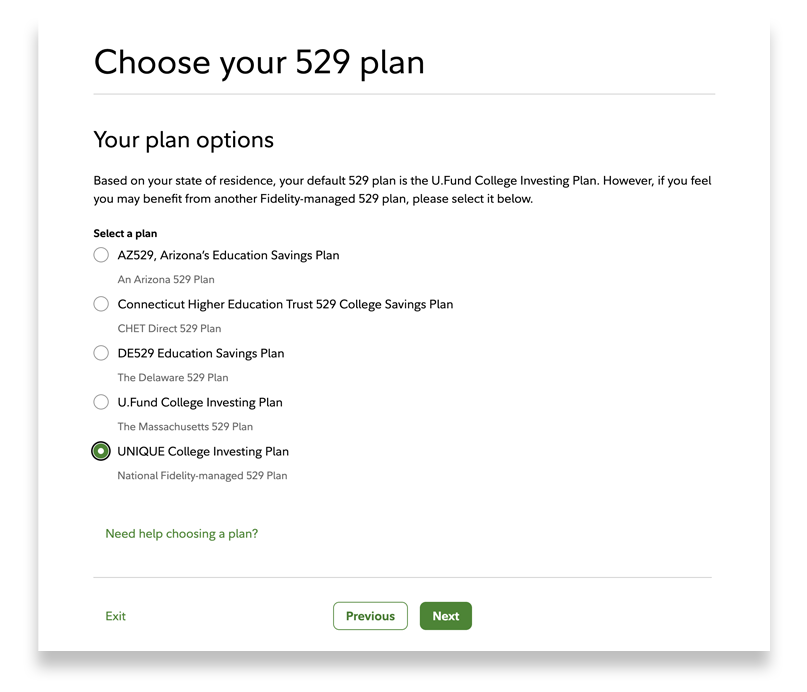
The Choose your 529 plan section that gives the various plan options, highlighting the  Unique College Investing Plan.

10. Choose your investment strategy: Age-based or Custom. Be sure to review the Fact Kit.
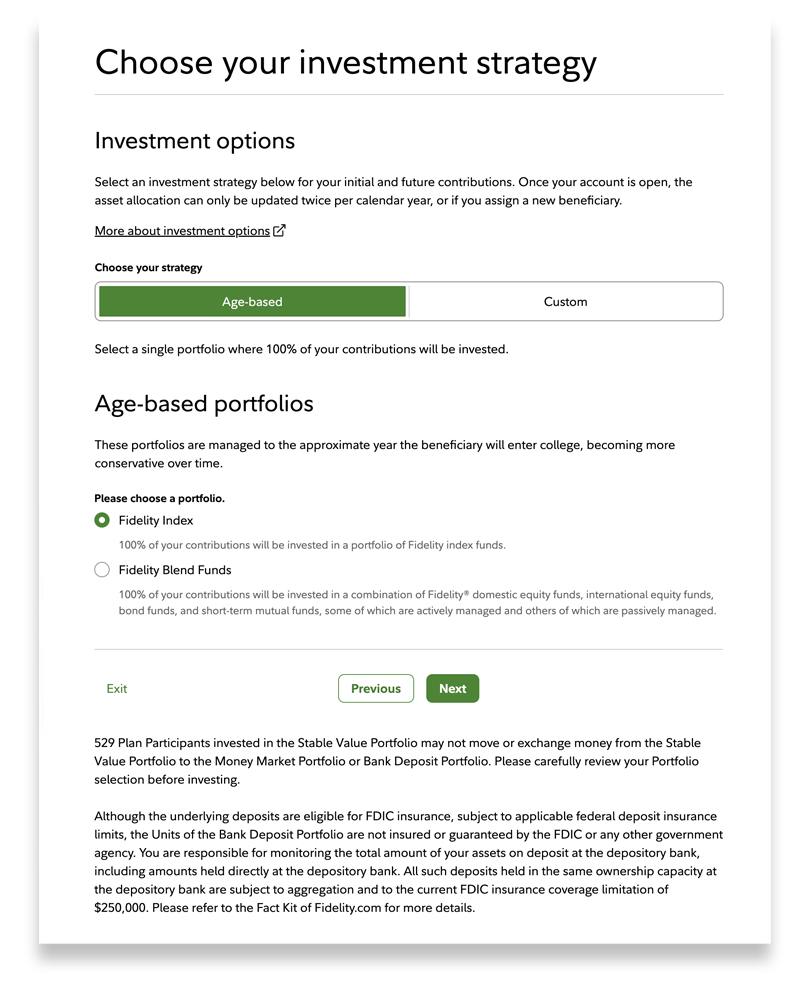
The Choose your investment strategy section with options and portfolios to select. The Age-based strategy and Fidelity Index portfolio are highlighted.

11. Review all your information to make sure it's correct. Take time to review all the important documents and confirmation, including the account opening agreements.
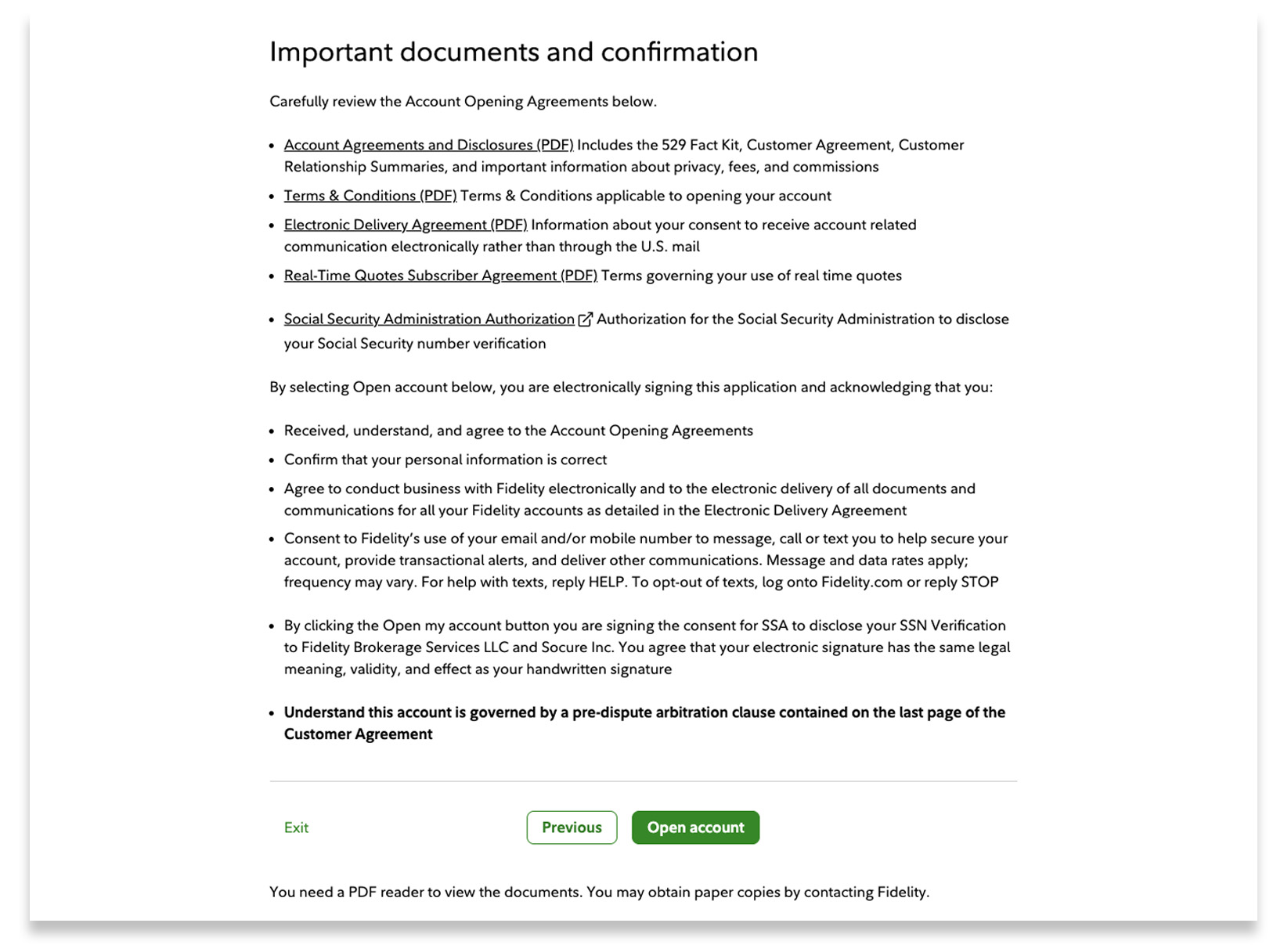
The important documents and confirmation page is displayed.

12. Select Open account—and you're all set!

Congratulations message confirming the account is open.

What to do next after you’ve opened your 529 account

If you’re new to Fidelity, you’ll need to set up your login to access your 529 plan. After that, you’re ready to add money to your account.

It’s important to do your research to learn how to make the most of your 529 plan. And be sure to let family members know they can also gift money through Fidelity’s free college gifting program. Even small amounts can add up over time.

If the beneficiary’s education plans change, or they don’t need all of the money in the account, there are other flexible uses for the funds. One of which, provided certain conditions are met, is to transfer a portion of the assets to a Roth IRA, if eligible.4 You can also change the beneficiary to an eligible family member to use for their qualified expenses.2

And, if you ever decide you wish to change your investment strategy or systematic contributions, you can always go back and do so.

Opening a 529 plan and choosing your investments can help put you and your family on the path toward maximizing savings for a college education.

Save and invest for college

Open a flexible, tax-advantaged 529 college savings plan.

More to explore

1. 529 distributions for qualified education expenses are generally federal income tax free. 529 assets may be used to pay for (i) qualified higher education expenses, (ii) qualified expenses for registered apprenticeship programs, (iii) up to $10,000 per taxable year per beneficiary for tuition expenses ($20,000 for expenses beginning in taxable years after December 31, 2025) in connection with enrollment at a public, private, and religious elementary and secondary educational institution. Although such assets may come from multiple 529 accounts, the $10,000 qualified withdrawal ($20,000 beginning in taxable years after December 31, 2025) limit will be aggregated on a per beneficiary basis. The IRS has not provided guidance to date on the methodology of allocating the $10,000 annual maximum ($20,000 beginning in taxable years after December 31, 2025) among withdrawals from different 529 accounts, (iv) amounts paid as principal or interest on any qualified education loan of a 529 plan designated beneficiary or a sibling of the designated beneficiary. The amount treated as a qualified expense is subject to a lifetime limit of $10,000 per individual. Although the assets may come from multiple 529 accounts, the $10,000 withdrawal limit for qualified educational loans payments will be aggregated on a per individual basis. The IRS has not provided guidance to date on the methodology of allocating the $10,000 annual maximum among withdrawals from different 529 accounts, and (v) tuition, fees, books, supplies, and equipment required for the enrollment or attendance in a recognized postsecondary credential program as defined under Section 529 of the Code and identified by the Secretary of the Treasury as being such a reputable program. Any earnings on distributions not used for qualified higher educational expenses or that exceed distribution limits may be taxed as ordinary income and may be subject to a 10% federal tax penalty. Some states do not conform with federal tax law. Please check with your home state to determine if it recognizes the expanded 529 benefits afforded under federal tax law, including distributions for elementary and secondary education expenses, apprenticeship programs, postsecondary credentialing programs, and student loan repayments. You may want to consult with a tax professional before investing or making distributions. 2. The new beneficiary must be an eligible family member of the original beneficiary to avoid federal income taxes and the 10% federal penalty. A family member is a person who has one of the following relationships with the original beneficiary: (1) son or daughter; (2) stepson or stepdaughter; (3) brother, sister, stepbrother, or stepsister; (4) father, mother, or an ancestor of either; (5) stepfather or stepmother; (6) son or daughter of a brother or sister; (7) brother or sister of a father or mother; (8) son or daughter-in-law, father or mother-in-law, brother or sister-in-law; (9) spouses of the individuals listed in (1)–(8) or the spouse of the beneficiary; and (10) any first cousin. Note that a new account will be required in order to change the beneficiary. 3. Periodic investment plans do not guarantee a profit or protect against a loss in a declining market. 4. Beginning January 2024, the Secure 2.0 Act of 2022 (the "Act") provides that you may transfer assets from your 529 account to a Roth IRA established for the Designated Beneficiary of a 529 account under the following conditions: (i) the 529 account must be maintained for the Designated Beneficiary for at least 15 years, (ii) the transfer amount must come from contributions made to the 529 account at least five years prior to the 529-to-Roth IRA transfer date, (iii) the Roth IRA must be established in the name of the Designated Beneficiary of the 529 account, (iv) the amount transferred to a Roth IRA is limited to the annual Roth IRA contribution limit, and (v) the aggregate amount transferred from a 529 account to a Roth IRA may not exceed $35,000 per individual. It is your responsibility to maintain adequate records and documentation on your accounts to ensure you comply with the 529-to-Roth IRA transfer requirements set forth in the Internal Revenue Code. The Internal Revenue Service (“IRS”) has not issued guidance on the 529-to-Roth IRA transfer provision in the Act but is anticipated to do so in the future. Based on forthcoming guidance, it may be necessary to change or modify some 529-to-Roth IRA transfer requirements. Please consult a financial or tax professional regarding your specific circumstances before making any investment decision.

Investing involves risk, including risk of loss.

Past performance is no guarantee of future results.

Fidelity does not provide legal or tax advice. The information herein is general and educational in nature and should not be considered legal or tax advice. Tax laws and regulations are complex and subject to change, which can materially impact investment results. Fidelity cannot guarantee that the information herein is accurate, complete, or timely. Fidelity makes no warranties with regard to such information or results obtained by its use, and disclaims any liability arising out of your use of, or any tax position taken in reliance on, such information. Consult an attorney or tax professional regarding your specific situation.

The UNIQUE College Investing Plan, U.Fund College Investing Plan, DE529 Education Savings Plan, AZ529, Arizona's Education Savings Plan, and the Connecticut Higher Education Trust (CHET) 529 College Savings Plan - Direct Plan are offered by the state of New Hampshire, MEFA, the state of Delaware, and the state of Arizona with the Arizona State Treasurer's Office as the Plan Administrator and the Arizona State Board of Investment as Plan Trustee, and the Treasurer of the state of Connecticut respectively, and managed by Fidelity Investments.

If you or the designated beneficiary is not a New Hampshire, Massachusetts, Delaware, Arizona or Connecticut resident, you may want to consider, before investing, whether your state or the beneficiary's home state offers its residents a plan with alternate state tax advantages or other state benefits such as financial aid, scholarship funds and protection from creditors.

Units of the portfolios are municipal securities and may be subject to market volatility and fluctuation.

Please carefully consider the plan's investment objectives, risks, charges, and expenses before investing. For this and other information on any 529 college savings plan managed by Fidelity, contact Fidelity for a free Fact Kit, or view one online. Read it carefully before you invest or send money.

Screenshots and graphics are for illustrative purposes only. Although some screenshots reflect currently available functionality, others may show concept designs being considered for future development. Fidelity reserves the right to modify or cancel any concept designs being displayed. This information should not be construed as an offer to sell or a solicitation to buy any product or service.

Fidelity Brokerage Services LLC, Member NYSE, SIPC, 900 Salem Street, Smithfield, RI 02917

1235018.1.0