
Estimate Time5 min

3 keys to picking a 529 plan

Key takeaways

  • 529 plans offer tax-deferred growth potential and cover college expenses, K–12 tuition (up to $10,000 per year in 2025), student loans (up to $10,000), apprenticeships, and vocational schools—making them a flexible tool for lifelong education savings.1
  • Beginning January 2026, up to $20,000 can be used for K–12 expenses. Federal law changes also expanded eligible expenses to include books, tutoring, standardized test fees, and some other non-tuition costs.
  • Compare plans by tax benefits, fees, and investment options—your home state may offer deductions, but out-of-state plans might perform better or cost less.
  • Tax breaks are nice, but long-term growth matters more—strong investments and low fees can significantly boost your college fund over time.

Education can be a great investment. A college degree, or beyond, could increase lifetime earnings and improve your chances of successfully meeting your financial goals.2 That’s why it can make good sense to start saving for education early in a child’s life. Try Fidelity’s college savings calculator to check if you’re on track.

Saving and investing in a 529 plan can be a smart, tax-advantaged way to save for everything education related—from kindergarten through college and beyond.

But not all 529 plans are created equal. To help make the most of your savings, it’s important to understand how these plans work and what factors to consider when choosing one.

Fidelity Viewpoints

Sign up for Fidelity Viewpoints weekly email for our latest insights.


First, what is a 529 plan?

A 529 plan is a state- or state agency-sponsored investment account that allows you to save for education expenses with tax-deferred growth potential and tax-free withdrawals when used for qualified expenses. These can include:

  • College expenses
  • Room and board
  • Books and supplies
  • Student loan repayment (a lifetime limit of up to $10,000)
  • Tuition for kindergarten through 12th grade (up to $10,000 annually in 2025, increasing to $20,000 per year in 2026)1 and college or vocational training
  • Even transfers into a Roth IRA (with limits and caveats)3

To learn more about 529 plans, read Fidelity Viewpoints: The ABCs of 529 savings plans

3 key considerations when comparing 529 plans

The 3 top considerations when looking for a 529 plan are often the location and tax benefits for contributing, fees, and historical and potential investment performance.

1. Location and tax benefits

While you can open a 529 plan from any state, your home state may offer tax deductions or credits for contributions. Some states, like Arizona and Kansas, offer tax breaks no matter which state’s plan you choose—these are called tax parity states. Others, like New Hampshire, North Carolina, and California, offer no tax incentives at all.

For example, in Massachusetts, a tax deduction is available up to $2,000 for a married couple, filing jointly. But in Georgia, a married couple filing jointly may be able to deduct up to $8,000 per year, per beneficiary.

Indiana offers a 20% tax credit up to $1,500.

States like New Mexico and Colorado offer an unlimited tax deduction.

Tip: A plan with no tax break might still be worth it if it has historically competitive performance or lower fees.

2. Fees

Some 529 plans charge annual maintenance fees ranging from $10 to $50. These can eat into returns over time.

How to offset fees:

  • Choose a plan with potentially strong investment performance.
  • Look for low-cost options or plans that waive fees under certain conditions.

3. Investment performance

Each 529 savings plan offers its own range of investment options, which might include age-based strategies; conservative, moderate, and aggressive portfolios; or even a mix of funds from which you can build your own portfolio.

529 plans typically include a mix of:

  • Mutual funds
  • Exchange-traded funds (ETFs)
  • Age-based portfolios (adjust risk as the beneficiary gets older)
  • Static portfolios (fixed allocation)

Evaluate the plan’s historical performance, investment options, and how well it aligns with your risk tolerance and time horizon.

Typically, plans allow you to change your investment options twice each calendar year or if you change beneficiaries.

Think carefully about how you invest your savings. A strategy that's too aggressive for your time frame could put you at risk for losses that you might not have time to recoup before you need to pay for college. Being too conservative can also be a risk because your money might not grow enough to meet costs.

Fidelity offers age-based investments that adjust automatically over time, shifting from more aggressive investments to more conservative ones as the target college date approaches, helping to manage risk as your savings near their intended use.

In-state tax benefits vs. potential investment growth: What really matters?

While state tax deductions or credits can offer a nice upfront benefit, the real potential power of a 529 plan often lies in how your contributions are invested and the potential to grow over time.

State tax benefits: A nice bonus

  • These are typically one-time annual savings based on how much you contribute.
  • They vary by state and may be limited to in-state plans.

Investment growth potential: The long game

  • Contributions have the potential to grow tax-deferred.
  • Distributions are tax-free when used for qualified education expenses.
  • The longer your money stays invested, the more it can potentially compound.
  • Choosing a plan with strong investment options and low fees can make a significant difference over time.

Here’s a hypothetical example

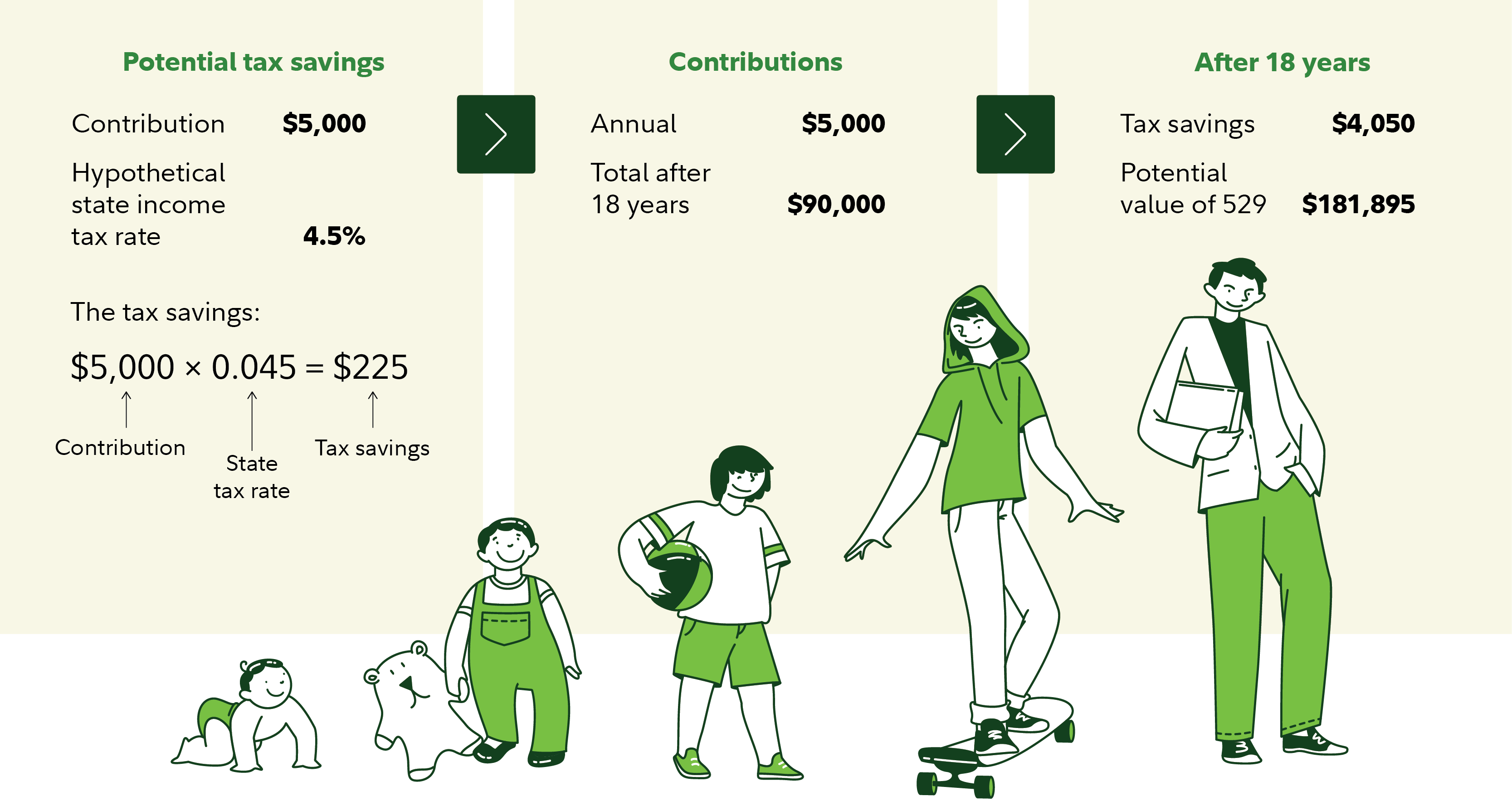
If a state hypothetically allows a $10,000 state income tax deduction per year for married couples filing taxes jointly, at a 4.5% state income tax rate, the maximum annual tax savings from a $5,000 deduction is:

$5,000 × 4.5% = $225

A couple earning $80,000 per year contributes $5,000 annually to their child’s 529 plan for 18 years, totaling $90,000 in contributions.

  • Total tax savings after 18 years: $4,050
  • Total contributions: $90,000
  • Potential value after 18 years: $181,895
Graphic described in text.
This hypothetical example assumes the following: (1) annual contributions made at the beginning of the year, with no withdrawals, (2) an annual nominal rate of return of 7%, and (3) no taxes on any earnings or fees. The ending values do not reflect taxes, fees, or inflation. If they did, amounts would be lower. The assumed rate of return used in this example is not guaranteed. Investments that have potential for a 7% annual nominal rate of return also come with risk of loss. Source: Fidelity Investments.

Compare 529 plans and learn about the 529 plans managed by Fidelity.

A smart strategy

Use the state tax benefit as a tiebreaker—not the main decision-maker. If your state offers a generous deduction or credit, it might make sense to stick with the in-state plan. But if the investment options are unappealing or the fees are high, you could be better off with an out-of-state plan, especially in tax parity states.

The bottom line

While state tax deductions are a nice perk, especially in states that offer them, they shouldn’t be the only factor in your decision. In states where no state tax break is available, it’s even more important to focus on what really drives growth: low fees, strong potential investment performance, and a plan that fits your goals. No matter where you live, a well-chosen 529 plan—paired with consistent saving—can be a powerful tool to help you reach your education funding goals.

Fidelity-managed 529 plans earned a best-in-class rating from Morningstar® in 2024.4

Save and invest for college

Open a flexible, tax-advantaged 529 college savings plan.

More to explore

Please carefully consider the plan's investment objectives, risks, charges, and expenses before investing. For this and other information on any 529 college savings plan managed by Fidelity, contact Fidelity for a free Fact Kit, or view one online. Read it carefully before you invest or send money.

1. 529 distributions for qualified education expenses are generally federal income tax free. 529 assets may be used to pay for (i) qualified higher education expenses, (ii) qualified expenses for registered apprenticeship programs, (iii) up to $10,000 per taxable year per beneficiary for tuition expenses in connection with enrollment at a public, private, or religious elementary or secondary educational institution. Although such assets may come from multiple 529 accounts, the $10,000 qualified withdrawal limit will be aggregated on a per beneficiary basis. The IRS has not provided guidance to date on the methodology of allocating the $10,000 annual maximum among withdrawals from different 529 accounts, and (iv) amounts paid as principal or interest on any qualified education loan of a 529 plan designated beneficiary or a sibling of the designated beneficiary. The amount treated as a qualified expense is subject to a lifetime limit of $10,000 per individual. Although the assets may come from multiple 529 accounts, the $10,000 withdrawal limit for qualified educational loans payments will be aggregated on a per individual basis. The IRS has not provided guidance to date on the methodology of allocating the $10,000 annual maximum among withdrawals from different 529 accounts. Any earnings on distributions not used for qualified higher educational expenses or that exceed distribution limits may be taxed as ordinary income and may be subject to a 10% federal tax penalty. Some states do not conform with federal tax law. Please check with your home state to determine if it recognizes the expanded 529 benefits afforded under federal tax law, including distributions for elementary and secondary education expenses, apprenticeship programs, and student loan repayments. You may want to consult with a tax professional before investing or making distributions. 2. Jaison R. Abel and Richard Deitz, "Is College Still Worth It?," Libertystreeteconomics.newyorkfed.org; Federal Reserve Bank of New York, Liberty Street Economics; April 16, 2025, https://libertystreeteconomics.newyorkfed.org/2025/04/is-college-still-worth-it/.

3. Beginning January 2024, the Secure 2.0 Act of 2022 (the "Act") provides that you may transfer assets from your 529 account to a Roth IRA established for the Designated Beneficiary of a 529 account under the following conditions: (i) the 529 account must be maintained for the Designated Beneficiary for at least 15 years, (ii) the transfer amount must come from contributions made to the 529 account at least five years prior to the 529-to-Roth IRA transfer date, (iii) the Roth IRA must be established in the name of the Designated Beneficiary of the 529 account, (iv) the amount transferred to a Roth IRA is limited to the annual Roth IRA contribution limit, and (v) the aggregate amount transferred from a 529 account to a Roth IRA may not exceed $35,000 per individual. It is your responsibility to maintain adequate records and documentation on your accounts to ensure you comply with the 529-to-Roth IRA transfer requirements set forth in the Internal Revenue Code. The Internal Revenue Service (“IRS”) has not issued guidance on the 529-to-Roth IRA transfer provision in the Act but is anticipated to do so in the future. Based on forthcoming guidance, it may be necessary to change or modify some 529-to-Roth IRA transfer requirements. Please consult a financial or tax professional regarding your specific circumstances before making any investment decision. In order for an accelerated transfer to a 529 plan (for a given beneficiary) of $95,000 (or $190,000 combined for spouses who gift split) to result in no federal transfer tax and no use of any portion of the applicable federal transfer tax exemption and/or credit amounts, no further annual exclusion gifts and/or generation-skipping transfers to the same beneficiary may be made over the 5-year period, and the transfer must be reported as a series of 5 equal annual transfers on IRS Form 709, United States Gift (and Generation-Skipping Transfer) Tax Return. If the donor dies within the 5-year period, a portion of the transferred amount will be included in the donor's estate for estate tax purposes. The Roth contribution limit is the lesser of the annual contribution limit or the 529 beneficiary's income for the year. However, under SECURE 2.0 this phase out is adjusted for the 529 rollover but may not permit a full contribution in all cases. You should consult a tax advisor regarding your specific situation.

4. November 2024, Morningstar assigned analyst ratings to 59 plans, which represent more than 90% of assets invested in 529 plans. Morningstar identified 32 best-in-class plans, assigning these programs a Morningstar Medalist Ratings of Gold, Silver or Bronze. The Medalist Rating uses a scale of Gold (highest), Silver, Bronze, Neutral, and Negative (lowest). Plans were rated across four key pillars: People, Process, Price and Parent. For the full rating methodology, click here. ©2024 Morningstar, Inc. All rights reserved. The information contained herein: (1) is proprietary to Morningstar and/or its content providers; (2) may not be copied or distributed; and (3) is not warranted to be accurate, complete, or timely. Neither Morningstar nor its content providers are responsible for any damages or losses arising from any use of this information. Past performance is no guarantee of future results.

This information is intended to be educational and is not tailored to the investment needs of any specific investor.

The UNIQUE College Investing Plan, U.Fund College Investing Plan, DE529 Education Savings Plan, AZ529, Arizona's Education Savings Plan, and the Connecticut Higher Education Trust (CHET) 529 College Savings Plan - Direct Plan are offered by the state of New Hampshire, MEFA, the state of Delaware, and the state of Arizona with the Arizona State Treasurer's Office as the Plan Administrator and the Arizona State Board of Investment as Plan Trustee, and the Treasurer of the state of Connecticut respectively, and managed by Fidelity Investments.

Fidelity does not provide legal or tax advice. The information herein is general and educational in nature and should not be considered legal or tax advice. Tax laws and regulations are complex and subject to change, which can materially impact investment results. Fidelity cannot guarantee that the information herein is accurate, complete, or timely. Fidelity makes no warranties with regard to such information or results obtained by its use, and disclaims any liability arising out of your use of, or any tax position taken in reliance on, such information. Consult an attorney or tax professional regarding your specific situation.

Investing involves risk, including risk of loss.

Fidelity Brokerage Services LLC, Member NYSE, SIPC, 900 Salem Street, Smithfield, RI 02917

1217416.1.0