

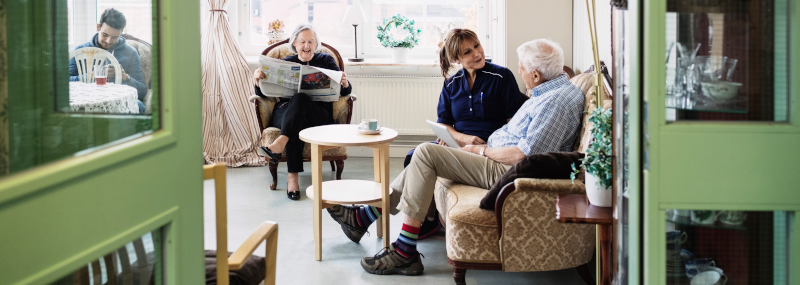
There are a wide range of communities, homes, services, and facilities designed for seniors and that provide eldercare. It can be challenging to decide which is the right option for your loved one and even where to start. Here we offer an overview of some of the most common eldercare options to better help you make your decision for your loved one's care.
It's important to note that caregiving can generally be split into medical and non-medical care—or basic and instrumental. Healthcare providers and insurance companies tend to characterize someone's eligibility for services based on their need for help with the basic activities of daily living (ADLs) such as bathing, dressing toileting, and eating.
In-home caregivers
The right caregiver is someone who can make a positive impact on your aging loved one's quality of life. The right caregiver can also alleviate your concerns, knowing your loved one is in good hands. Whether there's a need for just a few hours per week or something much more intensive, in-home care is a great way to help your loved one age in place.
Sure, it can be hard to know where to start when looking for help. That's why it's sensible to find someone who understands your loved ones' needs, to decide whether to use an agency or hire privately, and to also run background checks as well as check references.
Types of caregivers
There's a range of skillsets and certifications for in-home caregivers that may fit your loved one's needs. During your search, you may encounter caregivers who provide different levels of care, and who have different certifications.
Home health aide (HHA) and Personal care aide (PCA)
- Help with your loved ones with ADLs, as well as housekeeping, grocery shopping, and serving meals
- If qualified, can check vital signs
- Typically requires a high school diploma
Certified nursing assistant (CNA)
- Provides basic care needs for your loved one's daily activities
- Measured vital signs and blood pressure
- Some can administer medications
- Must complete a state-approved education program and pass a competency exam
License practical nurse (LPN) and licensed vocational nurse (LVN)
- Provides more advanced care needs under the supervision of a Registered Nurse (RN)
- Checks vitals, changes bandages, inserts catheters, and reports back to RN or doctors
- Some can administer medication and IV drips
- Must receive a certificate or diploma through a state-approved educational program and must pass the National Council Licensure Examination
Registered Nurse (RN)
- Provides advanced care needs
- Can assess medical conditions, administer medication and treatments, run medical equipment, perform diagnostic tests and analyze results
- Can educate the patient and family on how to manage illnesses and injuries
- Some oversee LPNs, CNAs, and HHAs
- Requires a Bachelor of Science in nursing (BSN), Associate Degree in nursing (ADN), or diploma from approved nursing program. Must also pass the National Council of Licensure Examination
Care outside the home
Outside-the-home caregiving typically involves a professional level of care, support, and medical monitoring that may not be possible with in-home caregiving. Your loved one may be interested in exploring the possibility of moving into a care community, or there may come a time when continuing to live at home becomes unmanageable or unsafe.
As you assess what's right for your loved one, keep these questions in mind: What is your loved one's overall health? How active or independent are they? What kinds of access and activities are important to them?
From providing no hands-on care to full 24/7 monitoring with medical care on-hand, there’s a range of housing options that provide varying levels of care. The costs below are averages; actual costs may vary depending on region or location.
Independent living communities
Average cost: about $3,065 per month3
- Restricted to residents of a certain age (generally 55+)
- Offer independent homes or apartments for those who require little to no extra help
- May offer social activities, landscaping and housekeeping services, transportation or dining options
Adult day cares
Average cost: about $2,000 per month1
- Provide a safe environment for loved ones who may be isolated, need structured services, or supervised care during at least part of the day
- Not a residential facility. Daytime services only
- Typically provide socializing, activities, meals, and sometimes some health care
- May have nursing staff and offer transportation
- Can be used to offer respite care for caregivers
Assisted living communities
Average cost: about $6,200 per month1
- Provide a range of independence and hands-on care in apartment-sized homes
- Offer help with daily living, such as getting dressed, bathing, and managing medication
- Typically include meals, housekeeping, social activities, and certain utilities
- Depending on the facility, units may be either rented or owned
Skilled nursing facilities
Average cost: about $10,000 per month for semi-private room or $11,000 per month for a private room1
- Provide 24-hour intensive medical care for the very ill or those recovering from a serious health event
- May include activities, opportunities for socializing, and exercise programs
- Typically accommodate both long-term stays and short-term rehab stays
Continuing care retirement communities
Average cost: entrance fee from $100,000 to over $400,000, and monthly costs from $3,000 to $7,0002
- Offer a range of living and caregiving options that keep pace with residents' changing needs
- Designed to offer a range of residence types and levels of care from periodic personal care to full-time skilled nursing and in some cases, memory care
- Tend to involve an entrance fee or home purchase, in addition to monthly fees or rent in exchange for some assurance that needs will be met for the rest of the resident's life
Memory care facilities
Average cost: Can vary widely. Median average is around $5,000 monthly3
- Secure units on a separate floor or wing of an assisted living, skilled nursing, or continuing care retirement community
- Offer specialized care for those with Alzheimer's or other forms of dementia
- Design of the unit and training of the caregivers is specific to the needs of memory loss and related impairments