

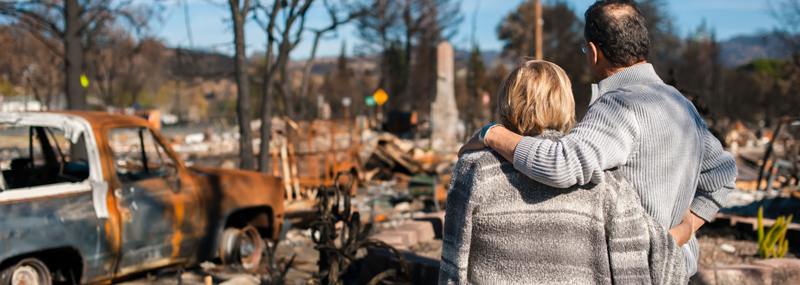
Grief, sadness, fear: These might be some of the initial feelings you're experiencing if you've just survived a natural disaster.
Once you're sure that you and your loved ones are safe and out of harm's way, you may find yourself contending with a new set of challenges: the daunting task of sorting through your losses, rebuilding your life, and putting your finances back together.
Coming back from a natural disaster may not be easy or quick. But taking a few initial actions quickly, and making use of relief programs that might be available to you, can help you start to find your footing again.
Dealing with a damaged residence
In the hours and days following a natural disaster, you might need to find a new place to live through a friend, relative, or an emergency shelter. But if your house is severely damaged or there's an ongoing threat such as a nearby wildfire, you may need to find longer-term temporary housing. Contact your local emergency management agency for help finding a place to stay.
After a disaster is declared, you may qualify for federal funding through the Federal Emergency Management Agency (FEMA) to cover hotel expenses while you look for housing, as well as the cost of a rental for a certain length of time, or until you're able to return to your home.
Your homeowners or renters insurance may also provide “loss of use” coverage (also called additional living expenses), which can reimburse you for temporary housing, meals, storage, and other increased living costs if your home is uninhabitable due to a covered event. Ask your insurer what limits apply and what documentation you’ll need.
Tip: After a disaster, local officials may place temporary restrictions on access to affected homes. Follow their guidance on when residents are allowed to return. Once you’re safely able to reenter, document the damage to your residence with photos as best you can. To make sure you don't lose valuable financial benefits, ask your insurance company for exact details on how the claims process works, including documentation required and if any pre-approvals are needed.
Managing the insurance claims process
Whether you have a homeowners policy, renters insurance, or business insurance, contact your insurance company as soon as you can after a natural disaster. Even if you don't know the full extent of the damage, you'll want to get a claim number to reference in future calls.
Take these 3 steps:
- Confirm that your policy will cover the damage. Floods and earthquakes often aren't covered by homeowners insurance, for instance, and require separate coverage.
- Ask how long you have to file a claim and what documentation your insurance company requires.
- Create an inventory of property that was lost or damaged and save your receipts for any expenses related to the disaster or recovery because you may need them for your claim. Don’t discard damaged belongings until an insurance adjuster has documented them. Throwing items away too soon can make it harder to prove your losses and may reduce your claim payout.
Remember that insurance companies need to deal with a high volume of claims after a disaster. It can take several months or even more than a year to receive a payout.
Replacing lost income
Between emergency expenses and lost wages, natural disasters can seriously impact your cash flow. While Fidelity recommends building up emergency savings of at least 3 to 6 months' worth of expenses, you may not have that cushion—or you may find that's not enough to cover your needs.
Additional options for dealing with lost income include:
- Unemployment assistance. If your employment is interrupted or you lose your job or business because of the disaster—and you're not eligible for regular state unemployment—you can apply for unemployment benefits through the Disaster Unemployment Assistance program.
- SBA disaster loans. The US Small Business Administration (SBA) offers long-term, low-interest loans to help homeowners and renters recover from disasters for lost and damaged property that's not covered by insurance—and you don't have to be a small business owner to qualify for one of these loans.
- Emergency grants. Individuals may be eligible for disaster relief funds through FEMA to help pay for food, utilities, medical bills, cleanup, and other costs not covered by insurance.
- 401(k) disaster distributions, loans, or hardship withdrawals. If your workplace retirement plan allows for it and if you meet certain other requirements, you may be able to take a qualified disaster recovery distribution from your 401(k). The SECURE Act 2.0 expanded distribution options and favorable tax treatment for up to $22,000 of qualified disaster recovery distributions from eligible plans. The associated income tax can be spread over subsequent years and you may have the option to recontribute the funds. To learn more, visit the IRS website and consult your workplace plan documents. Another possible option, if permitted by your plan, could be a 401(k) loan to cover losses that aren't covered by insurance, savings, or other relief funds. And only if necessary, you could apply for a hardship withdrawal. Consider this as a last resort, though, because you'll owe income tax and possible penalties on your withdrawal and you'll lose out on the potential growth of that money.
Learn more about where to find cash when you're facing a sudden emergency.
Handling mortgage payments
Even if you can't stay in your house because it's too badly damaged or completely destroyed, you must still pay your mortgage. If you're having trouble keeping up with payments, talk to your mortgage servicer as soon as possible to find out if they'll offer forbearance (an option to delay loan payments), waive late fees, or provide options for reducing or stopping payments temporarily.
Many lenders will offer forbearance for several months after a major natural disaster, and they may extend the period on a case-by-case basis. Lenders are more likely to offer forbearance if you have a mortgage through Fannie Mae or Freddie Mac. You can also talk to Housing and Urban Development (HUD)-approved housing counselors, who can help you understand your options.
Replacing lost documents
Losing vital records is common in a natural disaster—and can cause problems long after you've recovered from the physical damage if you don't replace them. Make a list of your missing documents and then check the appropriate issuing agencies or offices for instructions on obtaining a replacement.
Key documents you may need to replace include:
- US birth certificate: Contact the vital records office in your state of birth.
- Driver's license: Contact your state's motor vehicles department.
- Social Security card: Check the Social Security Administration website for replacement steps.
- US Passport: Report your lost card/passport to the State Department and fill out a form for a new one.
For other important documents, such as insurance cards and financial statements, you may have online accounts where your information is stored. But if you need hard copies or physical cards, contact each company for assistance replacing your records.
Stay vigilant against fraudsters
After a disaster, scams targeting homeowners often increase. Criminals may impersonate FEMA officials, contractors, or relief organizations in an effort to gain access to your personal information. They may then apply for relief assistance using stolen identities.
Be cautious of unsolicited contractors, and avoid paying large deposits upfront. Make sure to verify the identity of anyone who claims to represent a government agency or your insurance company. (Learn more about how to spot a scam and how to stop identity thieves.)
Get back on track
Natural disasters can leave individuals and communities reeling—and recovery is often a long process. But it is possible to build back financially, so try to get started and get organized as soon as you safely can. And if you're experiencing financial strain, reach out for help. Taking advantage of grant programs and relief organizations can help you get back on track as quickly as possible.