


There are 2 ways to analyze a stock: fundamental and technical analysis. Fundamental analysis involves analyzing the characteristics of a company in order to estimate its value. Technical analysis takes a different approach—it’s mostly interested in the price movements in the market, studying past and current market behavior. Investors use this information to spot trends early, read momentum, and gauge where prices may be headed. Here’s how technical analysis works—and how to use it effectively.
What is technical analysis?
Technical analysis focuses on interpreting trends and patterns formed by market-generated data—such as trading activity and price fluctuations—to spot momentum shifts and anticipate how a stock may move next.
At its core, this approach rests on a few foundational assumptions:
1. Prices reflect all available information
This means, stock prices reflect the collective views of buyers and sellers based on all publicly available information. For example, if a specific company reports lower‑than‑expected earnings due to weaker demand for its products, investors may adjust their expectations for future growth and choose to sell. That change in investor sentiment is then reflected in a lower share price.
2. Prices usually move in trends
While day-to-day stock price changes may appear unpredictable, over longer time horizons they can often move in observable trends. Technical analysts believe that once trends are identifiable, they are more likely to continue than reverse. They use indicators and chart patterns to measure when a trend starts and ends, rather than focusing on the underlying reason for the movement.
3. History tends to repeat itself
Studying historical market behavior can provide useful context for understanding price movements today. Many of the chart patterns used in technical analysis have appeared for decades because human behavior in markets tends to be consistent over time, and prices often reflect that consistency. For example, prices frequently rise rapidly during periods of optimism until they reach a resistance level, followed by sharp declines driven by panic selling. Afterwards, markets may stabilize, forming support levels as buying interest returns. These repeating patterns can help investors anticipate future movements by identifying trends.
How does technical analysis work?
Technical analysis is used to understand how prices behave, and investors do this by examining charts and trending data. It’s commonly used for shorter-term decision-making, but its principles can be applied across different time horizons.
When using technical analysis to assess stocks, investors typically start by examining a stock’s price chart. From there, they often incorporate 2 main categories of indicators: overlays and oscillators.
1. Overlays
Overlays are indicators displayed directly on the price chart and are used to interpret price movement, trends, and volatility. Common examples include moving averages, as well as Bollinger Bands®, which help determine just how volatile the stock’s price has been on a relative basis.
2. Oscillators
Oscillators usually appear in a separate section just below the price chart and can help identify whether a stock may be overbought or oversold. Popular oscillators include the Relative Strength Index (RSI), which tracks the speed and magnitude of price changes, and the Stochastic Oscillator, which compares a stock’s closing price to its price range over a specific time period.
Another key aspect of technical analysis is recognizing supply and demand dynamics, often described as support and resistance levels. A support level represents a price area where buying interest may be strong enough to prevent further declines. In contrast, a resistance level is a point where selling pressure may limit the stock’s ability to move higher.
Major technical indicators
There are hundreds of technical indicators—tools to help investors analyze price action and better understand factors like trend direction, momentum, volatility, and volume. Let’s take a closer look at a few commonly used indicators and how they’re applied.
Moving averages (simple and exponential)
Moving averages smooth out price data to help identify the overall direction of a stock. They make it easier to see trends by filtering out short-term price noise. Investors commonly watch for when 2 moving averages cross or intersect one another. For example, when the 50-day SMA crosses below the 200-day SMA, that's known as a "Death cross," which is a bearish signal. However, when the reverse occurs, it's known as a "Golden cross," which is a bullish signal.
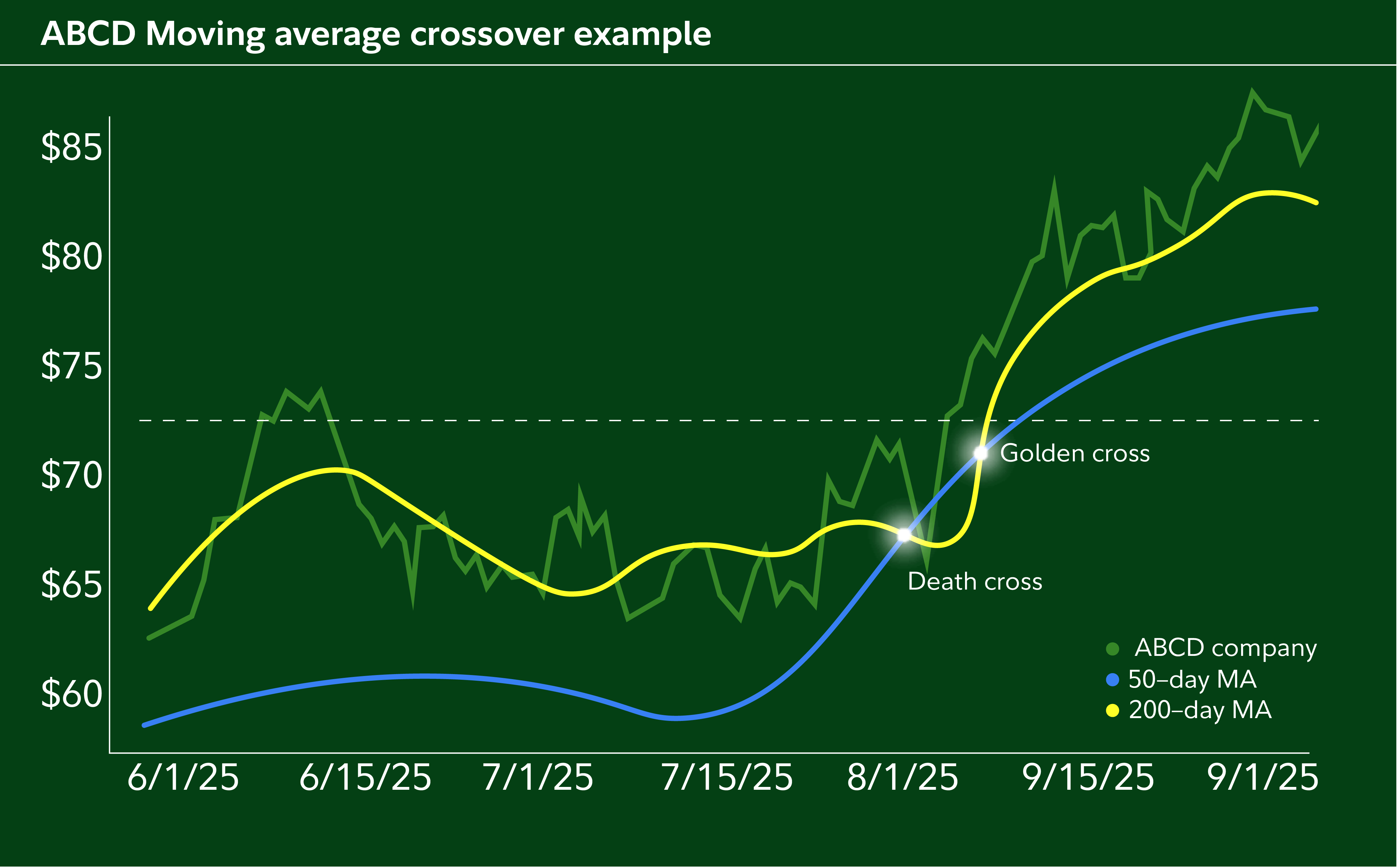
- Simple moving average (SMA) calculates the average price of a stock over a specific time period, such as 20 or 50 days. Each price in that period is given equal weight. Traders use the SMA to smooth out short-term price fluctuations and better see the overall trend.
- Exponential moving average (EMA) also shows the average price over time, but it gives more importance to recent prices. Because of this, the EMA reacts faster to new price changes, making it popular with traders who want quicker signals.
Relative Strength Index (RSI)
RSI measures momentum by comparing recent gains to recent losses, usually on a 0–100 scale and helps determine whether a stock may be overbought or oversold. A stock is often considered overbought when above the 70 level and oversold below the 30 level. Investors can use it to spot potential reversals in price, which often happens near price highs or lows.
Moving average convergence/divergence (MACD)
MACD compares 2 moving averages to show changes in momentum by comparing 2 moving averages of a stock’s price—a short-term average and a longer-term average. It’s commonly used to confirm trend direction and possible entry or exit points.
When the short-term average moves above the longer-term one, it suggests upward momentum is building. When it moves below, momentum may be turning downward.
Bollinger Bands
Bollinger Bands show how far the price is moving away from its simple moving average. When prices move outside the bands, or the bands themselves widen significantly, it may signal higher volatility or a potential change in direction.
Volume
Volume tracks how many shares are traded over a given period. Rising volume can confirm the strength of a price move (many traders likely agree on the direction), while low volume may suggest weak momentum (likely fewer traders are interested).
Support and resistance levels
Support and resistance levels are price areas on a chart that show where a stock’s price tends to stop falling (support) or stop rising (resistance). You can use these levels to help plan trades and manage risk.
Want to dive deeper on technical indicators? Check out our Technical Indicators Guide.
Advantages of technical analysis
Technical analysis can be an approachable method to viewing and trading market opportunities. Here are some key advantages of technical analysis:
- Can help manage risk
- Can help identify market timing for both entering and exiting trades
- Works across many markets (i.e., stocks, ETFs, options, etc.) and timeframes
- Offers objective structure which can help reduce emotional trading
- Reflect the human psychology behind the prices—fear, supply and demand, trader trends
Disadvantages of technical analysis
While powerful, technical analysis is not predictive in nature, rather it is reactive. It works best as a probability-based decision tool, not a guarantee.
- Price history doesn’t always repeat itself, at least not reliably
- Sometimes different indicators will show mixed signals—like one shows buy and another shows sell
- Entry and exit point accuracy isn’t 100%, so even when an entry or exit point is indicated, it doesn’t guarantee a successful trade
- Technical indicators methods used to analyze a stock and can vary from one analyst to another
How to do technical analysis
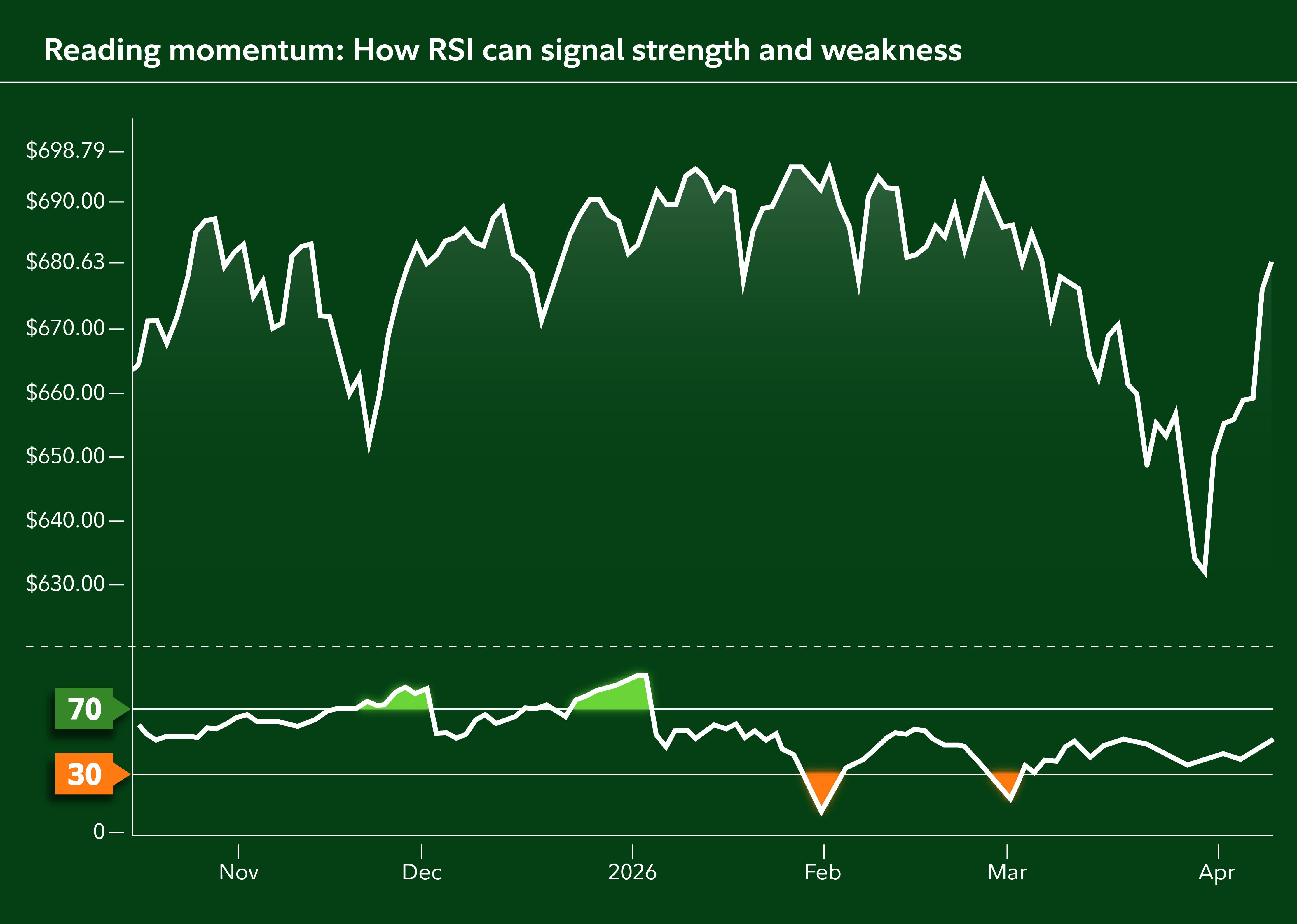
Technical analysis involves studying price data and indicators to assess market momentum and spot possible turning points. Let’s use the Relative Strength Index (RSI) as an example. When looking at a price chart, RSI helps give a quick sense of a stock’s momentum by measuring the strength of recent gains versus losses.
RSI moves on a scale from 0 to 100. In the chart below, the RSI indicator is plotted as a separate line beneath the price chart. The green highlighted areas show when RSI rises above 70, signaling the stock may be overbought, while the orange areas indicate when RSI falls below 30, suggesting it may be oversold. By referencing the RSI chart alongside the price chart, you can better judge whether the price move may slow down, reverse, or continue—adding useful context beyond simply watching price rise or fall.
The bottom line on technical analysis
Keep in mind that technical analysis is not an exact science and, as such, is not perfect. When you take away all the bells and whistles, technical analysis is basically a study of supply and demand. If you understand the benefits and limitations of technical analysis, it can give you a new set of tools or skills that will help enable you to be a better trader or investor.