

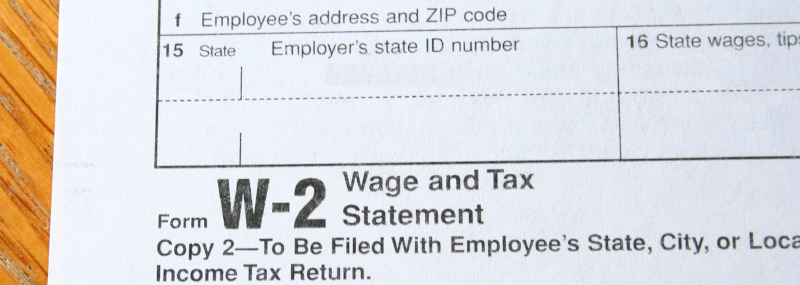
If you work as a regular employee, as opposed to as a contractor or freelancer, your employer is required to track your pay and tax withholding. Every year, they’ll send this information to you and the government via Form W-2. This form details your annual income from this employer, which directly affects your tax liability.
What do you do with a W-2? Read on to find out how to use the form for preparing your tax return.
What is Form W-2?
Form W-2, also known as the Wage and Tax Statement, is a tax document that employers must send to all employees they pay at least $600 annually. Employers track employees’ income and tax withholding and prepare W-2s with that information. Employers also send this form to the Social Security Administration (SSA) for every employee. The SSA then shares the data with the Internal Revenue Service (IRS). This ensures all entities are on the same page about employees’ taxable income, withheld taxes, and the amount of Social Security benefits the employee may be entitled to in retirement.
What is a W-2 form for?
A W-2 form is for employees to use to prepare their tax returns. Form W-2 is also for the SSA and IRS to learn about employees’ taxable income and how much taxes have already been withheld on the employees’ behalf. Payroll departments are required to withhold taxes from employee paychecks throughout the year, rather than leaving the employee to pay everything all at once during tax season. If the employer has fulfilled their legal obligation, employees can take the information from a W-2 form, plus all their other income forms, subtract their eligible deductions and credits, and then learn whether they still owe more taxes or are due a refund from the IRS.
W-4 vs. W-2
Form W-4 (also called the Employee’s Withholding Certificate) is different from a W-2. When you start a job, you’ll likely submit a W-4 to your payroll department. This is where you list:
- Your tax-filing status (as in, single; married filing jointly; married filing separately; qualifying surviving spouse; or head of household)
- Your dependents
- The amount of any tax credits or deductions you plan on claiming
- Other income outside of that job
Your employer uses this supplied information to calculate how much to withhold from your paycheck so you can cover your expected tax bill. If your situation changes, you can update your W-4 to adjust your tax withholding. You might do this if you experience a major life event like getting married or having a child.
A W-2, on the other hand, is sent to you by your employer by January 31 following a year you were paid at least $600. You don’t need to return a W-2 to your employer; you do need to return a W-4 to your employer.
How to read a W-2
So what does a W-2 look like? It’s a 1-page form with a bunch of boxes, many of which will have information filled in when it reaches you. For instance, in the top left, you’ll find your employer’s address and employer identification number, your name and address, and your Social Security number. From there, the W-2 lists information such as:
- Your total taxable wages, including any tips you received and whether they were allocated (as in, assigned by your employer)
- How much federal, state, and local tax was withheld during the year
- How much of your compensation should be taxed for Social Security and Medicare, along with the tax withheld for these programs
- Any contributions made to an employer-sponsored plan, such as a 401(k) or health savings account (HSA)
- Any distributions (aka payouts) you took from your employer’s deferred compensation plan, such as a 401(k)
When do employers send out W-2s?
Employers typically send out W-2s by January 31 following the tax year reflected on the form. That gives employees plenty of time to prepare their returns by the mid-April tax-filing deadline.
What to do if you find an error in your W-2
If you find an error in your W-2—say, your employer incorrectly reported your income or how much tax was withheld during the year—the IRS recommends contacting your employer as soon as possible to fix the mistake. Then they should reissue a new W-2 to both you and the government.
If your employer doesn’t fix the error by the end of February, the IRS recommends you contact one of its agents for help. You can call 800-829-1040 or schedule an in-person appointment at a local IRS Taxpayer Assistance Center.
The IRS will contact the employer on your behalf to fix the W-2 and also give you Form 4852, which you can use to estimate your tax liability or refund and prepare your return.
What to do if your employer doesn’t send you a W-2
If your employer hasn’t given you a W-2, check if they have an online portal that allows you to download an electronic copy of the form. Still no form and the mailing deadline has passed? Ask your employer if they’ve sent the form and when you can expect to receive it. If all goes well, you’ll be able to resolve the issue directly with your employer.
If you still don’t have your W-2 by the end of February, the IRS recommends contacting one of its agents by calling 800-829-1040. You’ll need to provide your:
- Name, address, and phone number
- Social Security number
- Employer’s name, address, and phone number
- Dates of employment
The IRS will contact the employer to help you get the missing form. They’ll also send you Form 4852 (Substitute for Form W-2, Wage and Tax Statement), which you can use to prepare your taxes.
What is the penalty for an employer not sending a W-2?
Employers that don’t deliver their W-2s on time could face a steep penalty. Fees are based on when they send them out:
- Up to 30 days late: $60 per form
- After 30 days through August 1: $130 per form
- After August 1: $340 per form
Employers pay even higher penalties if they intentionally disregard their responsibility to prepare employee W-2 forms. In this case, the penalty is $680 per form.
W-2 instructions
Here’s exactly how to use a W-2 to file taxes:
1. Collect your W-2s and other income forms
If you worked for multiple employers, you should receive a W-2 from each one. If you earn money outside of your regular job—from freelancing, gig work, or investing—you should also receive 1099 forms showing this income if you earned $600 or more from each payer.
2. Include W-2 information on your 1040 tax return
Form 1040, the US Individual Income Tax Return, specifically asks for numbers from your W-2s. That includes the sum of all your W-2 income and the total tax withholding. By working through the 1040 form, you’ll determine whether you owe any additional tax on your income or if you’re owed a refund.
3. Or provide your W-2s to your tax preparer or accountant
If you’re not filing your taxes yourself and are instead working with an accountant or using tax software to complete your return, you’ll need to hand over or upload copies of your W-2s. They can then prepare the 1040 on your behalf using this information.
4. Save your W-2s for recordkeeping
You typically don’t need to submit your W-2s to the IRS with your return. Instead, hold onto them in a safe place in case of an audit. The IRS generally recommends keeping these forms for 3 years after you file your return.