
Estimate Time9 min

Your complete guide to municipal bonds

Key takeaways

  • Municipal bonds can offer tax-exempt income, making them attractive for high-income investors seeking stable, low-risk returns.
  • There are several ways to invest in municipal bonds, depending on your financial goals, risk tolerance, investment knowledge, and how much control you want over your portfolio.

Municipal bonds, or “munis,” offer a unique combination of tax advantages, income stability, and relatively low risk, making them a popular choice for investors who are interested in regular income—especially those in higher tax brackets.

“While municipal bonds might seem intimidating to investors who have never invested in them before, their ability to provide a predictable stream of tax-exempt income offers a unique and potentially powerful capability, especially useful for high-income earners in high-tax states,” says Richard Carter, Fidelity vice president of fixed income strategy.

Here’s a look at how municipal bonds work, their pros and cons, and the different ways to invest in munis.
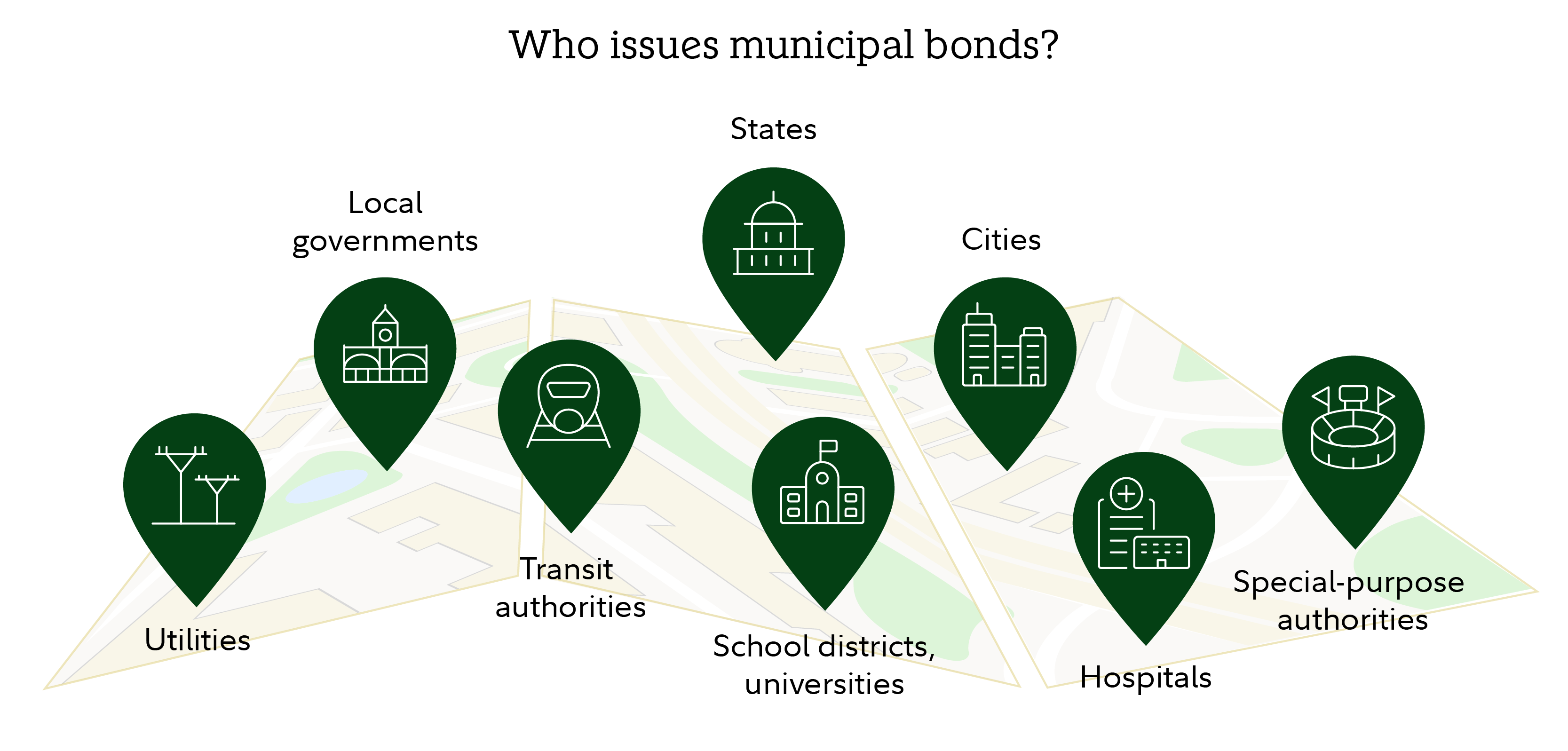
Illustration shows some of the authorities that issue municipal bonds: states, cities, local governments, utilities, transit authorities, school districts, universities, hospitals, and special purpose authorities.
For illustrative purposes.

What are municipal bonds?

When you buy a municipal bond, you are essentially loaning money to the issuing authority—whether it is a state, local government, school district, or something else—to fund public projects such as the construction of schools, hospitals, and highways. In return, the issuing authority agrees to pay you interest for the duration of the bond, and return the principal to you when the bond matures.
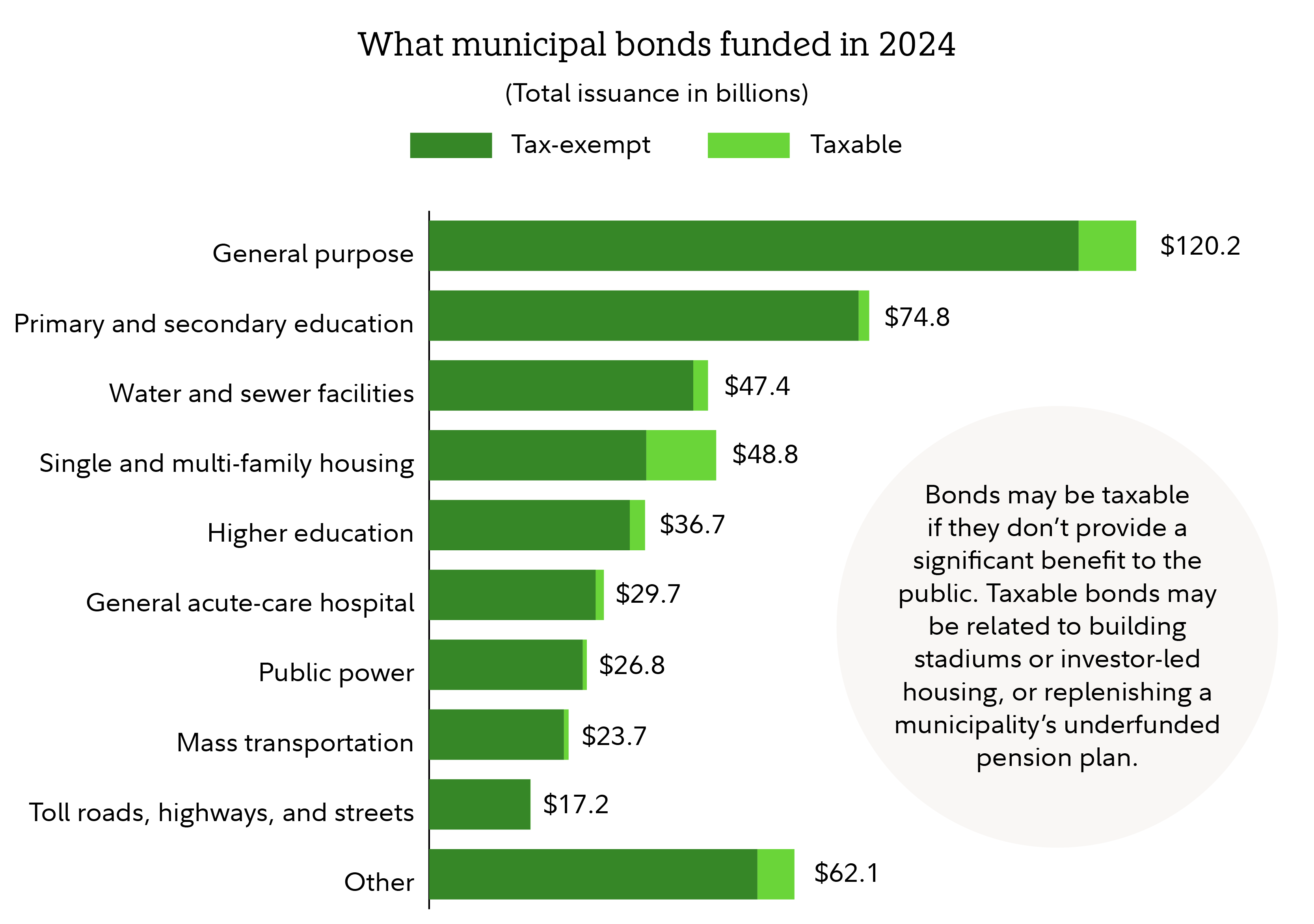
Graphic shows what muni bonds issued in 2024 funded: $120.2 billion for general purposes; $74.5 billion for primary and secondary education; $47.4 billion for water and sewer facilities; $48.8 billion for single and multi-family housing; $36.7 billion for higher education; $29.7 billion for hospitals; $26.8 billion for public power; $23.7 billion for mass transportation; and $17.2 billion for roads. Less than 10% of the total were taxable bonds, meaning they were for projects not considered to provide significant benefit to the public.
Source: Municipal Securities Rulemaking Board (MSRB), Municipal Market Facts, January 2025

How do municipal bonds work?

Like bonds issued by the federal government or corporations, municipal bonds are simply debt instruments—money lent by investors to states, counties, cities, and nonprofit organizations to pay for public projects or to refinance existing debt.

In return for an investor’s loan, the municipality promises to pay the investor interest—usually semiannually—and to return the investor’s principal on a specified date, often referred to as the maturity date (assuming no default).
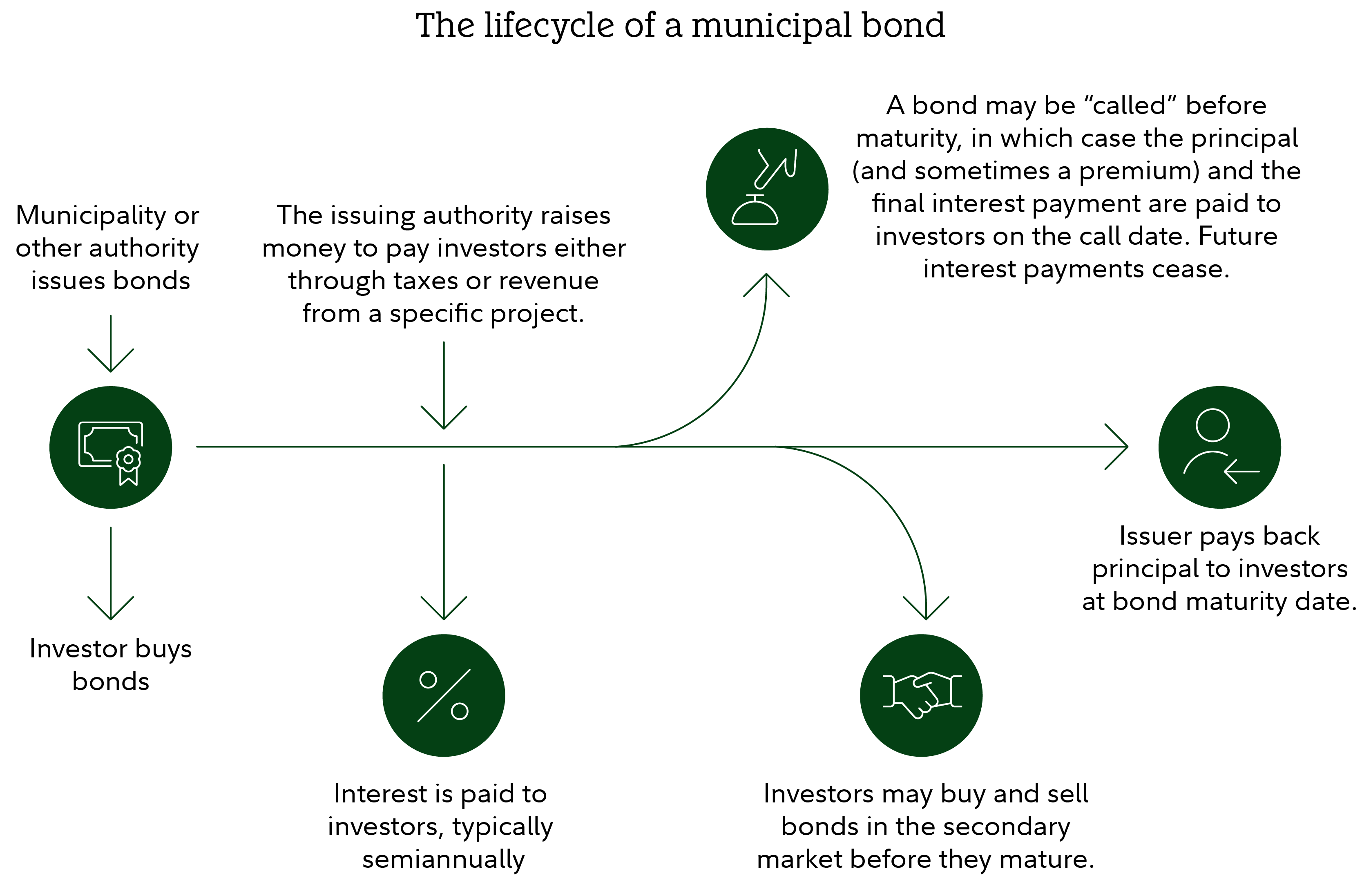
Graphic illustrates the life cycle of a bond: The municipality or other authority issues bonds that are purchased by investors. The issuing authority raises money to pay interest to investors either through taxes or revenue from a specific project. A bond may be called be fore maturity, in which case the principal and sometimes a premium and the final interest payment are paid to investors on the call date. Investors may buy and sell bonds in the secondary market before they mature. When the bond maturity date comes, the issuer pays back principal to investors.
For illustrative purposes.

Types of municipal bonds

In general, municipal bonds fall into 1 of 2 categories, based on the source of their interest payments and principal repayments. However, within these categories, a municipal bond can be structured in different ways, with each variation offering different benefits, risks, and tax treatments.

General obligation bond

These bonds are issued by states, cities, or counties and are backed by the government’s power to tax residents to pay bondholders.

Revenue bond

These bonds are backed by revenues from a specific project, such as a toll road or a utility project.

Advantages of municipal bonds

Municipal bonds offer several appealing benefits, especially for income-focused investors seeking tax efficiency.

Tax advantages

The interest you earn from most muni bonds is typically exempt from federal income tax and may be exempt from state or local income tax, depending on whether you are a resident of the state that issued the bond. A small percentage of municipal bonds are taxable at the federal level.
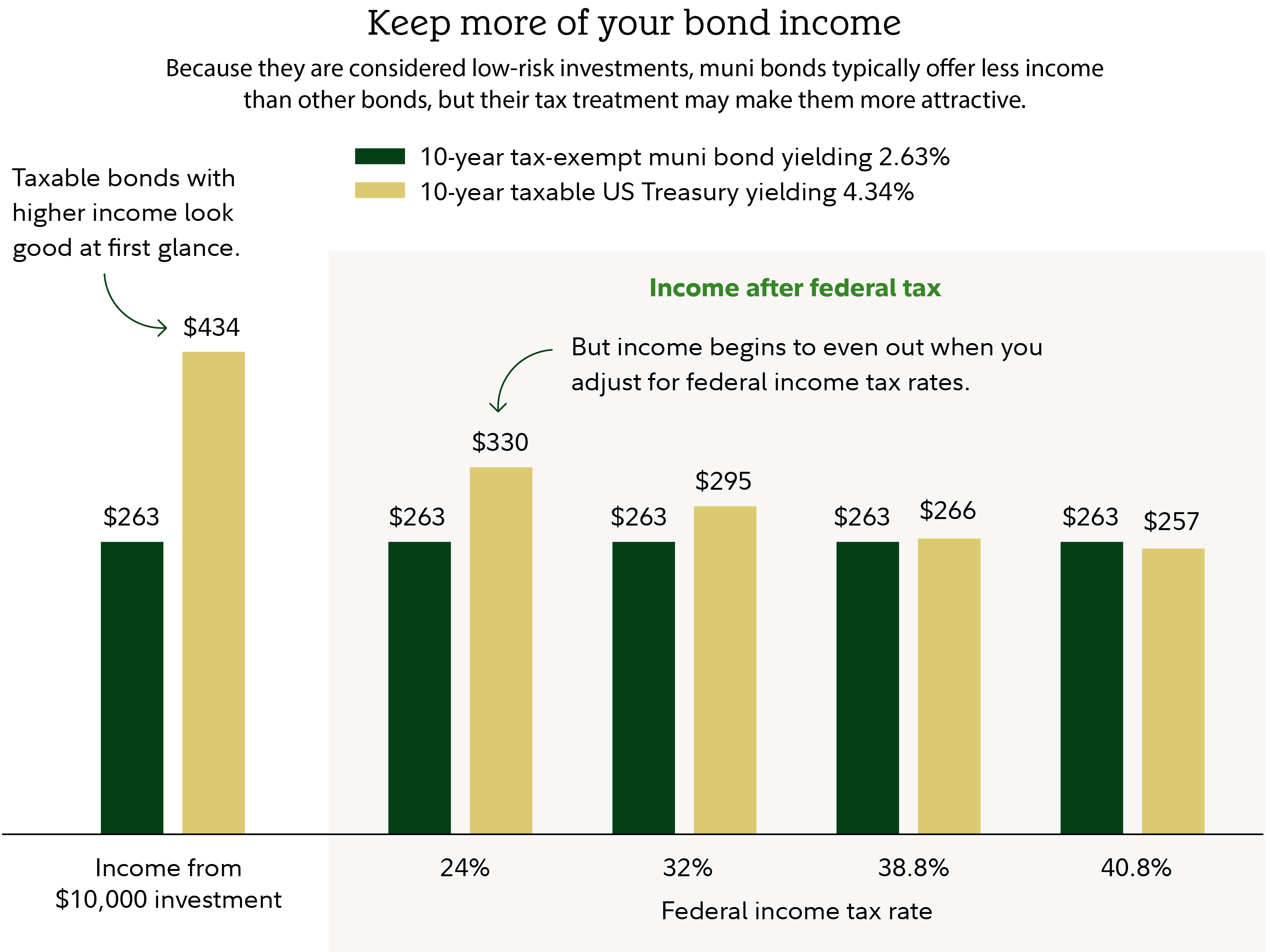
Graphic shows how muni bonds may offer less income than comparable corporate bonds, but their tax treatment makes them more attractive. An example shows a muni bond paying $263 in interest, compared to $434 for a corporate bond. But taking into consideration a 24% federal income tax rate, the corporate bond's income is cut to $330. At higher tax rates, the corporate bond's advantage shrinks even more or is eliminated.
All or a portion of the income may be subject to the federal alternative minimum tax. Income attributable to capital gains is usually subject to both state and federal income taxes. This hypothetical example shows annual income from a $10,000 investment in a taxable account and the impact on that income from the 4 highest federal tax rates. The municipal bond investment has a 2.63% assumed yield and the taxable US Treasury yield is assumed to be 4.34% (data sourced from Refinitiv TM3, as of 11/30/23). This hypothetical example is used for illustrative purposes only; actual investments may vary. It does not reflect the impact of state taxes, federal and/or state alternative minimum taxes, tax credits, exemptions, fees, or expenses. If it did, after-tax income might be lower. Please consult a tax representative for further details.

Low level of default risk

Credit risk is the risk that the issuer will default or be unable to make required principal or interest payments. Despite the fact that many municipal bonds have high credit ratings and their default risk has been historically low compared to corporate bonds, credit risk still increases with lower-rated municipal bonds.

Fidelity Viewpoints

Sign up for Fidelity Viewpoints weekly email for our latest insights.


Disadvantages of municipal bonds

While municipal bonds offer tax advantages and stability, they also come with trade-offs that investors should carefully consider.

Interest rate risk

Like all fixed income securities, the market prices of municipal bonds are susceptible to fluctuations in interest rates. If interest rates rise, market prices of existing bonds will typically decline, despite the lack of change in both the coupon rate and maturity. Bonds with longer maturities are generally more susceptible to changes in interest rates than bonds with shorter maturities.

Call risk

Many municipal bonds carry provisions that allow the issuer to call or redeem the bond prior to the actual maturity date. An issuer will typically call bonds when prevailing interest rates drop, allowing the entity to reissue bonds at a lower borrowing cost. In this circumstance, the action makes reinvestment less desirable for the holder.

Liquidity risk

The bond market is large and fragmented, with more than 50,000 entities issuing a million different bonds, which represent trillions of dollars in the market. For that reason, the vast majority of municipal bonds are not traded on a regular basis, so the market for a specific bond may not be particularly liquid.
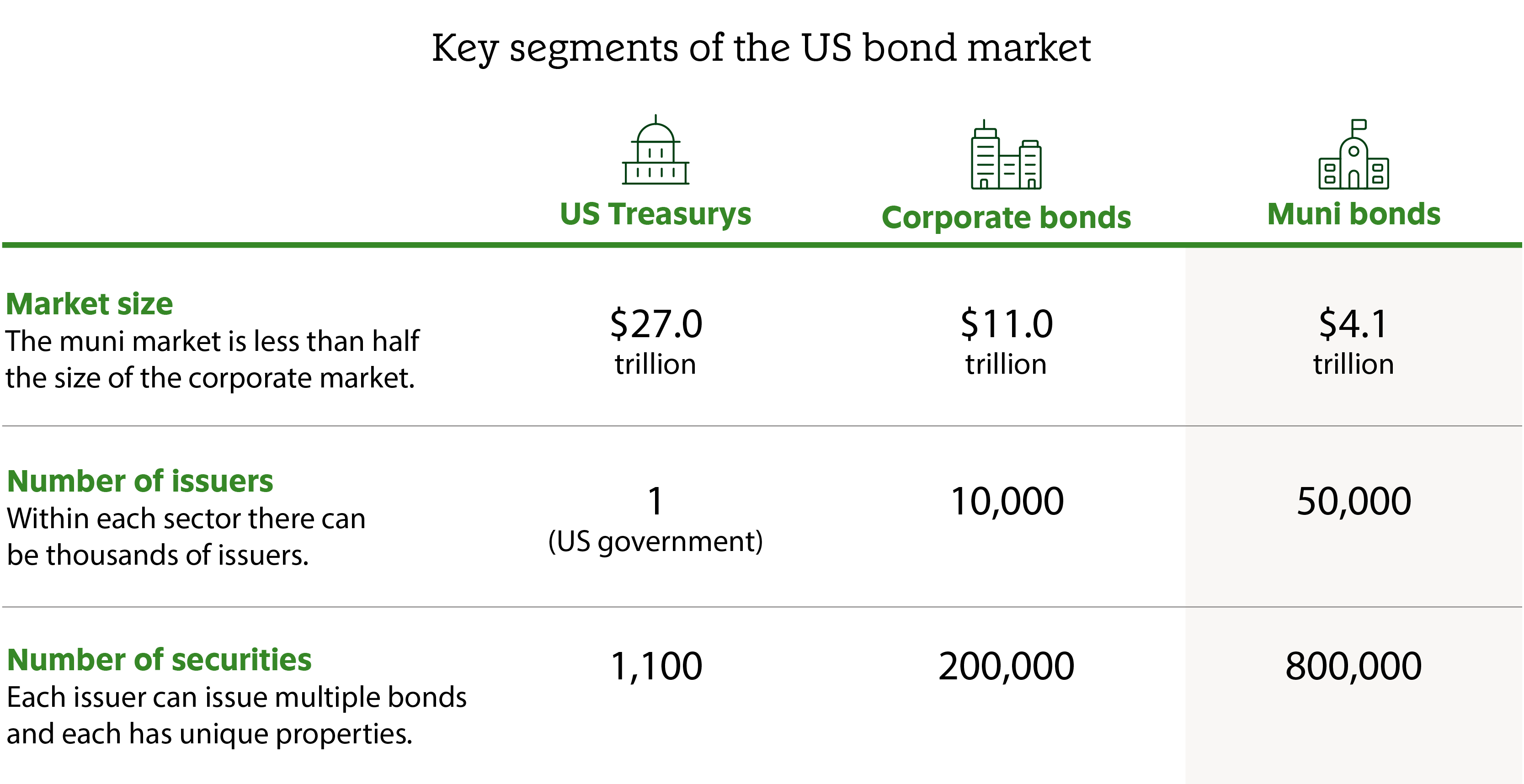
Graphic shows a snapshot of the bond market. There are $4.1 trillion in muni bonds in the market, compared to $11 trillion in corporate bonds and $27 trillion in US Treasuries. There are 50,000 issuers of munis, compared to 10,000 corporate issuers and only 1 issuer for US Treasuries. There are 1 million different types of munis in the market, compared to 43,000 corporate bonds and 1,950 types of US Treasuries.
Source: Fidelity and the Securities Industry and Financial Markets Association (SIFMA), as of Q2 2024 for corporates and municipals and as of August 2024 for US Treasurys.

How to buy municipal bonds

There are 3 ways investors generally gain exposure to muni bonds.

Individual bonds

You can buy a single municipal bond for as little as $5,000, but it may take much more than that to build a complete portfolio of bonds.

There are 2 ways to buy individual bonds.

  • New issues: These are municipal bonds that are being sold for the first time. For example, a city issues bonds to fund a new school. These bonds are offered to investors as a new issue. Investors buy directly from the issuer or through a broker, and can invest at the same price as large institutions are paying for the same new issue.
  • Secondary market: This is where existing municipal bonds are bought and sold after the initial issuance. For instance, an investor buys a 10-year municipal bond from another investor 5 years after it was issued. Prices in the secondary market fluctuate based on interest rates, credit ratings, and market demand. Investors can buy or sell bonds through brokers at prices at or above par, and include the broker’s trading fee known as a markup for a purchase and markdown on when a customer sells.

Buying munis one-by-one means assessing the value of individual bonds and choosing from different issuers, yields, durations, and risk profiles.

If you want to build a portfolio of individual bonds, you can search for new issues or secondary market bonds with Fidelity’s research tools.

Bond funds and ETFs

Bond funds offer you the ability to invest in a broad portfolio of bonds for a low minimum investment. Mutual funds and ETFs that focus on munis generally fall into 3 categories:

  • National municipal funds invest in municipal bonds issued by various state and local governments. The income from these funds is generally free from federal taxes, although a portion may be subject to state and local taxes, as well as the federal alternative minimum tax (AMT).
  • State municipal funds invest primarily in bonds issued in a specific state. Each state-specific category includes long, intermediate, and short duration bond funds. The income from state-specific funds is generally exempt from federal taxes and may also be exempt from state taxes, depending on where you live.
  • Municipal money market funds invest at least 80% of assets in municipal securities whose interest is exempt from federal income tax.

Try Fidelity’s mutual fund screener or ETF screener to search for municipal bond funds.

Separately managed account

A separately managed account (SMA) offers professional active management along with the benefits of direct ownership. Unlike mutual funds, where your money is pooled with other investors and you own shares of the fund, SMAs provide you with direct ownership of the individual bonds in your portfolio. This means greater transparency, more control, and a personalized investment experience tailored to your financial goals.

Learn more about Fidelity’s municipal bond SMAs: Fidelity’s Intermediate Municipal Strategy and Fidelity® Limited Duration Municipal Strategy.

How to decide

The most appropriate way for you to invest in munis, if you choose to include them in your portfolio, will depend on your financial goals, risk tolerance, investment knowledge, and how much control you want over your portfolio. Here are some of the key factors to consider:

Individual bonds Bond funds/ETFs SMAs
Minimum investment Typically $5,000 per bond, but building a diversified portfolio may require $100,000+. Low minimums (as little as $100 or less). High minimums (Fidelity’s SMA offering has a minimum investment of $350,000).
Liquidity Less liquid; may be hard to sell at a fair price before maturity. Highly liquid; can be bought/sold daily at NAV. Less liquid than funds, but more flexible than individual bonds.
Transparency Full transparency—you know exactly what you own. Less transparent; holdings change frequently. High transparency; you can see all holdings.
Cost No ongoing fees, but may have small markups, such as $5 per $5,000 bond in the secondary market. Expense ratios (typically 0.1%–1% annually). Management fees (often 0.35%–0.40% annually) but may offer institutional pricing on bonds.
Expertise needed Requires knowledge of credit risk, duration, and market conditions. Professionally managed—good for hands-off investors. Professionally managed but tailored to your preferences.

Municipal bonds and bond funds are most effective when held in taxable accounts, such as brokerage accounts, because their primary advantage is tax-exempt interest income. Holding them in tax-advantaged accounts like IRAs or 401(k)s can negate this benefit, since those accounts already have tax advantages.

For this reason, most muni bonds are generally better suited for brokerage accounts, though there may be times when taxable muni bonds are appropriate for retirement accounts.

The bottom line

Municipal bonds can play an important role for certain investors, including:

  • Retirees or near-retirees who are seeking tax-exempt income with low risk.
  • Those who have maxxed out their tax advantaged accounts—IRAs and 401(k)s—and are looking for additional tax benefits.
  • Residents of high-tax states, where tax-exempt income can have a big impact.

Ultimately, consider whether municipal bonds align with your overall investment strategy, risk tolerance, and tax situation before adding them to your portfolio.

“Not only can investors tap into a valuable source of return and diversification from municipal bonds,” Carter said, “but they can also derive a sense of pride and satisfaction in knowing that their investments are supporting local schools, hospitals, and essential services that benefit from the funding they raise from municipal bond investors.”

Research bonds quickly and easily

Get investment analysis to help you invest in bonds.

More to explore

Before investing in any mutual fund or exchange-traded fund, you should consider its investment objectives, risks, charges, and expenses. Contact Fidelity for a prospectus, an offering circular, or, if available, a summary prospectus containing this information. Read it carefully.

The Fidelity screeners are research tools provided to help self-directed investors evaluate these types of securities. The criteria and inputs entered are at the sole discretion of the user, and all screens or strategies with preselected criteria (including expert ones) are solely for the convenience of the user. Expert screeners are provided by independent companies not affiliated with Fidelity. Information supplied or obtained from these screeners is for informational purposes only and should not be considered investment advice or guidance, an offer of or a solicitation of an offer to buy or sell securities, or a recommendation or endorsement by Fidelity of any security or investment strategy. Fidelity does not endorse or adopt any particular investment strategy or approach to screening or evaluating stocks, preferred securities, exchange-traded products, or closed-end funds. Fidelity makes no guarantees that information supplied is accurate, complete, or timely, and does not provide any warranties regarding results obtained from its use. Determine which securities are right for you based on your investment objectives, risk tolerance, financial situation, and other individual factors, and reevaluate them on a periodic basis.

The views expressed are as of the date indicated and may change based on market or other conditions. Unless otherwise noted, the opinions provided are those of the speaker or author, as applicable, and not necessarily those of Fidelity Investments. The third-party contributors are not employed by Fidelity but are compensated for their services.

This information is general in nature and provided for educational purposes only.

Diversification and asset allocation do not ensure a profit or guarantee against loss.

As with all your investments through Fidelity, you must make your own determination whether an investment in any particular security or securities is consistent with your investment objectives, risk tolerance, financial situation, and evaluation of the security. Fidelity is not recommending or endorsing this investment by making it available to its customers.

Fidelity does not provide legal or tax advice. The information herein is general and educational in nature and should not be considered legal or tax advice. Tax laws and regulations are complex and subject to change, which can materially impact investment results. Fidelity cannot guarantee that the information herein is accurate, complete, or timely. Fidelity makes no warranties with regard to such information or results obtained by its use, and disclaims any liability arising out of your use of, or any tax position taken in reliance on, such information. Consult an attorney or tax professional regarding your specific situation.

In general, the bond market is volatile, and fixed income securities carry interest rate risk. (As interest rates rise, bond prices usually fall, and vice versa. This effect is usually more pronounced for longer-term securities.) Fixed income securities also carry inflation risk, liquidity risk, call risk, and credit and default risks for both issuers and counterparties. Unlike individual bonds, most bond funds do not have a maturity date, so holding them until maturity to avoid losses caused by price volatility is not possible. Any fixed income security sold or redeemed prior to maturity may be subject to loss.

U.S. Treasury bonds and municipal bonds may be susceptible to some of the following risks: Lower yields — U.S. Treasury bonds typically pay less interest than other bonds in exchange for lower default or credit risk. Inflation risk — With relatively low yields, income produced by U.S. Treasury and municipal bonds may be lower than the rate of inflation. This does not apply to Treasury Inflation-Protected Securities (TIPS), which are inflation protected. Credit or default risk — Investors need to be aware that all bonds have the risk of default. Investors should monitor current events, as well as the ratio of national debt to gross domestic product, Treasury yields, credit ratings, and the weaknesses of the dollar for signs that default risk may be rising. Additionally, municipal bonds can carry the following risk: The municipal market can be affected by adverse tax, legislative, or political changes, and the financial condition of the issuers of municipal securities. In comparison, U.S. Treasury bonds are backed by the full faith and credit of the U.S. government. Interest income generated by U.S. territories is generally exempt from federal and state income taxes. Interest income generated by U.S. Treasury bonds and certain securities issued by possessions, agencies, and instrumentalities is generally exempt from state income tax but is generally subject to federal income and alternative minimum taxes and may be subject to state alternative minimum taxes. All investment strategies involve the risk of loss of a portion of or all assets. It is important to note that, while municipal bonds and U.S. Treasury bonds offer appealing tax advantages, these advantages come at a cost. Generally speaking, the higher your income tax bracket, the more advantageous the after-tax yield of municipal bonds may be for you. Tax-free income can be enticing to high-income investors, but tax-free municipal bonds offer a lower coupon rate than equivalent taxable bonds. Many corporate bonds, for example, offer higher coupon rates to compensate for the fact that the interest they pay is subject to income tax at a local, state, and federal level. When considering different bonds, the tax-equivalent yield is just one of a number of factors to consider (others being, for example, quality rating and term to maturity). Of course, as with any investment, your decision should take into account your personal investment objectives, needs, comfort with risk, and time horizon. Fidelity® Strategic Disciplines provides nondiscretionary financial planning and discretionary investment management for a fee. Fidelity® Strategic Disciplines includes the Fidelity® Intermediate Municipal Strategy. Advisory services offered by Strategic Advisers LLC (Strategic Advisers), a registered investment adviser. Brokerage services provided by Fidelity Brokerage Services LLC (FBS), and custodial and related services provided by National Financial Services LLC (NFS), each a member of NYSE and SIPC. Strategic Advisers, FBS, and NFS are Fidelity Investments companies. Strategic Advisers has engaged Fidelity Management & Research Company LLC, a registered investment adviser and a Fidelity Investments company, to provide the day-to-day discretionary portfolio management of Fidelity Intermediate Municipal Strategy accounts, including investment selection and trade execution, subject to Strategic Advisers' oversight.

Past performance is no guarantee of future results.

Fidelity Brokerage Services LLC, Member NYSE, SIPC, 900 Salem Street, Smithfield, RI 02917

1210311.2.0