Estimate Time4 min

Summer ETF flows surge

Key takeaways

  • Exchange-traded fund (ETF) flows could surpass $1 trillion annually for the second consecutive year.
  • Banner fixed income flows buttressed total flows alongside another big quarter for equity flows.
  • Tech ETFs have remained in demand as investors continued to ride the AI wave.

US-based ETF fund flows are once again on the precipice of setting a new annual record, as investors continue to gravitate to ETFs to invest in the market. Here are some of the key trends that drove ETF flows over the last 3 months that can help you find where the momentum may be in the market.

Market gains propel ETFs

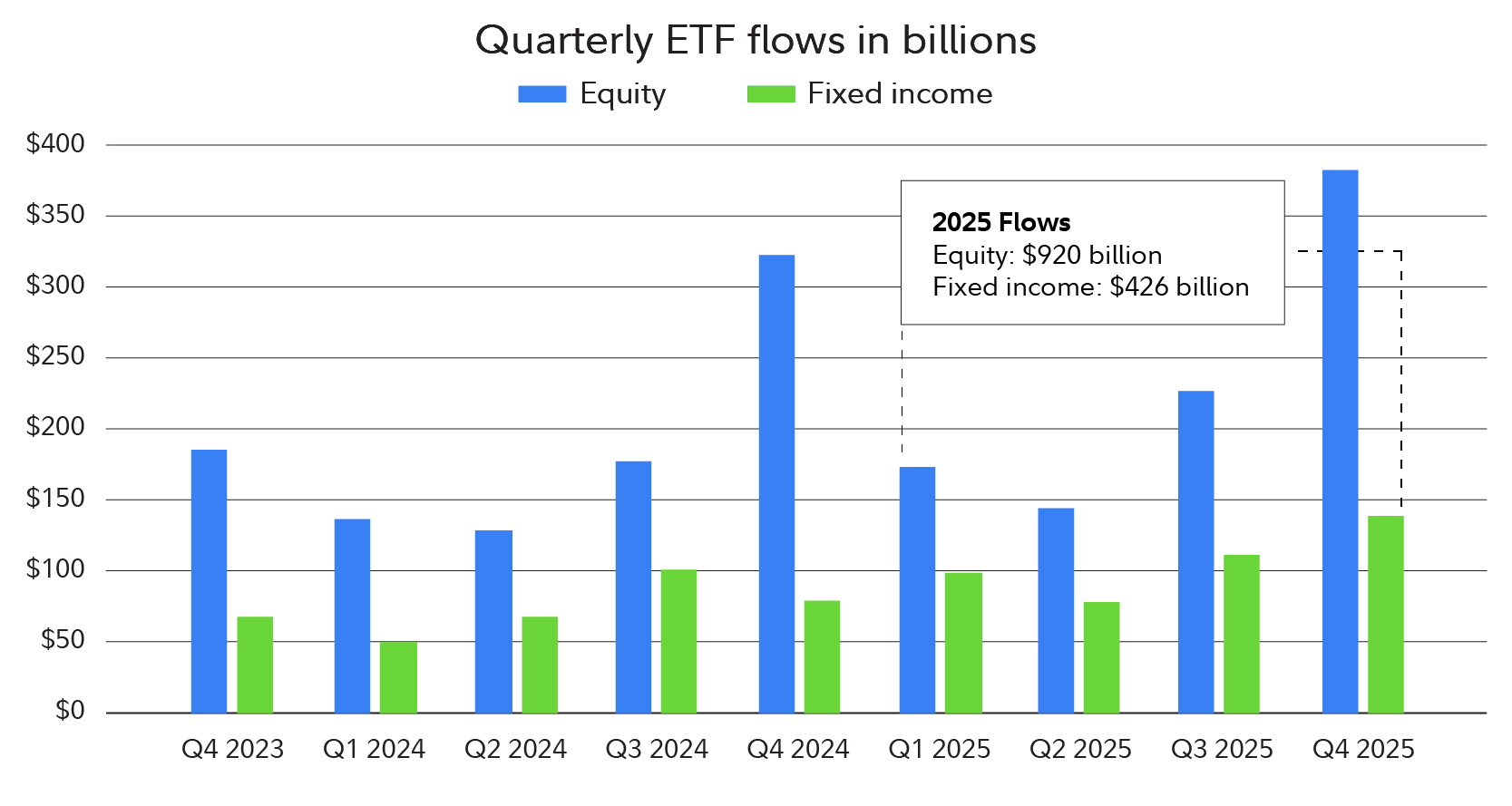
ETF flows snapped the trend of 2 straight quarterly declines that occurred during Q1 and Q2 of the year. Not only were total ETF flows higher in Q3 than the previous 2 quarters, they surpassed those from the same quarter last year.

During Q3, both equity (e.g., stock) and fixed income (e.g., bond) flows picked up. This could set the stage for momentum into Q4—which has been a big quarter for flows. Indeed, last year’s record-setting Q4 helped propel the full year past $1 trillion in ETF flows. 

Equity and fixed income flows by quarter, which rose during Q3.
Source: Fidelity Investments, as of October 8, 2025.

A major factor driving the demand for equity ETFs in particular was the massive 13% gain for the S&P 500 during Q3. The stock market saw its best Q3 since 2020, which included the strongest September (historically the worst month of the year on average for stocks) since 2010.

This momentum appeared to spill over into fixed income ETF flows as well, which rebounded from their Q2 dip and even surpassed robust Q1 flows. Despite the quarterly and annual uptick in fixed income flows, equity ETF flows have now led for 10 consecutive quarters.

Tech ETF flows lead again

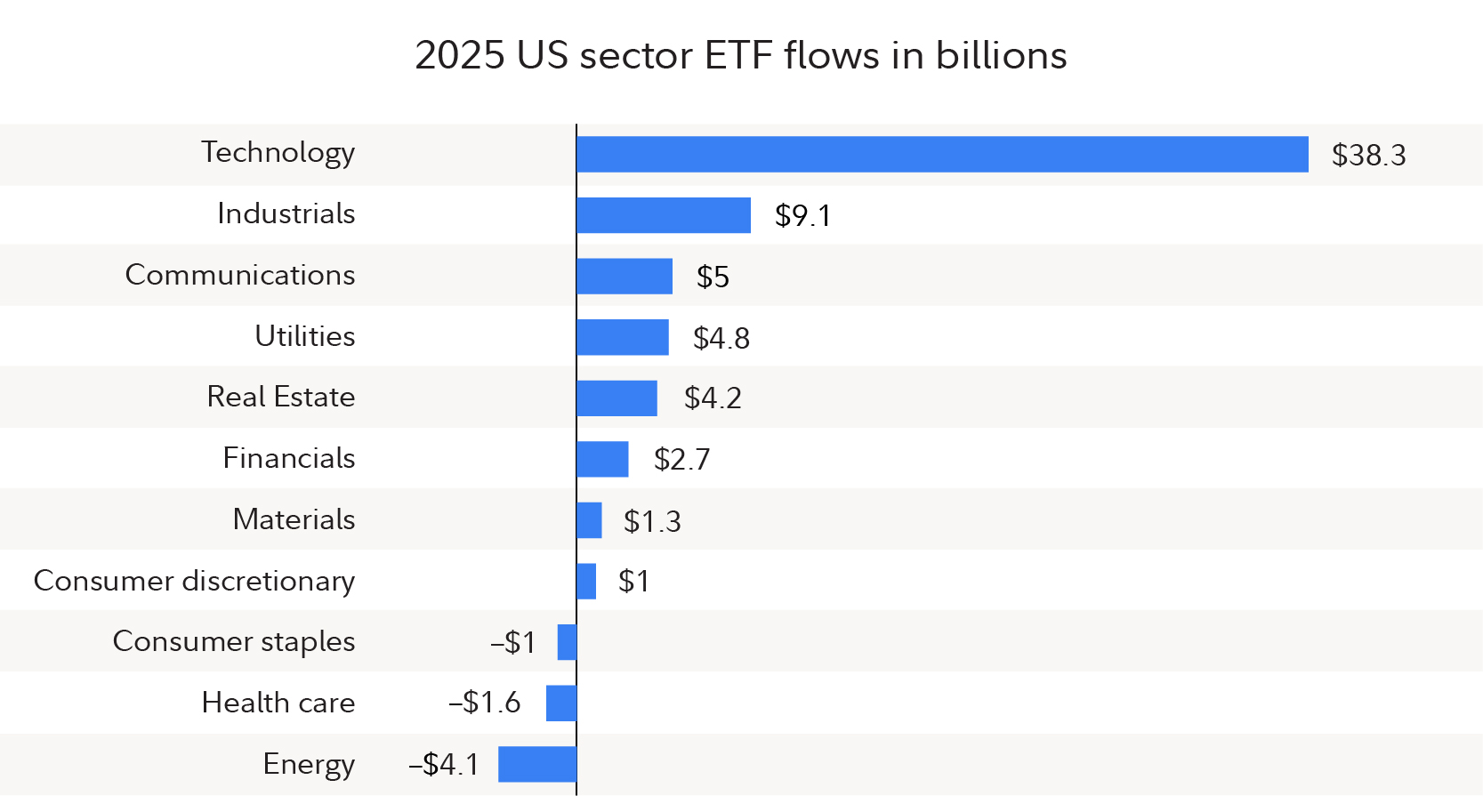
In what has become a reoccurring theme, tech ETF flows led the way among sector-based ETFs. Tech stocks played an outsized role in the S&P 500’s huge Q3 rally, and that was reflected by tech-themed ETFs’ leadership among sector-themed ETFs.

However, tech ETF flow outperformance was less pronounced relative to other sector flows over the summer, as both financial- and industrial-themed ETFs recorded strong flows last quarter. Financial ETFs actually bounced back from outflows during Q2, as did materials and energy ETFs.

Consumer discretionary– and health care–themed sector ETFs saw outflows. Notably, health care ETFs have now experienced several quarterly outflows as that sector continues to underperform the broad market year to date.

Sector flows during Q2, where tech sector ETFs led by a wide margin.
Source: Fidelity Investments, as of October 8, 2025.

Active ETF flows slow again

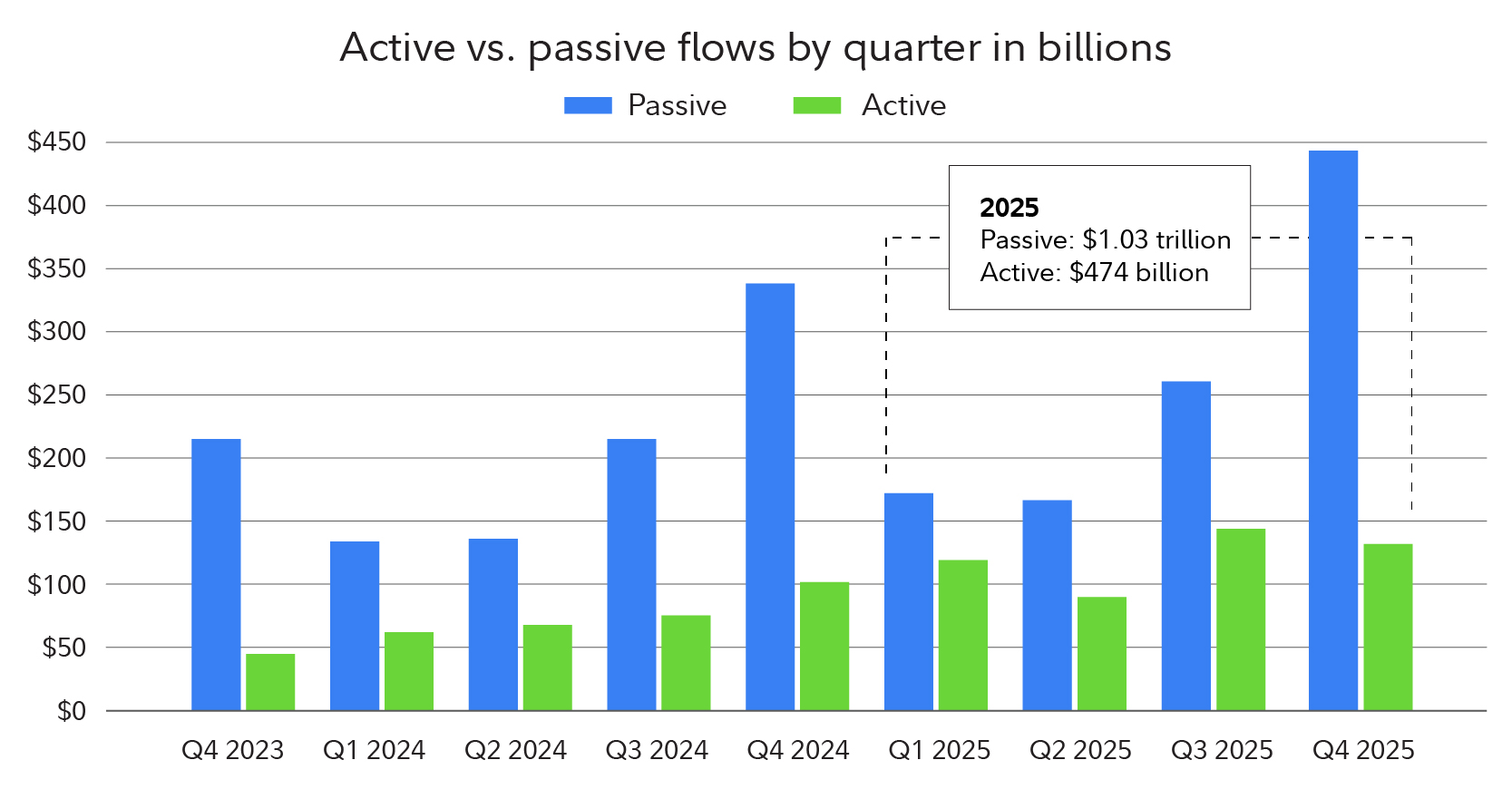
After the active-passive quarterly gap had narrowed substantially in Q1, Q3 saw actively managed ETFs lose some momentum for the second consecutive quarter. Meanwhile, passively managed ETFs experienced a tidal wave of flows in Q3. In fact, Q3’s passive ETF flows surpassed both the previous 2 quarters as well as the same quarter from a year ago. If recent precedent holds and the trend for big Q4 flows reoccurs, passively managed ETFs could once again set a new record for annual flows.

With that said, actively managed ETFs—which in contrast to passively managed ETFs are not designed to track a benchmark—are on pace for their best yearly flows ever.

Active vs passive ETF flows, where both are on track for a strong year.
Source: Fidelity Investments, as of October 8, 2025.

Looking for ETFs?

ETF flows can be a useful tool to help identify market trends, and to see where investors are broadly putting their money. If you are interested in investing in ETFs, Fidelity's ETF ScreenerLog In Required can quickly sort through a lot of data based on the filtering selections you make.

You can search for ETFs using a variety of characteristics, like the fund's objectives, fundamentals, technicals, performance, volatility, trading characteristics, tax considerations, and analyst ratings.

Find the right ETF for you

Use our screener to identify ETFs and ETPs that match your investment goals.

More to explore

Get started trading

Get industry-leading research, guidance, tools, and pricing. Open an account.

Past performance is no guarantee of future results.

Exchange-traded products (ETPs) are subject to market volatility and the risks of their underlying securities, which may include the risks associated with investing in smaller companies, foreign securities, commodities, and fixed income investments. Foreign securities are subject to interest rate, currency exchange rate, economic, and political risks, all of which are magnified in emerging markets. ETPs that target a small universe of securities, such as a specific region or market sector, are generally subject to greater market volatility, as well as to the specific risks associated with that sector, region, or other focus. ETPs that use derivatives, leverage, or complex investment strategies are subject to additional risks. The return of an index ETP is usually different from that of the index it tracks because of fees, expenses, and tracking error. An ETP may trade at a premium or discount to its net asset value (NAV) (or indicative value in the case of exchange-traded notes). The degree of liquidity can vary significantly from one ETP to another and losses may be magnified if no liquid market exists for the ETP's shares when attempting to sell them. Each ETP has a unique risk profile, detailed in its prospectus, offering circular, or similar material, which should be considered carefully when making investment decisions.

The Fidelity ETF Screener is a research tool provided to help self-directed investors evaluate these types of securities. The criteria and inputs entered are at the sole discretion of the user, and all screens or strategies with preselected criteria (including expert ones) are solely for the convenience of the user. Expert Screeners are provided by independent companies not affiliated with Fidelity. Information supplied or obtained from these Screeners is for informational purposes only and should not be considered investment advice or guidance, an offer of or a solicitation of an offer to buy or sell securities, or a recommendation or endorsement by Fidelity of any security or investment strategy. Fidelity does not endorse or adopt any particular investment strategy or approach to screening or evaluating stocks, preferred securities, exchange-traded products, or closed-end funds. Fidelity makes no guarantees that information supplied is accurate, complete, or timely, and does not provide any warranties regarding results obtained from its use. Determine which securities are right for you based on your investment objectives, risk tolerance, financial situation, and other individual factors, and reevaluate them on a periodic basis. ETFs are subject to market fluctuation and the risks of their underlying investments. ETFs are subject to management fees and other expenses. All the data presented within are from Fidelity Investments and Bloomberg, as of October 10, 2025. These data do not reflect mutual fund data, and investors who would like to monitor the entire fund flow universe may want to consider flows going into or out of mutual funds.

Fidelity Brokerage Services LLC, Member NYSE, SIPC, 900 Salem Street, Smithfield, RI 02917

1227554.1.0