
Transferring an IRA to Fidelity
If you already have an IRA, like a traditional, rollover, or Roth IRA that you’d like to move to Fidelity, we can help with the next steps.
A rollover IRA lets you consolidate and manage your old workplace savings accounts, like a 401(k), 403(b), or 457(b), in one place throughout your career. We’ll guide you through the process in three simple steps.
It’s important to roll your funds into an account that’s compatible with your old workplace account to avoid paying taxes or early withdrawal penalties. Because rollovers are irreversible, confirm you’ve chosen the right account(s) before moving your money. Use our chart to match your contribution type with the right IRA(s). You can roll into an existing account or open new ones.
| Your workplace account contributions | Your compatible account type |
| Pre-tax (common with 401(k), 403(b) plans) | Rollover IRA |
| Post-tax (usually called Roth contributions) | Roth IRA |
| Both pre- and post-tax | Both a rollover IRA and Roth IRA |
If you made after-tax contributions to a traditional workplace plan, earnings associated with those contributions may be taxable if they are rolled into a Roth IRA. Please consult a tax advisor about your unique situation.
To move the old 401(k) or workplace money into your Fidelity IRA, you'll start with the provider of your old workplace plan. Not sure who that provider is? Check your account statements or call your former employer. The next action you'll take depends on whether or not your old provider is Fidelity:
Start by checking your provider’s website or calling them to see if any forms are required to begin your rollover. You’ll need your Fidelity IRA account number to complete the process. If you have questions—or if you have shares of company stock—call a Fidelity rollover coordinator at 800-343-3548 for help.
Start by visiting NetBenefits® to complete your rollover—we’ll walk you through the process.
There are 2 types of rollovers: a direct rollover—have your old provider send the money directly to us for deposit—or an indirect rollover—have the funds sent to you and deposit them into your IRA yourself.
Direct rollover |
Indirect rollover |
|
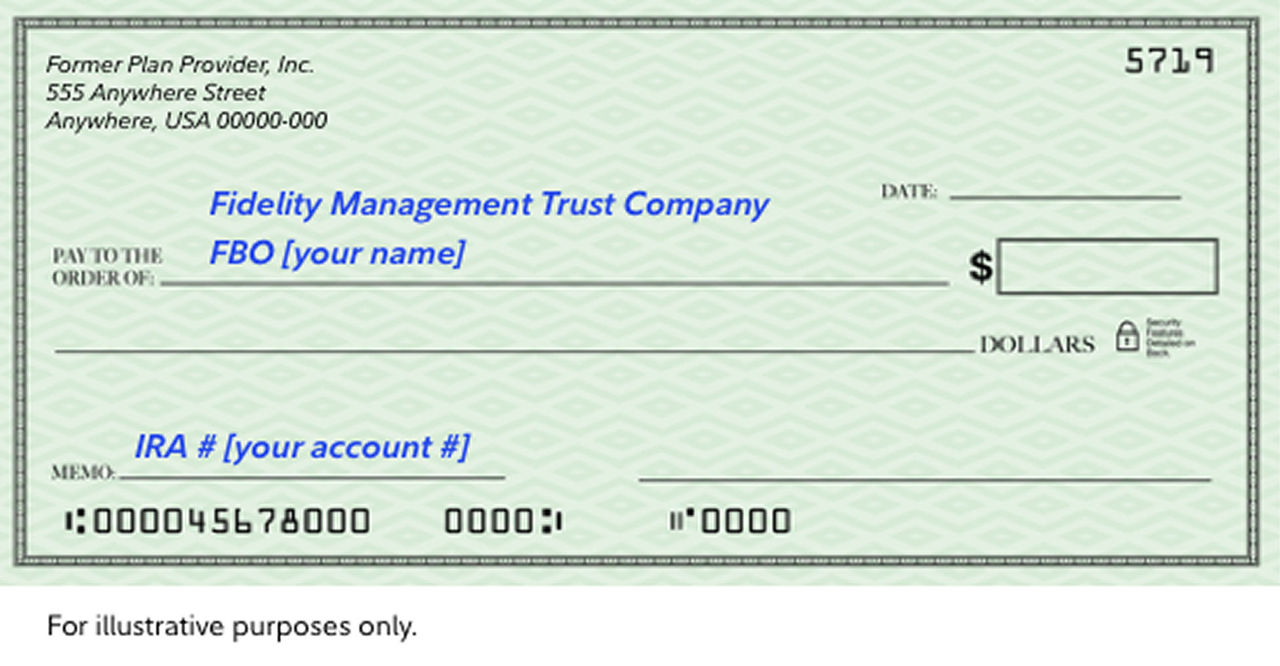
| How it works | Funds move directly from one financial institution to another by check (FBO your name) or electronic transfer. | Funds are paid to you first, then you deposit it into your IRA yourself. |
| 60-day rule | Not applicable | Funds must be deposited into your new IRA within 60 days. |
| Tax withholding | No mandatory tax withholding | 20% federal tax withholding typically applies for employer plans like 401(k)s. |
| Costs | $0 | To avoid taxes and penalties, you must redeposit the full amount—including the 20% that was withheld—by covering that portion out of pocket until you recover it when filing your taxes. |
Whether your rollover is direct or indirect, there are several ways the funds can be deposited into your IRA.
Whether your rollover is direct or indirect, there are several ways the funds can be deposited into your IRA.
Your rollover funds will arrive in your Fidelity IRA and be placed in your account’s core position—typically a money market fund used to hold cash and process transactions. To pursue greater long-term growth potential, you’ll need to choose investments for your IRA. If your funds rolled over to an IRA that Fidelity manages for you, such as a Fidelity Go® account, we’ll choose and manage your investments based on the information you provide.

If you already have an IRA, like a traditional, rollover, or Roth IRA that you’d like to move to Fidelity, we can help with the next steps.
Our rollover coordinators can help you.
You could lose money by investing in a money market fund. An investment in a money market fund is not a bank account and is not insured or guaranteed by the Federal Deposit Insurance Corporation or any other government agency. Before investing, always read a money market fund’s prospectus for policies specific to that fund.
Investing involves risk, including risk of loss.
Be sure to consider all your available options and the applicable fees and features of each before moving your retirement assets.
A Fidelity rollover coordinator can help guide you through the process of rolling from your former plan to an IRA with Fidelity. Their assistance includes help with new account opening, if needed to receive your rollover deposit, contacting your former 401(k) provider, to initiate your rollover, including providing helpful questions to ask your former plan provider when speaking with them or making the call to your former plan with you, education on options for depositing your rollover into your IRA with Fidelity, and help learning which investment options are available for your rollover once it arrives in your IRA.
Fidelity Go® provides discretionary investment management and, in certain circumstances, nondiscretionary financial planning for a fee.
Advisory services are offered by Strategic Advisers LLC (Strategic Advisers), a registered investment adviser. Brokerage services are provided by Fidelity Brokerage Services LLC (FBS), and custodial and related services are provided by National Financial Services LLC (NFS), each a member of NYSE and SIPC. Strategic Advisers, FBS, and NFS are Fidelity Investments companies.
Fidelity does not provide legal or tax advice. The information herein is general in nature and should not be considered legal or tax advice. Consult an attorney or tax professional regarding your specific situation.
Fidelity Brokerage Services LLC, Member NYSE, SIPC, 900 Salem Street, Smithfield, RI 02917
1270193.2.0