


The US stock market is at record highs, with the S&P 500 having crossed 6,900 for the first time ever. But beneath the bullish surface lies a swirl of factors that could derail investor confidence and trigger a downturn. Here are 5 of the most pressing threats to the stock market right now.
1. High stock prices and valuations
Surging stocks can be a double-edged sword. As stock prices have climbed and investment balances have grown, so too have stock valuations. One of the most glaring risks facing the stock market in 2025 is valuations that may have run too high, too fast. Consider the following:
- The S&P 500 is trading at a price-to-earnings (P/E) ratio of 24x next-12-month earnings projections—a 42% premium to the 20-year average.
- Several sectors are trading at big premiums to their 20-year average P/Es including the technology sector (66%), the communication services sector (43%), the consumer discretionary sector (41%), and the industrials sector (47%). In fact, all other sectors except energy (−8%), are trading at double-digit premiums to their 20-year average P/Es.
Relatively high valuations could risk market corrections if earnings do not continue to support stock prices. Moreover, the concentration of market gains in a handful of tech giants—such as the “Magnificent 7”—could heighten this risk. If these companies falter, the broader market could suffer disproportionately, given their outsized influence.
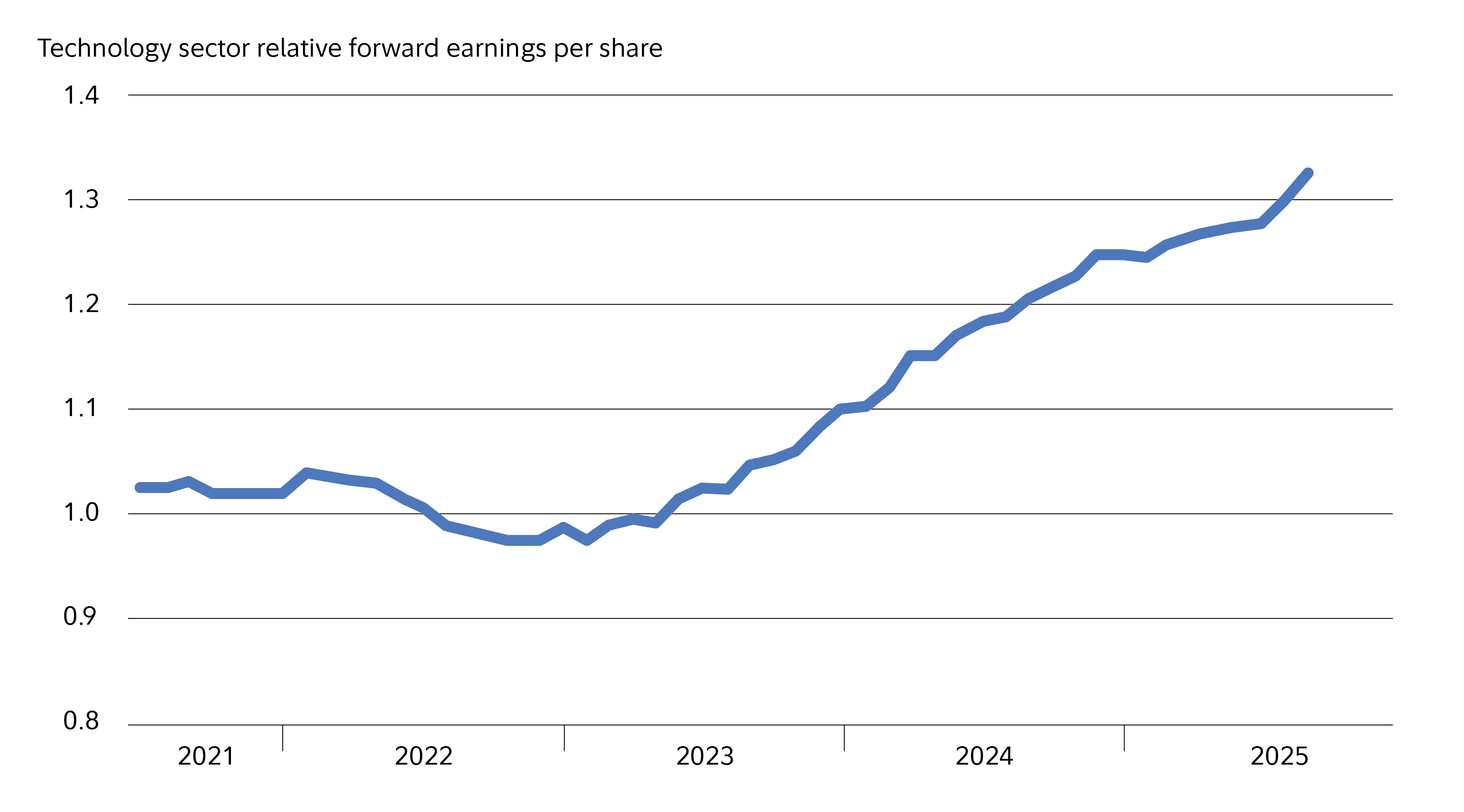
With that said, sometimes something is more expensive because it’s worth it. Higher valuations can simply reflect confidence in expected growth and durable earnings. Consider the tech sector’s relative forward earnings per share (EPS), which has exhibited noteworthy growth—particularly over the past couple years.
2. Counting on AI
A primary reason why many stock prices have soared has been the growth in expectations for artificial intelligence (AI). That’s boosted tech and other sectors in particular, which are benefitting from growth in AI capabilities, data centers, power generation, and other aspects related to the AI buildout.
Overexposure to AI has some investors worried there could be a magnified downside impact if there is an AI bubble that bursts. Indeed, Fidelity’s Asset Allocation Research Team has estimated that roughly 40% of US GDP growth is connected to this AI buildout. Additionally, fears of the potential AI impact on the labor market may be seeping into consumer confidence.
Yet portfolio managers like Chris Lin, manager of the Fidelity® OTC Portfolio (
3. Global instability
Geopolitical instability is another persistent risk to global markets. In addition to trade disputes between major economies like the US and China—which can lead to increased costs for businesses and consumers, among other effects—conflicts such as the ongoing war in Ukraine, hostilities in the Middle East, and rising frictions elsewhere have created a somewhat volatile geopolitical backdrop for investors.
According to a recent survey by the Depository Trust & Clearing Corporation, geopolitical risk was the top concern for financial institutions, with 84% of surveyed professionals citing it as a major threat. These conflicts can disrupt global supply chains, increase energy prices, and trigger inflationary pressures, all of which can negatively impact corporate earnings and investor sentiment.
Nevertheless, there is hope that many of these conflicts can be resolved. Moreover, markets have proven over the past several years that, even in the absence of resolutions to these conflicts, global economies and businesses can effectively manage the associated risks.
4. Inflation and interest rate uncertainty
High costs for many goods like food, shelter, and other products have been a multiyear issue for consumers that continues to cast a shadow over their outlook. While the pace of inflation growth has slowed substantially since the initial post-COVID-induced spike, prices broadly remain relatively high compared to pre-COVID levels. Recent data suggests the inflation problem is not going away as fears of trade disputes and other factors threaten to keep prices from coming down.
If inflation does not cool, the Federal Reserve may be forced to halt or reverse its current path of interest rate cuts. Such a move could alarm investors who've been hoping for rate cuts, as relatively higher interest rates can increase borrowing costs for both businesses and consumers and reduce company profits.
With that said, the Federal Reserve cut rates on October 29. That’s the second cut this year and fed fund futures forecast another rate cut is likely before the end of the year. If rates come down, and some of the factors that are contributing to inflation are addressed, that could result in a more optimistic outlook for stocks.
5. Debt stress
A looming but less overt threat to markets is the rising levels of debt. As interest rates remain elevated globally, companies that have borrowed money are facing relatively high debt servicing costs. This is particularly concerning for companies in industries where margins are under pressure.
The private credit market is showing signs of strain as well. Credit stress—especially in regional banks, which have come under the microscope in recent years—can cause havoc in the financial sector, which has tentacles that spread throughout the global economic system.
Additionally, credit card debt and default levels recently reached their highest levels in 14 years, according to data from the Federal Reserve Bank of New York, signaling growing financial stress among consumers. This could lead to reduced consumer spending, which is a key driver of economic growth and company revenues.
With that said, industry experts are not sounding the alarm regarding debt levels. If rates come down, that could alleviate some of the pressure on borrowers. Moreover, since the financial crisis, monitoring the health of financial institutions has become a greater priority among regulators, with more policies in place to head off potentially problematic developments in the financial system.
Investing implications
Despite the impressive performance of the stock market in 2025, investors must remain vigilant. As always, you should ensure your investment mix is diversified and that your positions align with your overall strategy and risk tolerance. As history has shown, markets can turn swiftly, and those who prepare for volatility are better positioned to manage any of it that may arise.