


After a period of gains, an investment or group of investments could drop into correction territory. What is a stock market correction, and what does it mean for your investments? Here are answers to frequently asked questions about stock market corrections.
What is a market correction?
While there is no official definition, a stock market correction is generally considered a drop of at least 10% from recent market highs. Corrections could apply to any investment, including individual stocks, bonds, commodities, or stock indexes. Indexes are groups of stocks that share a common feature, like all being large companies, as with the S&P 500®.
How does a market correction work?
A stock market correction has historically been a regular part of investing. Just as markets can rise, they can also fall. These periods of lower values can last days to months. In fact, the S&P 500, which is often used to gauge total market performance, has spent more than a third of the time since 1927 trading 10% or more below a recent high. Each time, the market has recovered from those drops and continued to deliver long-term gains—though past performance is no guarantee of future results.1
What causes a market correction?
Many factors can contribute to a market correction, including the following:News headlines
Think: political news and global conflicts. For example, unrest or uncertainty due to policy changes or war may prompt investors to sell some stocks and consider safer havens, such as bonds or cash.
Economic data
Whether it's jobs numbers, inflation, or factory orders, disappointing economic data could trigger a correction. Investor sentiment can play a role too—no matter what the economic data says. For example, pessimism about unemployment, inflation, or consumer confidence could make investors fear an economic slowdown enough to sell investments, even if the data itself doesn’t indicate trouble.
Earnings reports
Companies routinely release earnings reports to show investors how they’re faring financially. When company bottom lines are robust or beat investor expectations, their stock prices may rise, though not always. When the opposite happens, their stock prices may fall. In some cases, a company may beat its forecasted earnings but still decline in value because it was by less than expected.
Stock market correction vs. bear market
Corrections and bear markets share some common traits. They also differ in a few key ways.
Similarities
- Both are normal parts of long-term investing.
- Each can be driven by investor reactions to factors like news headlines, economic data, and company earnings.
- The timing of when they start and end is unpredictable.
- Historically, when past corrections and bear markets have ended, periods of gains have followed.
Differences
- A market correction is less steep a drop than a bear market, which is typically defined as a drop of 20% or more.
- Corrections have historically occurred more frequently than bear markets.
- Bear markets tend to last longer than market corrections.
Stock market correction vs. crash
A stock market crash is a sudden, drastic drop. Infamous crashes include the onset of the Great Depression in 1929, the dot-com bubble burst in 2001, the Great Recession in 2008, and the COVID pandemic’s onset in 2020.
Similarities
- The timing of when a crash or correction starts and ends is unpredictable.
- Historically, the market has recovered and delivered long-term gains after both corrections and crashes.
Differences
- Crashes have historically been faster and more severe than corrections.
- Crashes could, but don’t always, precede a recession or depression.
- If too many investors are trying to sell at once, exchanges may temporarily halt trading as a means to prevent a crash—or prevent it from worsening. Such extreme measures aren't used for corrections.
How long do market corrections normally last?
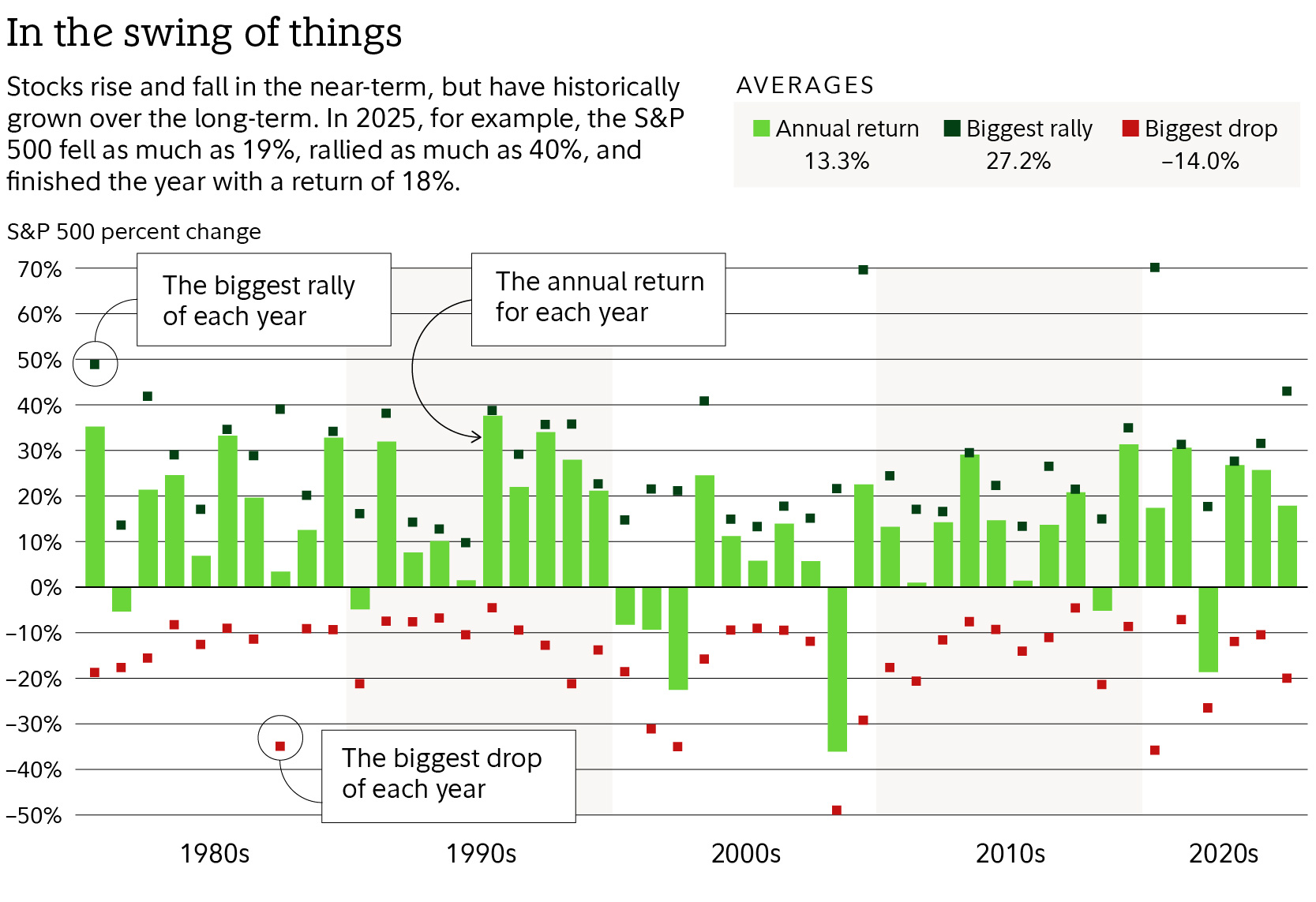
Market correction durations vary, but past corrections have averaged about 115 days, according to Yardeni Research, a consulting firm.2 Keep in mind, though, that a correction could deepen into a bear market, which may last longer. Still, the market has historically bounced back. Even though nearly half of calendar years since 1980 have experienced a correction, the average annual return over the same period has been above 13%.
Historical examples of market corrections
In this chart, red dots represent the biggest drops from market highs, while green bars show mostly positive annual returns. Red dots that appear in the -10% to -20% range represent corrections. You can find a few of these in virtually every decade. The S&P 500 and Nasdaq indexes entered correction territory in March 2025 and again in April 2025 following newly announced tariffs.
Market correction of March 2011
This correction occurred after an earthquake and tsunami in Japan.
Market correction of February 2018
Skittishness surrounding inflation, interest rates, and the bond market sent shares down in early 2018, though the correction lasted less than 2 weeks.
Market correction of January 2022
Most major indexes, including the S&P 500, declined more than 10% in the largest drop since the March 2020 onset of the COVID pandemic. At the time, the US was dealing with a new COVID variant, inflation (with the Fed indicating it would raise interest rates), and supply chain disruptions.
What should you do during a market correction?
A good investing strategy accounts for your current financial situation, your time horizon, and your risk tolerance. The idea is to stick with that plan through the market’s peaks and valleys. A disciplined approach could help remove emotions from investing, so you don’t panic-sell at market lows, lock in losses, and surrender potential growth. Consider these other ideas for handling market volatility too.
Prioritize building up a cash cushion
Having emergency savings means you may not have to sell investments to pay for expenses in the event you lose your income or face a surprise bill. Fidelity suggests starting with $1,000, then building up 3 to 6 months’ worth of essential expenses.
Diversify
Diversification means spreading your investments across a wide range of asset classes, including stocks, bonds, and short-term investments like money market funds, to help reduce risk. When you diversify, you limit your exposure to any single asset class. When one asset class is declining, another one might be rising. This could potentially lead to a smoother investment experience over time. Keep in mind that diversification doesn’t ensure gains or protect against losses.
Rebalance
Keep your target asset mix on track with periodic rebalancing, or making adjustments to the types and amounts of investments you hold. If you don't rebalance, your portfolio could have a risk level that no longer aligns with your goal and strategy.
Read more: A tactical guide to rebalancing your portfolio.
Consider investing regularly
While some investors consider downturns opportunities to scoop up shares “on sale,” another investment strategy is dollar cost averaging. That’s when you invest a certain amount at regular intervals no matter how the market is doing. This way, you’re consistently buying shares, whether the market is down (and your money gets you more shares) or up (and your money gets you fewer shares). Knowing you’ll stick with the same strategy whether the market’s on a hot streak or in correction territory could take the pressure off needing to make game-time decisions you could regret. You may already be practicing dollar cost averaging in a workplace retirement plan like a 401(k) if an amount is deducted from every paycheck and deposited into an investing account. You can set it up for other types of accounts, including a regular brokerage account.
Tax-loss harvest
A down market could be an opportunity to try a strategy called tax-loss harvesting in a taxable brokerage account, since the strategy requires selling investments at a loss—and you may have multiple investments that would satisfy that requirement at the time. If you sell profitable investments, you’re taxed on those gains. But if you sell investments for less than you paid for them, you could offset gains with those losses and reduce your taxable income.