


After setting new all-time highs in January, the S&P 500® Index has been declining for several weeks and nearing the threshold of a 10% drop. When major stock indexes fall by 10% or more from their peak, it's typically considered a market correction. Some other indexes, such as the tech-heavy Nasdaq Composite and the Russell 2000 index of small companies, have already crossed into correction territory in recent days.
Corrections can occur for a variety of reasons. The market's recent pullback has been driven by concerns around disruptions to global energy markets posed by the conflict in the Middle East, and how these disruptions may impact growth and inflation.
Corrections can be unsettling, and many investors find it difficult to stay the course when stocks are declining. But they can also present opportunities for investors. Knowing what typically drives them—and how they have tended to resolve—can help you navigate them with confidence.
How unusual are corrections?
While corrections can be unnerving, they have historically been a normal part of investing.
Since 1980, the S&P 500 has experienced a drop of 5% or more in 93% of calendar years, and has experienced a drop of 10% or more in 48% of calendar years.
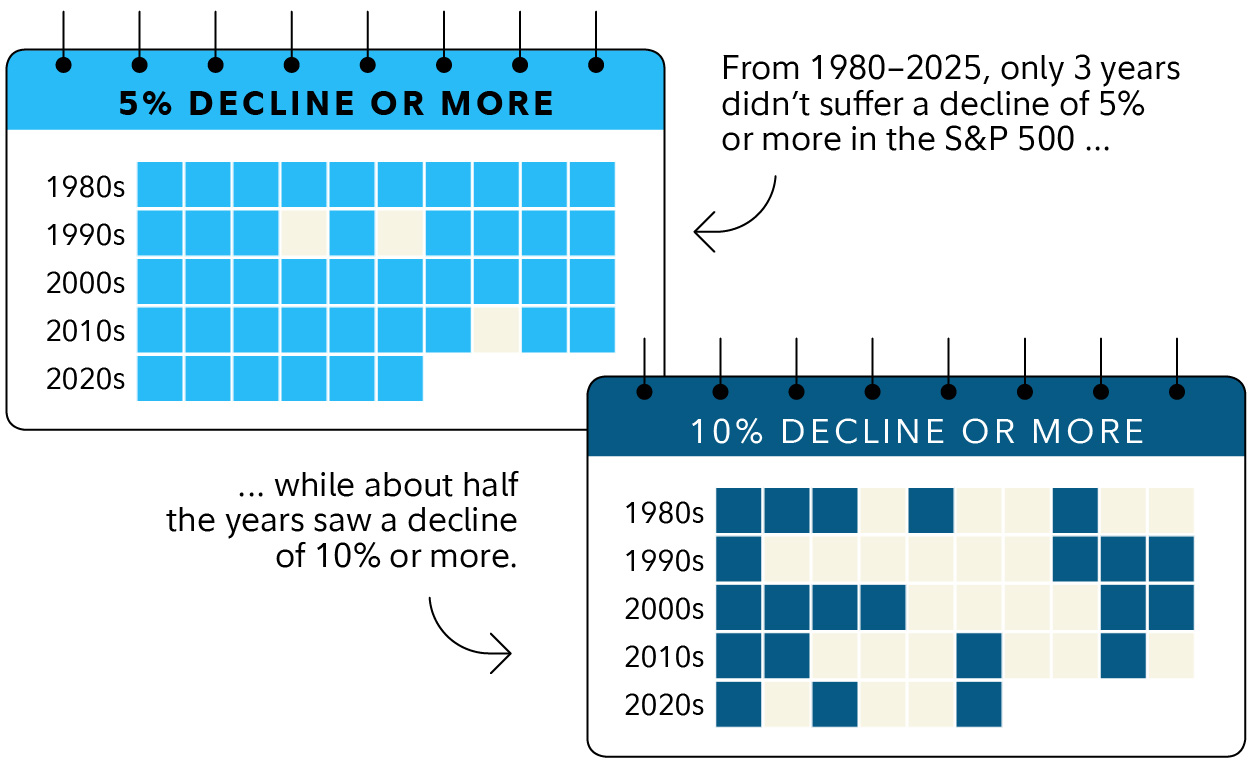
Despite those frequent declines, the market’s average calendar-year return over the same period has been 13.3%.
How long and deep is a typical stock market correction?
It's impossible to know how long it may take for stocks to recover their previous highs and for volatility to subside, due to the inherent unpredictability of future events.
But historically, the market has typically recovered quickly from corrections. The chart below shows the largest drop from a market high in each year (red dots). You can see that it’s not uncommon to experience significant market declines. But the market still has often recovered and produced positive results in most years (shown as the green bars).
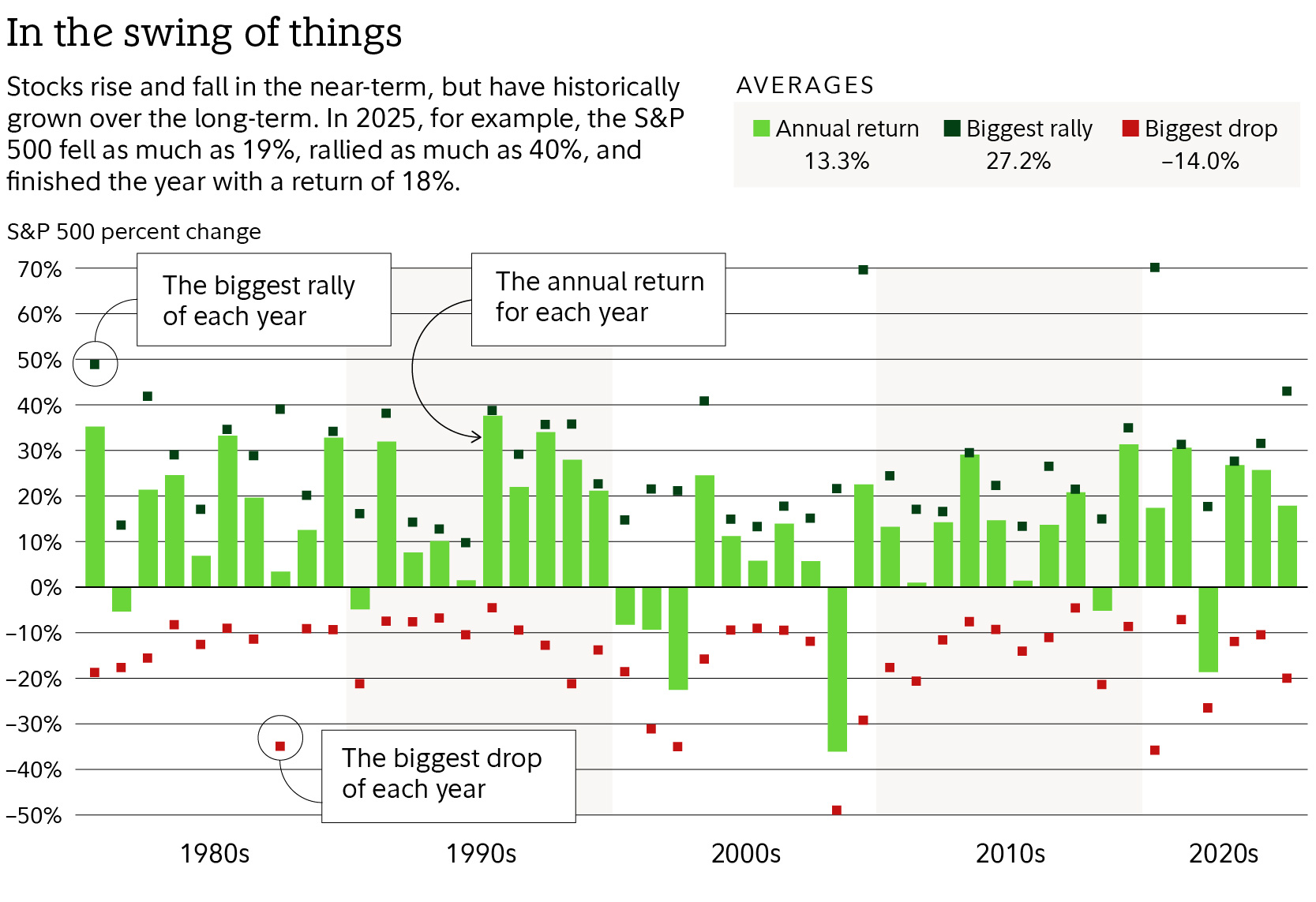
“Since 1980, the S&P 500 Index has experienced a decline of about −14% on average in any given calendar year,” says Naveen Malwal, institutional portfolio manager with Strategic Advisers, LLC, the investment manager for many of Fidelity’s managed accounts. “Yet stocks have normally recovered and finished with average gains of about 13% in any given calendar year, including dividends. So a market decline of −10% or −15% isn’t unusual, nor necessarily a sign that stocks will continue to decline. Market volatility can feel unsettling, but it is normal.”
What if this time is different?
Anytime the market enters a pullback, some investors start to worry that “this time is different.” In the midst of uncertainty, it’s natural to fear the worst. Yet investors should remember that historically the US economy and stock market have again and again surmounted steep obstacles—including pandemics, recessions, market bubbles, and even a depression—and eventually gone on to thrive.
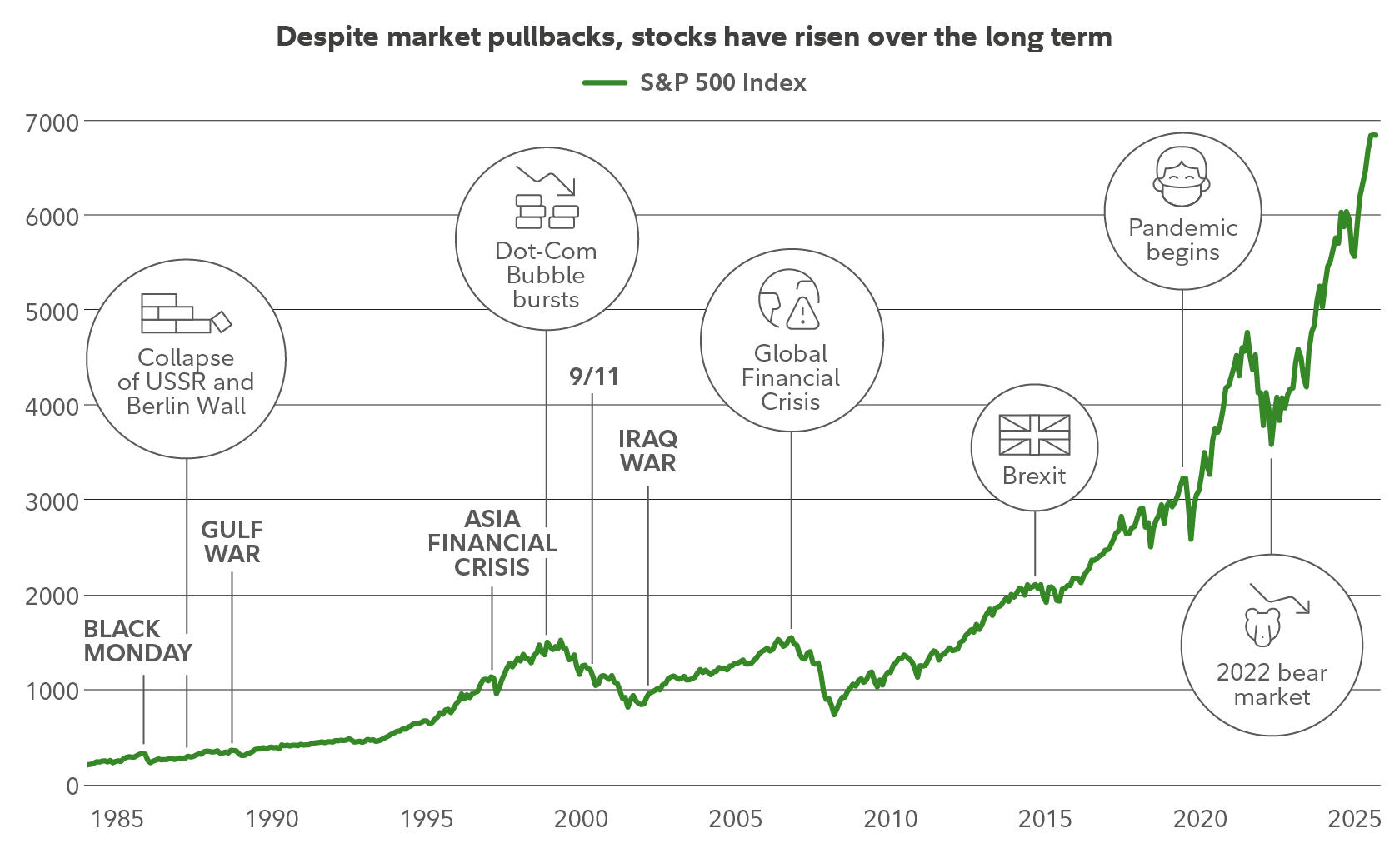
“It may also help to remember that markets can react to news headlines and emotions in the short term,” says Malwal. “But over the long run, stocks have usually risen if corporate profits are growing.”
Jake Weinstein, senior vice president on Fidelity's Asset Allocation Research Team, adds that the US economy still appears to be in the middle of an economic expansion rather than in, or on the cusp of, a recession. "Have risks increased? Yes," Weinstein says. But the increases seen in energy prices thus far may be unlikely to single-handedly derail the US economic expansion. "Overall, the US economy is very well diversified and seems to be in a pretty good spot."
What it means for investors
While it can take nerves of steel not to react when stocks are falling, this has often been the best course of action. Investors who sell, in an attempt to head off further losses, risk locking in potential losses and often miss out on the market’s subsequent recovery.
Here’s how to think about your potentially best course of action.
Long-term investors: Stick with your plan
If you are saving for retirement or another goal that is years away, the time to consider how much of a loss you can handle isn’t during a correction. Rather, you should consider the appropriate risk level for your portfolio when you are looking at your long-term goals, and thinking clearly about your financial situation and emotional reaction to risk.
If you haven’t created a plan, you should. If you have one, it may be worth checking in to see if your investments are still in line with that plan and if your plan continues to reflect your investment horizon, financial situation, and risk tolerance. If all that is so, you will likely be in a better position to manage the ups and downs of the market. If your mix of investments is off track, consider rebalancing back to a more neutral positioning.
Retirees: Manage your income
For retirees, who may be relying on their investment portfolio for a portion of their income, a market drop can present a different kind of challenge. If you have an income plan that is built to withstand different market conditions, then you typically don't need to react to a short-term market move. If not, it may be a good time to sit down with a financial professional to discuss your strategy.
Learn more about retiring into a down market.
The bottom line
It's always impossible to know, in the moment, whether a given pullback will be short-lived or the beginning of a bigger downturn. But history shows that the stock market has eventually recovered from past downturns—even steep ones. Most sound long-term investment strategies are built to withstand volatility.
If you understand your capacity to take on risk and are comfortable with your plan, there is typically no need to take action in a correction. If you are concerned about your portfolio's ability to weather future corrections, work with your financial professional to build or stress-test your plan.