
Estimate Time4 min

The power of compounding plus regular investing

Key takeaways

  • Compounding happens when your investment earns a return and those returns generate their own returns over time, creating a snowball effect.
  • Consistently adding money to your investments may help amplify compounding growth potential.
  • Accounts like 401(k)s, 403(b)s, and traditional IRAs can supercharge compounding because these accounts allow any earnings to grow tax-deferred, meaning more of your money stays invested.
  • Tax-advantaged accounts, combined with steady contributions and compounding, can make a substantial difference in long-term wealth accumulation compared to taxable accounts.

A brush and paint together can create something beautiful. In the same way, steady contributions paired with the power of potential compounding can help your money grow in ways neither could achieve alone.

What is compounding?

Compounding means your investment returns can generate additional returns of their own. Over time, this snowball effect has the potential to turn small amounts into something much bigger.

Compounding interest vs. compounding returns:

  • Compounding interest typically refers to fixed-rate products like savings accounts or CDs, where interest is added to your balance at regular intervals.
  • Compounding returns applies to investments like stocks or mutual funds, where reinvested earnings—such as dividends—can grow alongside market gains.

Why do regular investments help boost compounding?

Adding money to your account regularly—every paycheck, every month, or on another schedule—can help you stay invested through market ups and downs and reduces the risk of trying to time the market.

The combination of steady contributions with the potential of compounding is a way of adding fuel to fire. Each contribution increases your principal, and any compounding accelerates growth by generating returns on both old and new money. Over decades, this combination can make a dramatic difference in your total balance.

The added boost of tax-deferred growth potential

Tax-deferred accounts—like 401(k)s and 403(b)s or traditional IRAs—can help supercharge compounding. Because you defer paying taxes on any earnings, more of your money stays invested and working for you. That means every dollar you contribute, and any dollars earned, have the potential to grow more than it could in a taxable account. Over time, this tax advantage can significantly increase your ending balance.

The power of time

Time is the secret ingredient that makes compounding powerful. The longer your money stays invested, the more opportunities it has to potentially grow—and the more any earnings can generate additional earnings. Small contributions made early can outweigh larger contributions made later because they have more years to potentially compound. This can be why beginning to save for retirement early in life can be so effective. Starting sooner gives compounding more time to work its magic.
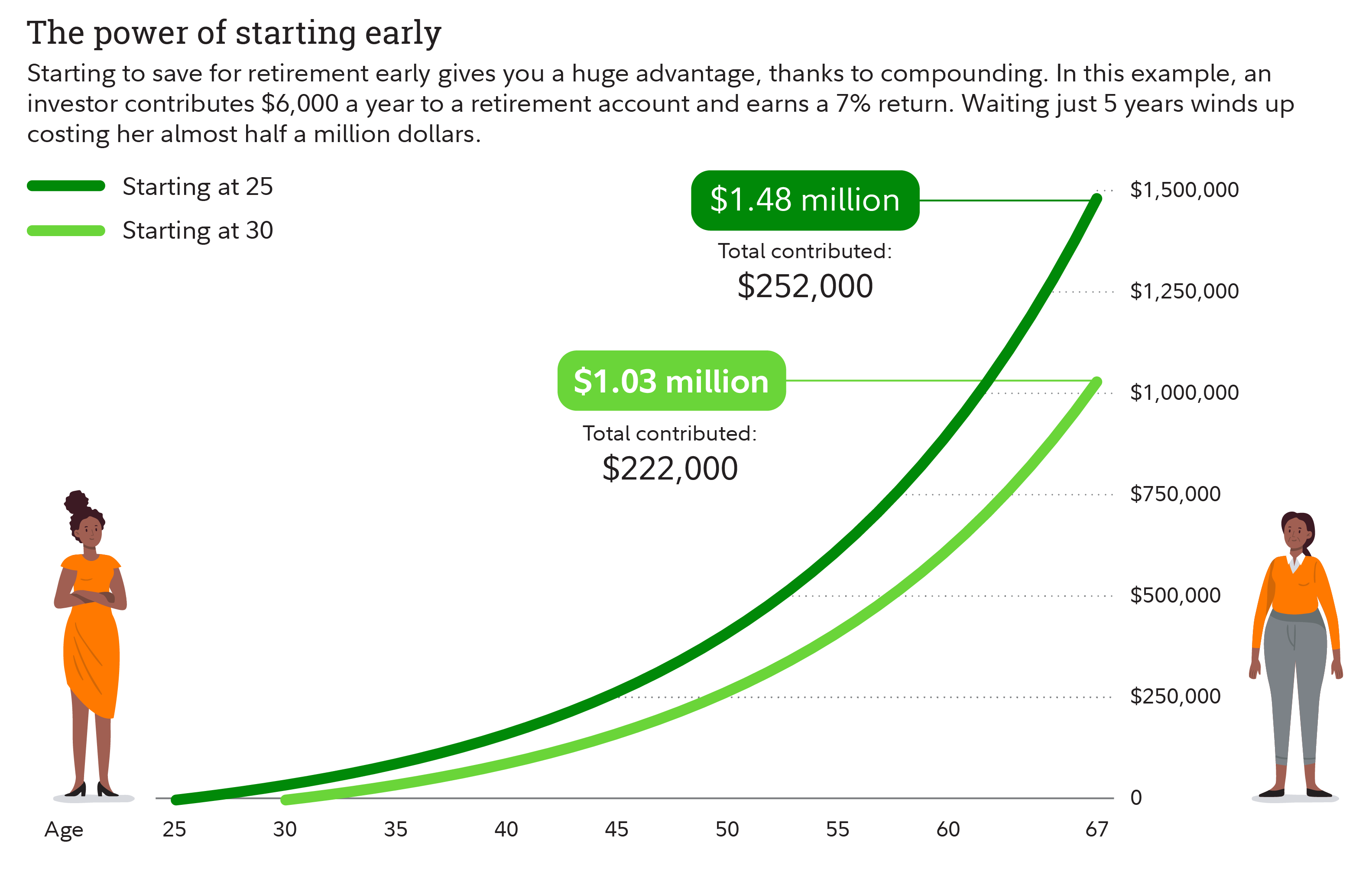
Graph showing differences in hypothetical compound interest returns based on starting at age 25 vs. 35.
This hypothetical example assumes the following: (1) $6,000 annual contributions at the beginning of each year for 42 and 37 years; (2) An annual rate of return of 7%. (3) The ending values do not reflect taxes, fees, inflation, or withdrawals. If they did, amounts would be lower. Earnings and pre-tax contributions are subject to taxes when withdrawn. Distributions before age 591/2 may also be subject to a 10% penalty. Contribution amounts are subject to IRS and plan limits. Systematic investing does not ensure a profit or guarantee against a loss in a declining market. This example is for illustrative purposes only and does not represent the performance of any security. Consider your current and anticipated investment horizon when making an investment decision, as the illustration may not reflect this. The assumed rate of return used in this example is not guaranteed. Investments that have potential for 7% annual rate of return also come with risk of loss.

Practical tips to harness the combination

  • Automate contributions: Setting up automatic transfers from your paycheck or bank account can help take the guesswork out of investing. Automation helps you stay consistent without having to remember each deposit—and it can reduce the temptation to skip contributions when markets feel uncertain.
  • Use dollar-cost averaging: By investing a fixed amount at regular intervals, you buy more shares when prices are low and fewer when prices are high. This strategy can help smooth out the impact of market volatility over time and keep you focused on your long-term goals.
  • Why consistency beats timing: Research shows that trying to time the market often leads to missed opportunities. For example, missing just a handful of the market’s best days over decades can significantly reduce your returns. Staying invested and contributing regularly helps you capture more of those good days.
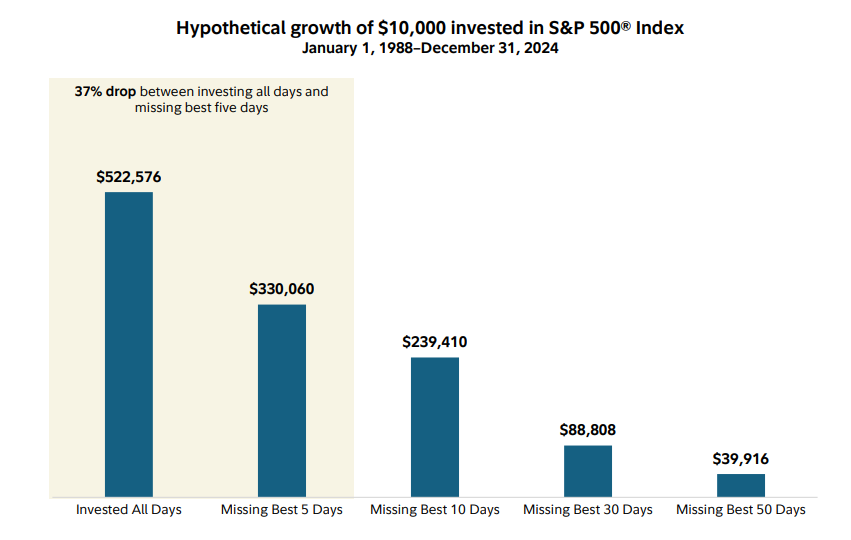
Missing the 5 best days in the market reduced portfolio value by 37%.
Past performance is no guarantee of future results. Source: Fidelity, Bloomberg as of 12/31/24. This is based on the cumulative percentage return of a hypothetical investment made in the noted index during periods of economic expansions and recessions. Index returns include reinvestment of capital gains and dividends, if any, but do not reflect the impact of taxes, fees, or expenses, which would lower these figures. This return information is not intended to imply any future performance of the investment product. "Best days" were determined by ranking the one-day total returns for the S&P 500® Index within this time period and ranking them from highest to lowest. There is volatility in the market and a sale at any point in time could result in a gain or loss. See important information for index definitions. Your own investment experience will differ, including the possibility of losing money. It is not possible to invest directly in an index. All indexes are unmanaged. Source: Bloomberg, S&P 500 Index® total return for 12/31/49 to 12/31/24; recession and expansion dates defined by the National Bureau of Economic Research (NBER). The S&P 500 Index was created in 1957; however, returns have been reported since 1926, and the index has been reconstructed for years prior to 1957.

Turn compounding into progress

Ready to put compounding to work? Explore Fidelity’s tools and calculators to see how consistent contributions paired with an appropriate investment strategy can help you reach your goals.

Are you on track for retirement?

Review your retirement savings plan and see how small changes could improve your outlook.

More to explore

This information is intended to be educational and is not tailored to the investment needs of any specific investor.

Past performance is no guarantee of future results.

Keep in mind that investing involves risk. The value of your investment will fluctuate over time, and you may gain or lose money.

Dollar cost averaging does not assure a profit or protect against a loss in declining markets. For a Periodic Investment Plan strategy to be effective, customers must continue to purchase shares both in market ups and downs.

Fidelity does not provide legal or tax advice. The information herein is general and educational in nature and should not be considered legal or tax advice. Tax laws and regulations are complex and subject to change, which can materially impact investment results. Fidelity cannot guarantee that the information herein is accurate, complete, or timely. Fidelity makes no warranties with regard to such information or results obtained by its use, and disclaims any liability arising out of your use of, or any tax position taken in reliance on, such information. Consult an attorney or tax professional regarding your specific situation.

All indexes are unmanaged, and performance of the indexes includes reinvestment of dividends and interest income, unless otherwise noted. Indexes are not illustrative of any particular investment, and it is not possible to invest directly in an index.

The S&P 500® Index is a market capitalization-weighted index of 500 common stocks chosen for market size, liquidity, and industry group representation to represent US equity performance.

Fidelity Brokerage Services LLC, Member NYSE, SIPC, 900 Salem Street, Smithfield, RI 02917

634295.12.0