No annual account fees or minimums
There's no minimum and no account fees to open a Fidelity-managed 529 account.

Tax-smart savings
Any earnings grow federal income tax deferred, plus get tax-free withdrawals for qualified education expenses.

Flexible use of funds
Pay for college, trade school, and K–12 nationwide, including tuition, fees, and books.1
Different states offer different plans. Choose the plan for you.
Fidelity manages state plans for Arizona, Connecticut, Delaware, Massachusetts, and New Hampshire. If Fidelity doesn’t manage a plan for the state you live in, the UNIQUE College Investing Plan (UNIQUE Plan) may be a great option for you. Before investing, you should consider if the the state you or the beneficiary lives in offers its residents a 529 plan with alternate state tax advantages, like a tax deduction, or other state benefits such as financial aid, scholarship funds, and protection from creditors.
Arizona
The AZ529 Education Savings Plan may be a great option for AZ residents, with a state tax deduction up to $4,000 for married couples.
Connecticut
The CHET 529 College Savings Plan may be a great option for CT residents, with a state tax deduction of up to $10,000 for married couples.
Delaware
The DE529 Education Savings Plan may be a great option for DE residents, with a state tax deduction of up to $2,000 for married couples.
Massachusetts
The MEFA U.Fund College Investing Plan may be a great option for MA residents, with a state tax deduction of up to $2,000 for married couples.
New Hampshire
The UNIQUE College Investing Plan may be a great option for NH residents.
Live in another state?
If Fidelity doesn’t manage your state‘s plan, the UNIQUE College Investing Plan, available nationally to US residents, may be a great option for you.
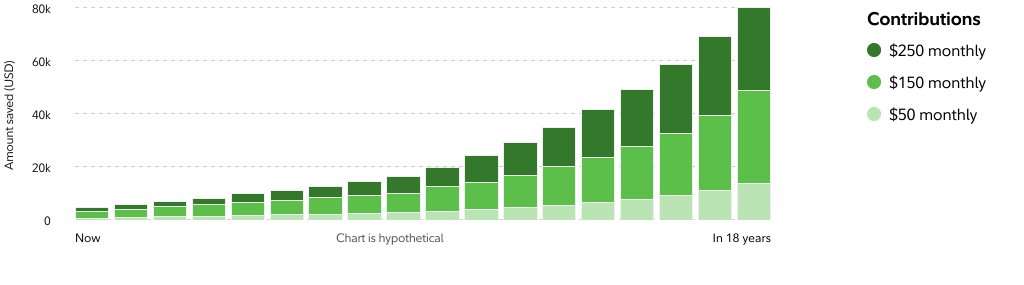
Saving a little over time can go a long way
Recurring contributions can potentially help your money grow—and reduce the amount of student loans borrowed.*
Investing options
Fidelity-managed 529 plans offer an age-based portfolio, which automatically becomes more conservative as the beneficiary nears 18, and a customized option that lets you pick the investment strategy.
The gift of education.
Your Fidelity gifting page lets friends and family easily contribute to your 529 account.
Learn

Explore the latest ways to save and pay for a child’s education with a 529 Plan
Learn how a 529 can help you reach your educational savings goals at any stage of your journey.

529 plans: The tax-smart way to help save for college
The money moves to help you reach your education goals.

The ABCs of 529 savings plans
Learn ways to explore investment options and potential tax advantages.


Frequently asked questions
Should I open a 529 account offered by the state I live in, or another state?
You can open a 529 account offered by any state. Be sure to consider your own state’s plan as it may have additional benefits, including state tax advantages. No matter what state your child will attend school in, you can use a 529 account to pay for qualified education expenses at eligible institutions nationwide.
What if my child doesn’t go to college, or there’s money left in the 529 account after they graduate?
You have a few options. You can change the 529 account beneficiary to an eligible family member for their qualified education expenses. Or, you may be eligible to transfer assets from the 529 to a Roth IRA in the beneficiary’s name, under certain conditions.2 Finally, you can take a non-qualified withdrawal. Only the portion of the non-qualified withdrawal attributed to investment earnings will be subject to federal and state income taxes, plus a 10% federal penalty.
410286.46.0