


You've contributed to an IRA (or another type of retirement account)—congratulations. The next step is to invest that money—and give it the potential to grow. Fidelity believes one of the best ways to do that over the long term is by considering an appropriate amount to invest in a diversified portfolio of stock mutual funds, exchange-traded funds (ETFs), or individual stocks as you plan and implement an investment strategy that fits your time horizon, risk preferences, and financial circumstances.
While this article references IRAs, the same investment principles apply to other retirement accounts—including those designed for small business owners and freelancers.
As a general rule, the more time you have to save, the greater the percentage of your money you can consider allocating to stocks. For those closer to retirement, a healthy allocation to stocks may still be appropriate. These days retirement may last for decades, so the money will likely still need to grow for many years even after you retire.
It's important that the stock exposure you select matches your comfort with risk, your investment timeframe, and your financial situation.
How risk tolerance affects the amount allocated to stock
With creating your asset mix, you should feel comfortable that the ups and downs of the stock market won't undermine your ability to reach your long-term goals. That way you'll be less likely to panic and sell when stocks fall—because doing so can lock in losses and could make it harder to recover and reach your goals.
How much risk do you feel comfortable with? Take a look at the worst case market scenarios for the 4 different investment mixes shown. During the worst market year since 1926, the conservative portfolio would have lost the least—17.67%, while the aggressive portfolio would have lost the most—60.78%. The chart also shows how each investment mix performed over a long period of time, in different markets. The average return: 5.78% for the conservative vs. 9.62% for the aggressive mix.
Choose an investment mix you are comfortable with
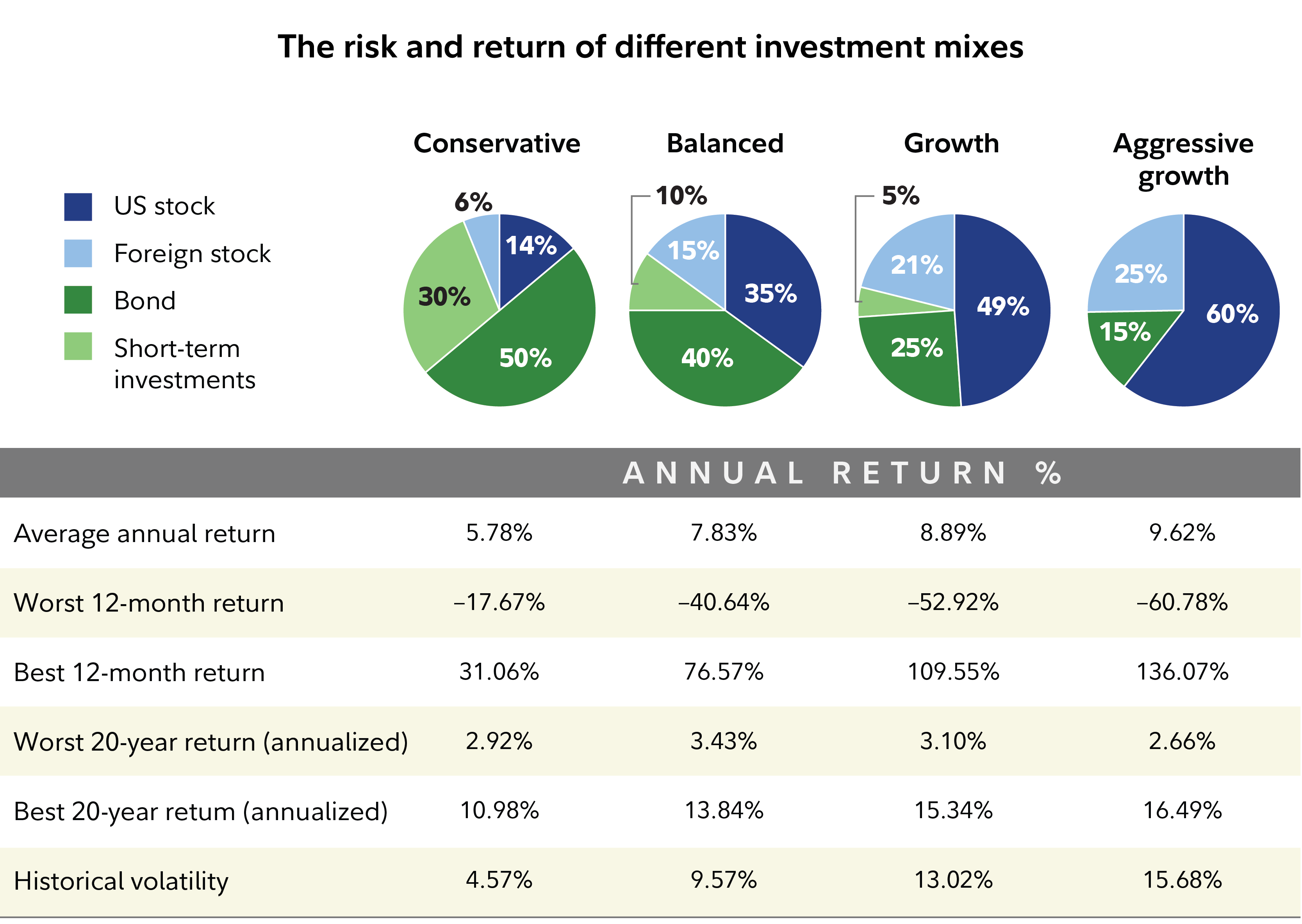
Past performance is no guarantee of future results. Returns include the reinvestment of dividends and other earnings. This chart is for illustrative purposes only. It is not possible to invest directly in an index. Time periods for best and worst returns are based on calendar year. The purpose of the target asset mixes is to show how target asset mixes may be created with different risk and return characteristics to help meet an investor's goals. You should choose your own investments based on your particular objectives and situation. Remember, you may change how your account is invested. Be sure to review your decisions periodically to make sure they are still consistent with your goals. The rates of return used in this example are not guaranteed.
Data Source: Fidelity Investments and Morningstar Inc. Hypothetical value of assets held in untaxed portfolios invested in US stocks, foreign stocks, bonds, or short-term investments. Historical returns and volatility of the stock, bond, and short-term asset classes are based on the historical performance data of various unmanaged indexes from 1926 through the latest year-end (2025) data available from Morningstar. US stocks represented by IA SBBI US Large Stock TR USD Ext Jan 1926-Jan 1987, then by Dow Jones US Total Market data starting Feb 1987 to Present. Foreign stocks represented by IA SBBI US Large Stock TR USD Ext Jan 1926–Dec 1969, MSCI EAFE Jan 1970-Nov 2000, then MSCI ACWI Ex USA GR USD Dec 2000 to Present. Bonds represented by US Intermediate-Term Government Bond Index Jan 1926–Dec 1975, then Barclays Aggregate Bond Jan 1976 - Present. Short-term/cash represented by 30-day US Treasury bills beginning in Jan 1926 to Present.
1253713.1.0
How age affects how much to invest in stocks
Age can also be used as an initial guideline when determining how much to invest in stocks when you're investing for retirement. That's because the longer the money will be invested, the more time there is to ride out any market ups and downs. That could help realize the potential for growth in your investments, which may be an important factor in saving enough for retirement. In general, the younger you are, the heavier your investment mix could tilt toward stock—as much as you are comfortable with and fits with your time horizon, risk preferences, and financial circumstances.
All else being equal, as you get closer to retirement, you may want to adjust your allocation. Being too aggressive could be risky as you have less time to recover from a market downturn. As a general rule, in the absence of changes to risk tolerance or financial situation, one's asset mix should become progressively more conservative as the investment horizon shortens. However, investing too conservatively could limit the growth potential of your money. So, it may make sense to gradually reduce the percentage of stocks in your portfolio, while increasing investments in bonds and short-term investments.
But don't forget that growth remains important even as you approach and then enter retirement—after all, your retirement could last 3 decades or more. But with retirement nearer, investors must balance that need for growth against the need to protect what they have saved.
To learn more about building an asset mix that fits you, read Viewpoints on Fidelity.com: How to start investing
How financial situation can affect how much to invest in stocks
If your goal is retirement in 20 years, your ability to take risk in a retirement account would be higher than in the account you use to pay your monthly bills. Your retirement account has time to recover from setbacks, and any immediate losses could be recovered. In your bill-paying account, a loss could very well jeopardize your ability to pay rent next month.
If the outlook for your financial situation seems uncertain, it can make sense to have a relatively lower allocation to stocks.
What kind of investor are you?
Don't have the time, expertise, or interest it would take to choose investments and maintain an appropriate mix of investments in your IRA? Consider a professionally managed target date or asset allocation fund.
Target date funds let an investor pick the fund with the target year closest to their expected retirement. The target date fund manager then selects, monitors, and adjusts the investment mix over time. Asset allocation funds can be another simple way to diversify your portfolio using a single fund. In these funds, the manager sets and maintains a fixed asset mix.
For those doing it on their own, a diversified mix of investments is important. That way, a portfolio isn't dependent on any one type of investment, although diversification does not ensure a profit or guarantee against loss. If you want to do it yourself, consider funds that hold a mix of investments in companies both big and small, from different parts of the world, and in different industries and sectors.
Low-fee investments that simply track the broad market through a benchmark index, may also be worth considering.
Get started
When saving for something really big, like retirement, it's important to get invested as soon as possible. That's because time is one of your biggest assets when investing for the long term.
Here are 3 ways to help get started when investing in an IRA.
- Use our tools. Get an analysis of your current portfolio, assess your financial situation, and find ideas to help you create an appropriate investment strategy in our Planning & Guidance Center.
- Choose investments. For those who want to invest in mutual funds or ETFs, there are a number of ways to choose. - Search and compare funds with Mutual Funds Research. - Get ideas with Fund Picks from Fidelity®. - Search and compare ETFs.
- Let someone else do the work. For those who prefer to have an investment professional manage an IRA, learn about Fidelity® managed accounts.
Put your money to work
Across most investment time frames, investing for growth matters. The potential for growth in your investment mix can be vital to helping you save enough to live the life you want in retirement. Ultimately, the appropriate asset mix is one you can live with—one that reflects your risk tolerance, investment horizon, and financial situation.