


When you invest, one consideration is how easily you can get your money back. Some assets—things of value that can help you make or grow money—can be turned into cash quickly at their current price, while others take longer to sell or require giving something up (like accepting a lower price). This idea is called liquidity.
Here's a quick rundown, including examples, for you to better understand why liquidity is important for your finances.
What is liquidity?
Liquidity is how easily something can be turned into cash, or cash equivalents. Cash is the benchmark for liquidity because it’s already money you can use right away, without needing to convert it. Other things—like investments or valuable items—usually need to be sold first to get cash. If an asset can be sold easily and quickly, it is considered more liquid compared to assets that are harder to buy or sell, since liquidity exists on a spectrum rather than as a binary value.
This explanation reflects how liquidity is used in investing. Banks and businesses use the term a bit differently, which is explained later.
How does liquidity work?
Liquidity is a function of supply and demand. If there are plenty of buyers, selling is often easier. If there aren’t many buyers, it may take longer to sell or require accepting a lower price. Liquidity reflects how easy it is for buyers and sellers to connect in a market. When there are lots of people buying and selling, trades happen more quickly and closer to the prevailing price.
Timing matters too. When someone needs to sell quickly—especially in a market where fewer buyers are available—they may not end up being able to transact at the current market price. Although rare, periods of market disruption can make even typically liquid investments harder to sell quickly.
Although many investments are liquid due to active market demand, certain investments, including private alternative investments, may have lock-up periods that restrict when they can be sold, making them less liquid.
Examples of liquid assets
Liquid assets can be turned into cash quickly, usually within a day or two.
- Cash and bank accounts: Physical cash, checking and savings accounts, and money market funds are highly liquid because they can be accessed quickly. Some products—like certificates of deposit (CDs) —are less liquid because they may limit withdrawals or charge fees for early access.
- Stocks: Shares of publicly traded companies are generally considered liquid because they can often be bought or sold during market hours. However, liquidity varies widely. Stocks of large, frequently traded companies are typically easier to sell quickly at a price close to the current market price. By contrast, thinly traded stocks, including some small-cap, penny, and over-the-counter (OTC) stocks, may take longer to sell, may require accepting a lower price, or may be difficult or impossible to sell at a desired time if there are few or no willing buyers.
- Treasury securities: US Treasurys are widely traded and usually easy to buy and sell, making them relatively liquid compared to many other investments.
- ETFs : These are generally liquid and can be bought and sold throughout the trading day, like individual stocks. Their liquidity can vary based on trading activity, both in the ETF itself and in its underlying holdings, which may lead to differences in bid-ask spreads and execution prices.
- Mutual funds : These are also considered liquid, but they work a bit differently. You can place a buy or sell order for a mutual fund at any time during the trading day, but the trade won't be processed until after the market closes. All trades that day are completed at the fund's end-of-day price, called its net asset value (NAV). Everyone who makes a trade that day gets the same price, so the buying and selling process is consistent and doesn’t change throughout the day like it can with ETFs.
Keep in mind that being able to sell quickly doesn’t mean you’ll get back what you originally invested. Prices can fall, and if your money is in a less liquid asset or the market is in distress, needing to sell in a hurry may mean accepting a lower price than the estimated market price.
Examples of illiquid assets
Illiquid assets are harder to turn into cash and often take more time, effort, or price negotiation to sell.
- Real estate: Selling a home or property can take weeks or months and usually involves finding a buyer, inspections, paperwork, and financing.
- Private alternative investments: This category can include private equity, private credit, and private real assets. They generally aren't traded on public markets, are often designed for long-term holding periods, and early withdrawals may be restricted.
- Collectibles: Items like artwork, antiques, or rare coins depend on finding a willing buyer, which can be unpredictable.
Types of liquidity
The meaning of liquidity—and why it matters—can vary depending on the type of market or industry you’re looking at.
What is liquidity in investments?
Investments that trade on public markets, like stocks or ETFs, are usually easier to sell because exchanges connect many buyers and sellers. For example, you can typically sell shares of a large, widely traded company quickly during market hours because there are many buyers in the market, including market makers whose role is to provide liquidity by continuously buying and selling shares.
Other assets can take longer to sell. For example, real estate requires finding a buyer and completing paperwork, which can take time. Alternative investments—such as private real assets or private equity—may be even harder to access quickly because fewer buyers are available or there are rules about when you can withdraw your money.
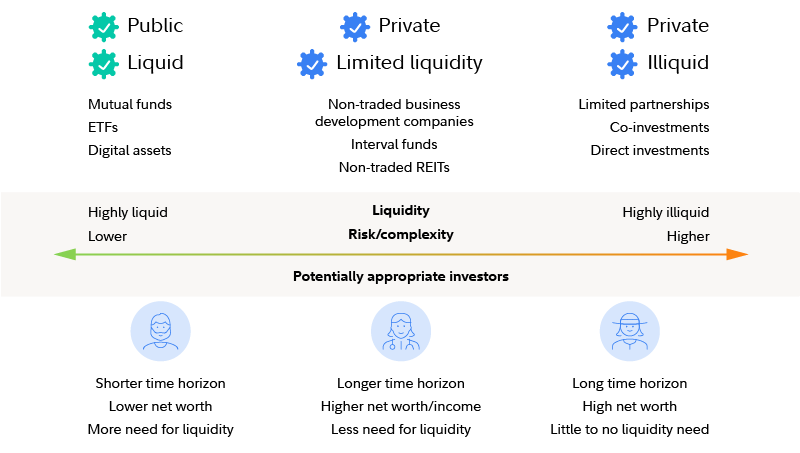
What is liquidity in trading?
In trading, liquidity is about how easy it is to buy or sell something without pushing the price up or down too much. Markets with lots of activity usually allow trades to happen quickly and with smaller price changes. Markets with fewer buyers and sellers can be less predictable, and prices may move more when trades occur.
What is liquidity in stocks?
Shares of large, well-known companies usually trade more often, which can make them easier to sell. Stocks of smaller companies, including many penny stocks, may trade less frequently, so selling them can take longer or you may not be able to transact at the current market price.
What is liquidity in crypto?
In crypto, liquidity can be very different from one coin to another. Well-known cryptocurrencies like Bitcoin and Ethereum usually have more buyers and sellers, which can make them easier to trade. Smaller market cap, less popular coins have fewer people interested in them, so they can be harder to buy or sell. In some cases, a coin may stop being traded altogether.
What is liquidity in business?
In a business context, liquidity is about whether a company has enough cash, or assets that can quickly become cash, to pay its short-term bills. Companies that are liquid usually have money available to cover everyday costs like rent, payroll, and supplies. Companies with low liquidity may not have enough cash on hand to cover these expenses and can make it harder to handle surprise expenses or slow periods.
What is liquidity in banking?
In banking, liquidity is about whether a bank has enough cash available to handle customer withdrawals and pay its short-term expenses. Banks often accept deposits that customers can access at any time, while using that money to make loans that are paid back over longer periods.
Because these inflows and outflows don’t happen on the same schedule, banks must plan carefully to make sure cash is available when customers need it. If a bank faces sudden cash demands, it will typically borrow from other institutions or the Federal Reserve. However, if a bank ultimately fails due to severe liquidity issues, government programs like FDIC insurance protect depositors up to legal limits.
How do you measure liquidity?
Liquidity can be measured in different ways depending on whether you’re focusing on a company or on how investments trade in the market.
- Bid‑ask spread: In financial markets, liquidity can be measured by the bid‑ask spread —the gap between what buyers are willing to pay and what sellers are asking. Smaller gaps usually mean the asset is easier to trade, while larger gaps suggest fewer buyers and/or sellers and less trades.
- Trading volume: This shows how often something is bought and sold. When trading happens more often, it’s usually easier to make a trade.
- Current ratio: This measures a company’s ability to pay short-term obligations (current liabilities) using its short-term resources (current assets).
- Quick ratio: This looks only at cash and money coming in soon, leaving out inventory. It helps show whether a company could pay near-term bills without selling products.
- Cash ratio: This focuses just on cash and very short-term investments compared to upcoming debts. It shows how much a company could pay right away using cash alone.
Why is liquidity important?
- Helps with flexibility and day-to-day needs: Liquidity makes it easier to manage your money, handle unexpected expenses, and rebalance your portfolio when needed.
- Supports risk management: In slower markets, less liquid assets can be harder to sell, sometimes requiring you to wait or accept a lower price. Having liquid assets like cash can reduce the need to sell under pressure.
- Involves tradeoffs: Less liquid investments may offer higher potential returns, but your money can be tied up longer.
- Encourages balance: Many people keep a mix—some money in liquid assets for short-term needs and other investments for long-term goals.