


There often comes a moment when retirement starts to look more appealing than another year of work. That's when many people begin asking: When can I retire?
The answer depends on more than your age or account balance. Financial readiness generally means having a reasonable plan to cover your expected expenses without relying on a regular paycheck. Your savings matter, but so do your spending needs, Social Security and other income sources, health care costs, and the number of years your retirement may last.
Looking at the full picture can help you identify a retirement date that feels both realistic and comfortable. You may even find you’re closer than you think.
When can you retire?
No single age determines when you’re ready to retire. But several age-based milestones can affect when you can access retirement savings, qualify for Medicare, and receive Social Security benefits.
Age 55: If you leave your job during or after the year you turn 55, you may be able to take withdrawals from that employer’s 401(k) or 403(b) without paying the additional 10% federal tax, depending on the plan’s rules. Read Viewpoints: What is the Rule of 55?
Age 59½: Generally, you can begin taking withdrawals from IRAs and workplace retirement plans, such as 401(k)s and 403(b)s, without the early withdrawal penalty. Income taxes may still apply.
Age 62: If you’re eligible for Social Security retirement benefits, this is generally the earliest age you can claim them. But claiming before your full retirement age will permanently reduce your monthly benefit.
Age 65: Most people become eligible for Medicare, which can significantly change how they plan and pay for health care in retirement.
Full retirement age, 66 to 67: This is when you’re eligible to receive your full Social Security retirement benefit. Your full retirement age depends on the year you were born. For people born in 1960 or later, it’s 67.
Age 70: Delayed retirement credits stop accumulating. If you haven’t claimed Social Security retirement benefits by then, waiting longer won’t increase your benefit further.
What factors determine when you can retire?
When you may be able to retire generally depends on 4 things:
- What your retirement lifestyle may cost
- How much guaranteed income you expect
- How much income your savings may need to provide
- How long your plan may need to last
Looking at these factors together can give you a clearer picture of when retirement may be possible and what changes could help bring your preferred date within reach.
A helpful starting point is to estimate your retirement spending, subtract your guaranteed income from Social Security, pensions, or annuities, and determine how much your savings may need to provide.
7 signs you may be ready to retire
No single sign can determine whether you’re ready to retire. But together, these 7 signs can help you assess your progress and identify any gaps in your plan.
1. You have estimated what retirement will actually cost
Many workers assume they'll need to replace most or all of their current income in retirement. But your expenses may look very different once you stop working.
For example, you may no longer be:
- Saving for retirement each paycheck
- Paying payroll taxes
- Covering commuting costs
- Spending as much on work-related expenses
At the same time, some costs may remain the same or even increase. You may spend more on travel, hobbies, health care, or other priorities, particularly during the early years of retirement.
That’s why it’s helpful to estimate your future spending rather than simply assume you’ll need the same income you earn today. Review your current expenses and sort them into 3 groups: those likely to decrease, those likely to stay about the same, and those that could increase in retirement.
If your expected retirement expenses are lower than your current income, your plan may not need to replace your full paycheck. That could mean retirement is more affordable than you assumed.
One starting point is the 80% rule, which suggests planning to spend about 80% of your pre-retirement income in retirement. But your actual needs will depend on your lifestyle, housing costs, health care needs, and other circumstances.
Read Viewpoints: How much will you spend in retirement?
2. Your essential expenses will be manageable without a paycheck
Housing, debt payments, and other fixed expenses can take up a significant share of a household budget. The lower these costs are in retirement, the less income your plan may need to provide each month.
Consider 2 couples retiring with the same amount of savings and identical homes. Their property taxes, homeowners insurance, maintenance costs, and other expenses are also the same. The only difference is their mortgage:
- Couple 1 owns its home outright.
- Couple 2 still owes $200,000 on a mortgage with a 6% interest rate and 15 years remaining.
Couple 2’s monthly principal-and-interest payment would be about $1,688, or roughly $20,250 a year.1 That means its retirement plan would need to provide about $20,250 more in annual income to support an otherwise identical lifestyle.
Of course, owning a home outright doesn’t eliminate housing expenses. Property taxes, insurance, repairs, maintenance, and homeowners association fees may continue. And paying off a mortgage before retirement may not always be the best use of available cash, particularly if doing so would significantly reduce your emergency savings or retirement assets.
A mortgage isn’t the only essential expense to consider. Rent, recurring debts, and other required payments can also affect how much income you’ll need. Review which obligations are likely to continue into retirement and whether any could be paid down, refinanced, or otherwise reduced.
If your housing costs and other fixed expenses will fit comfortably within your expected income, that may be a sign that retirement is becoming more affordable.
Read on Learn: How to pay off your mortgage early
3. Your investments are doing more of the work
Early in your career, your contributions may be the primary driver of your retirement savings. But, assuming your balance grows, potential investment earnings can begin playing a larger role.
That can be an encouraging sign of progress, but investment growth alone doesn’t determine whether you’re ready to retire. Markets don’t move in a straight line, future returns aren’t guaranteed, and losses early in retirement can be especially difficult if you’re also withdrawing money from your portfolio.
As your preferred retirement date approaches, consider reviewing:
- Whether your investment mix still reflects your goals, time frame, and comfort with risk
- What your withdrawal rate will be, how and when you plan to withdraw money, and how flexible your strategy may need to be
- Whether your plan works with more modest returns or market losses
- How you plan to cover essential expenses, so you aren’t relying on selling investments during a downturn (note that Fidelity suggests covering essential retirement expenses with guaranteed income, such as Social Security, pensions, or annuities)
If your savings can support the withdrawals you expect to need under a range of market conditions, that may be a more meaningful sign of retirement readiness than recent investment performance alone.
4. Your plan works with less income from work—or none at all
Retirement doesn't have to mean never earning a paycheck again. More than half of Americans plan to ease into retirement by continuing to work in some capacity, according to a recent Fidelity study.2
Some retirees choose to consult, work seasonally, freelance, or pursue part-time opportunities that provide both income and flexibility—an arrangement that’s sometimes called semi-retirement.
Even modest earnings can reduce the amount you need to withdraw from savings. They may also help you bridge the years until you claim Social Security, become eligible for Medicare, or can access certain retirement accounts without the additional 10% federal tax.
But work may not always go according to plan. Your health, caregiving responsibilities, or job opportunities could change. Consider testing your retirement plan with the income you expect to earn, as well as with less income or none at all.
If part-time work gives you more flexibility without being essential to covering your basic expenses, that may be a sign your retirement plan is on solid footing.
Read Viewpoints: Phasing into retirement: 5 key steps
One caveat: If you claim Social Security before full retirement age but continue to work, earnings above the annual limit may temporarily reduce your benefits.
5. You know how you’ll cover health care
Health care can be one of the biggest unknowns in retirement, particularly if you plan to retire before becoming eligible for Medicare at 65.
If you’re retiring before 65, identify where your coverage could come from and estimate both premiums and out-of-pocket costs. Options may include coverage through a spouse’s employer, COBRA, or an individual health insurance plan.
You’ll also want to plan for costs after Medicare eligibility begins. Medicare doesn’t cover every expense, and premiums, deductibles, supplemental coverage, prescription drugs, and other out-of-pocket costs can add up.
A health savings account (HSA) can help eligible savers prepare by providing a tax-advantaged way to save for qualified medical expenses. But an HSA is only one part of the picture. Build estimated health care costs into your retirement budget and consider how you would manage higher-than-expected expenses.
If you know where your coverage will come from and have accounted for its potential cost, you’ve addressed one of the biggest variables in determining when you can retire.
Read Viewpoints: 4 retirement health care decisions to get right
6. You know how much income your portfolio must provide
Retirement income may come from several places. Social Security, pensions, and annuities can help cover some of your expenses. Your savings and investments may need to cover the rest.
To estimate how much your portfolio may need to provide:
- Add up your expected spending. Include both essential and discretionary expenses.
- Subtract guaranteed income. This may include Social Security, a pension, or guaranteed income from an annuity. You can check your Social Security statement to find out the benefit you’ve earned through your career.
- Find the gap. The amount left may need to come from withdrawals from your portfolio.
At Fidelity, we believe it can be a good idea to cover essential expenses in retirement with guaranteed income. That can help provide flexibility around the withdrawals that may need to come from savings or investments.
In this example, $2,500 from Social Security and $1,500 from a pension cover $4,000 of the retiree’s $6,000 in monthly spending. That leaves a $2,000 monthly income gap, or $24,000 a year, that may need to come from savings and investments.
Does your income cover your spending?
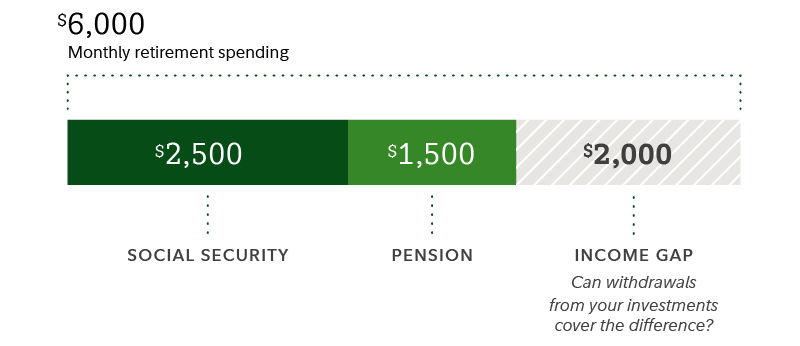
Knowing the size of the gap is an important first step. Next, consider whether your savings can sustainably provide that income. The answer may depend on:
- When you retire
- How much you have saved
- How your savings are invested
- How much you withdraw each year
- How markets perform
- How long your retirement lasts
Your income gap may also change over time. Part-time earnings may end, Social Security or pension benefits may begin, or a mortgage may be paid off. Inflation could increase your expenses, and taxes can affect how much of your income is available to spend. Withdrawals from traditional retirement accounts are generally taxable, while other income sources may receive different tax treatment. It’s best to consult a tax professional regarding your situation.
Read Viewpoints: 6 retirement tax moves most people miss
A retirement plan can help you estimate how much you may need to save to fill the gap while accounting for taxes, inflation, market returns, and how long your retirement may last. Use our free retirement planning tools to estimate how much you may need and explore ways to improve your strategy.
7. You’ve tested your plan against the unexpected
Planning for retirement can help you determine whether your money may support the retirement date you have in mind.
Start by separating essential expenses, such as housing, food, health care, and taxes, from discretionary expenses you could adjust if needed. Consider using lifetime guaranteed income from sources such as Social Security, pensions, or income annuities to help cover essentials, with savings and portfolio withdrawals covering more flexible expenses.
Then estimate a sustainable withdrawal rate. As a starting point, Fidelity suggests withdrawing roughly 4%-5% of your savings in the first year of retirement, then adjusting that dollar amount annually for inflation. The rate that may be appropriate for you will depend on factors such as your retirement age, investment mix, and how long your retirement may last. People who retire early may want to consider a lower starting rate.
Finally, put your plan through a few potential scenarios. Consider what would happen if:
- Markets declined early in your retirement
- Inflation or health care costs were higher than expected
- Part-time work ended sooner than planned
- A major unexpected expense arose
- Your retirement lasted longer than anticipated
Fidelity’s Retirement Income Calculator can help illustrate how retirement expenses may be covered by a combination of guaranteed income sources and withdrawals from savings and investments. The tool can also show how changes to your plan, such as delaying retirement, adjusting spending, or increasing guaranteed income, may affect the amount you need to withdraw from your portfolio.
Read Viewpoints: The 5-step financial health test to take now
The bottom line on when you can retire
No single age or savings balance determines when you can retire. A more useful test is whether your expected income and savings can cover your spending, taxes, and health care for as long as your retirement may last.
Start by estimating your expenses, subtracting guaranteed income, and determining the gap your savings may need to fill. Then test your plan at several retirement ages and under less favorable conditions.
You may find that retiring sooner is possible or identify a few targeted changes that could bring your preferred date within reach.