


The coming year brings with it new challenges and opportunities to build your tax plan.
The good news is that since major tax legislation known as the One Big Beautiful Bill Act (OBBBA) was passed in 2025—and with mixed party control across the federal government at least until 2029—another big tax overhaul isn’t expected in the next 2 years or longer. This could provide a measure of stability and certainty as you think about taxes in the near term.
Further out, however, the picture may look less clear. No one knows what policymakers may do and how tax policy may change to adjust to a fiscal picture that includes record levels of federal debt and deficits, climbing interest expense, and questions around entitlement spending. Many taxpayers may be concerned about the possibility of tax increases in the future to help finance the federal debt and may wonder if they should make moves today to help with their tax bills many years down the line.
As a result, tax planning may require balancing what we know today with what we don’t know tomorrow. Here are some ideas for building a flexible tax plan for 2027 and beyond.
Tax planning opportunities for 2027
Tax policy is not expected to change much in the immediate future, so it may make sense to focus on what’s known.
1. Make use of temporary tax breaks today
Several provisions in the 2025 tax law will expire in the next few years. If you can, and it makes sense for your individual financial situation, consider taking advantage of them now to help reduce your taxable income.
“We don’t know what the future holds for tax policy,” says Andrew Bachman, a director of Financial Solutions at Fidelity. “During this time, it might make sense to lean into the temporary provisions.”
- A higher state and local tax (SALT) deduction: Recent tax legislation quadrupled the state and local tax (SALT) deduction cap to $40,400 for the 2026 tax year and $40,804 in the 2027 tax year for single and joint filers. The cap will increase 1% per year through tax-year 2029.
There are several caveats, however: The full deduction phases out for filers with modified adjusted gross income (MAGI) above $505,000 ($252,500 in the case of a married individual filing separately) for tax-year 2026, and reverts to $10,000 for MAGI of $606,333 and above ($303,166 in the case of married filing separately).
While the deduction and the phase-out levels will also increase by 1% a year, these changes are in effect only through 2029, after which point the cap reverts to $10,000. For married couples who file separately, the deduction increases to $20,200 in 2026 and returns to its previous level of $5,000 in 2030. (See footnote below for 2027 SALT deduction MAGI phaseout thresholds.)1
Although the larger deduction may have the biggest impact on higher earners in high-tax states, itemizing could also open the door to other deductions and credits. Among them: deductions for charitable contributions above a 0.5% adjusted gross income floor,2 mortgage interest, theft and casualty losses if you live in a designated natural disaster area,3 and unreimbursed medical expenses that exceed 7.5% of your adjusted gross income (AGI).
Good to know: Starting in 2026, the value of itemized deductions for those in the 37% tax bracket will be capped at 35%, or approximately 35 cents for every dollar they deduct.
- Additional senior deduction: If you’re 65 or older, you may be eligible for a temporary senior deduction of $6,000. This additional senior deduction is good for tax years 2025 through 2028, and you don’t need to itemize to qualify for it. However, the deduction begins to phase out at a modified adjusted gross income (MAGI) of $75,000 for single filers, and $150,000 for married joint filers.
The additional senior deduction can be used with the existing standard deduction normally available to people who are 65 and older.4
Other temporary tax provisions that may apply to you:
- No taxes on tips or overtime. The OBBBA created 2 new deductions: a deduction of up to $25,000 of tipped income and a deduction of $12,500 of overtime income ($25,000 for joint filers). The deductions begin to phase out for single filers with income over $150,000 and $300,000 for joint filers.
- Deductible car loan interest. The new law allows for a deduction of up to $10,000 of loan interest for purchased vehicles whose final assembly took place in the US. The deduction begins to phase out for single taxpayers with MAGI greater than $100,000 (greater than $200,000 for people who are married filing jointly).
- Contributions to new savings accounts for children. The legislation includes a savings account called the Trump Account, generally fundable up to $5,000 a year, treated similarly to a nondeductible traditional IRA contribution for parents or other individuals. Generally speaking, contributions can be made by parents, relatives, and other eligible donors, until the year the child turns age 18 at which point the account effectively converts to a traditional IRA. Although these accounts are not a temporary provision, parents of children born between January 1, 2025 and December 31, 2028 can qualify for $1,000 in federal seed money to start the account during this window. Good to know: Once the account is held as a traditional IRA it would become eligible for a Roth conversion, which could be a useful long-term strategy, potentially allowing the balance to grow tax-free.
2. Continue to make the most of tax-advantaged accounts now
For people still earning a paycheck, continuing to add to workplace and other retirement accounts can help reduce taxable income. Increasing tax-deferred savings now can make sense, particularly if you expect to be in a lower tax bracket when you stop working and begin drawing on these assets.
- For the 2026 tax year, you can contribute up to $24,500 in total combined traditional and Roth contributions to a 401(k) workplace retirement plan. If you're 50 or over, you can make additional catch-up contributions.5
- Health savings accounts (HSAs) are another way to save additional money if you have a high-deductible health plan. Contributions can help to lower your taxable income, any earnings grow tax-free, and distributions are tax-free if they are used for qualified medical expenses.
- HSA contribution limits for 2026 are $4,400 ($4,500 in 2027) for self-only coverage and $8,750 ($9,000 in 2027) for family coverage. Those 55 and older who are not enrolled in Medicare can contribute an additional $1,000 as a catch-up contribution.
3. Estate planning considerations for 2027 taxes
For 2027, remember recent tax legislation increased the lifetime gift and estate tax exemption to $15.48 million per person ($30.96 million per couple).
While the lifetime exemption is now permanently higher (absent any future legislation), gifting using the federal annual gift tax exclusion can still be an important part of your strategy. For 2026, the annual exclusion is $19,000 per person ($20,000 in 2027) and $38,000 ($40,000 in 2027) per married couple using gift splitting, to an unlimited number of individuals without incurring federal gift tax liability or affecting your lifetime exemption amount.
Even with the higher lifetime exemption, you may want to consider what assets to use when gifting. “For example, it's important to remember that assets gifted during life generally get carryover basis,” says Catherine Neijstrom, vice president, financial and trust planning lead at Fidelity. So it’s important to consider whether it might be a tax advantage to pass an asset at death to potentially receive the stepped-up basis, rather than during life.
One caveat for 2027 and beyond: “Most people are focused on the federal estate tax, but some states also have estate taxes or inheritance taxes,” Neijstrom says, adding that state estate tax thresholds can be much lower than the federal amount.
For the long-term: Consider tax diversification
One of the challenges for longer-term tax planning is you don’t know what type of environment you’ll be in, which can be of particular concern for people on the verge of retirement.
For those who are worried about higher rates down the road, creating a plan that maximizes tax diversification could help navigate an uncertain future. Tax diversification is a way to maximize your tax flexibility by having multiple kinds of accounts such as tax-deferred, tax-free, and taxable accounts. Rather than concentrating your assets in too few buckets, it can help you prepare for multiple tax outcomes.
“The more tax diversification you have, the more options you may have to adjust your portfolio,” Bachman says. “This is a risk-mitigation strategy.”
4. How to create tax diversification
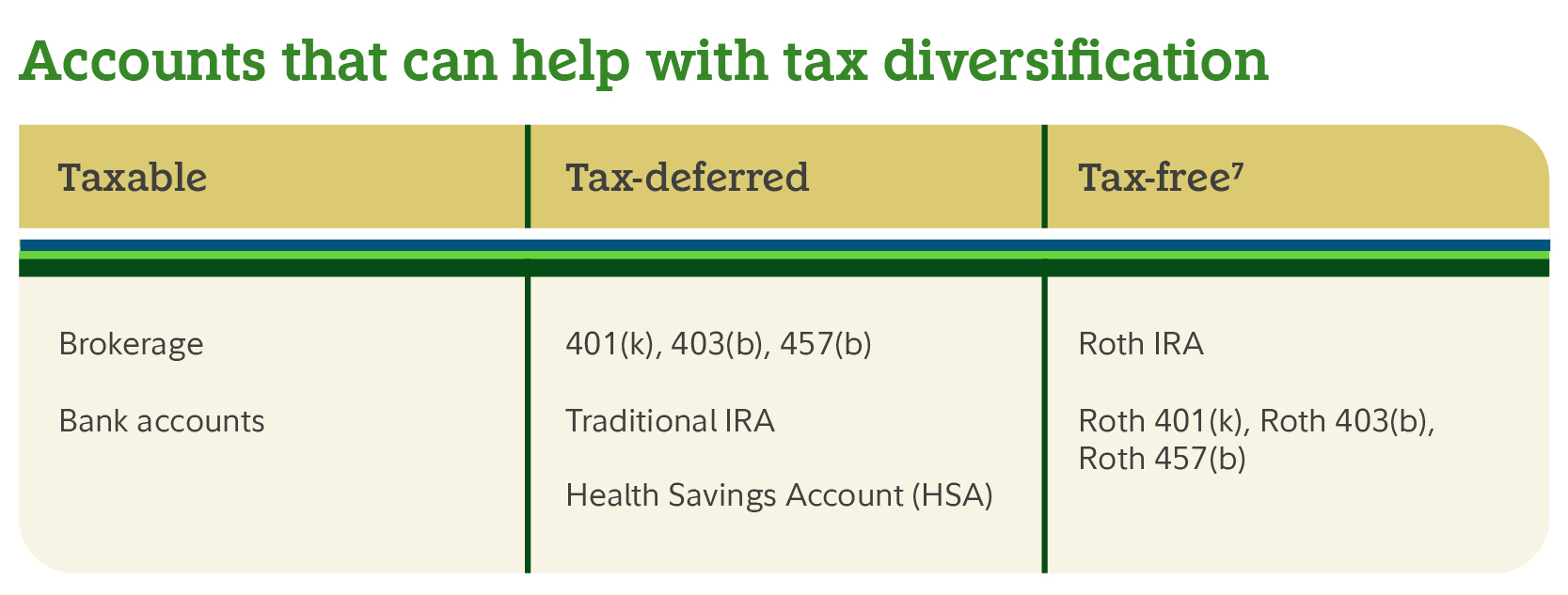
Tax diversification can include building assets across:
- Tax-deferred accounts such as workplace 401(k) and traditional IRAs
- Tax-free6 accounts such as Roth IRAs and workplace Roths
- Taxable brokerage accounts
If tax rates move higher, you could potentially consider withdrawing more from Roth assets. If tax rates stay where they are or move lower, withdrawals from pre-tax or taxable accounts could make more sense.
For a Roth IRA distribution to be considered qualified, the 5-year aging requirement has to be satisfied, and you must be age 59½ or older or meet one of several exemptions (disability, qualified first-time home purchase, or death among them).
HSA withdrawals are tax-free for qualified medical expenses, with respect to federal taxation only. Contributions, investment earnings, and distributions may or may not be subject to state taxation. A penalty may apply for withdrawals for non-medical expenses prior to age 65.
5. Consider a Roth conversion
You could think of a Roth conversion as a hedge for your tax plan that can help you diversify your retirement savings.
For example, if you’ve been an aggressive saver and have accumulated a lot in a traditional account and therefore expect larger taxable withdrawals in retirement when required minimum distributions (RMDs) begin, you might want to consider a Roth conversion sooner rather than later. Over time, you can potentially achieve a more tax-diverse mix by shifting some funds into a Roth where withdrawals are tax-free.
Converted amounts are generally taxed as ordinary income, but once inside a Roth account any earnings can potentially accumulate tax-free, and contributions can be withdrawn at any time tax- and penalty-free. Unlike a traditional IRA, the assets do not have RMD requirements. Note: the 5-year aging rule applies.
Even if you’re expecting to be in a lower income tax bracket in retirement due to something Fidelity calls the retirement income valley, you may want to consider a Roth conversion to help build assets free from taxes later on. Charitable contributions may be an option to offset Roth conversion income.
6. A potential role for annuities
And if you’re seeking additional diversification options, you might consider a tax-deferred annuity which, as its name implies, can help you grow retirement savings on a tax-deferred basis. You might consider one after you've maxed out contributions for the year to qualified plans such as 401(k)s and IRAs. Unlike these accounts, annuities aren't subject to annual IRS contribution limits.
“If you’re unable to adequately get diversified using a brokerage and tax-advantaged accounts, a tax-deferred annuity might be a good option for you,” Bachman says.
Balancing today’s tax benefits with future tax flexibility
Although tax policy is likely to continue evolving in the future, it doesn’t mean higher tax rates are certain. Policymakers have other tools at their disposal to raise revenue, especially given how unpopular tax increases can be. That’s why Fidelity suggests continuing to save in tax-deferred accounts during higher-income working years. However, if you’re personally worried about tax rates rising in the coming years, tax diversification can be a useful middle-ground strategy that can help you stay financially flexible.
Get your plan together for 2027
Remember, it’s always best to talk to a financial professional who can help you come up with a plan that’s best suited to your financial situation. The new year and the years ahead will present many new challenges and opportunities, plus a renewed chance to invest in your financial future and peace of mind with the right tax strategy for you.