


Anyone who’s bought a home in the past few years has probably been holding their breath waiting for interest rates to fall.
After the sub-3% mortgage rates of the COVID era, the 6% to 7% rates of recent years have been a tough pill for homebuyers to swallow.
But with mortgage rates gradually retreating from their peaks as the Fed has cut rates, those who have recently bought homes may be wondering whether rates have fallen enough to make refinancing worth it.
Here’s a closer look at the main factors that go into this, and a few quick guidelines to consider.
Try Fidelity's free refinancing calculator
Answer a few quick questions to get an estimate of how much you could save by refinancing.
Try the calculatorWhat is refinancing a mortgage?
Refinancing a mortgage means replacing your existing home loan with a new one. The funds from the new mortgage are used to pay the old loan off in full.
Homeowners often refinance to take advantage of lower interest rates, especially if rates have dropped since they first borrowed.
How does refinancing a mortgage work?
Refinancing a mortgage works by taking out a new mortgage, which then pays off and takes the place of your old mortgage. The new mortgage will come with its own terms, which can provide flexibility—such as switching to a shorter or longer repayment period, or tapping into home equity for cash.
Keep in mind, refinancing isn’t free. It typically involves closing costs and requires time and effort to complete, so it’s important to weigh the potential savings against these expenses.
When to refinance a mortgage
The question of when to refinance a mortgage because rates have fallen comes down to simple math. In general, if your interest savings on a new mortgage outweigh the closing costs on the new loan, then from a financial point of view refinancing is probably worth it. A few factors are very important here:
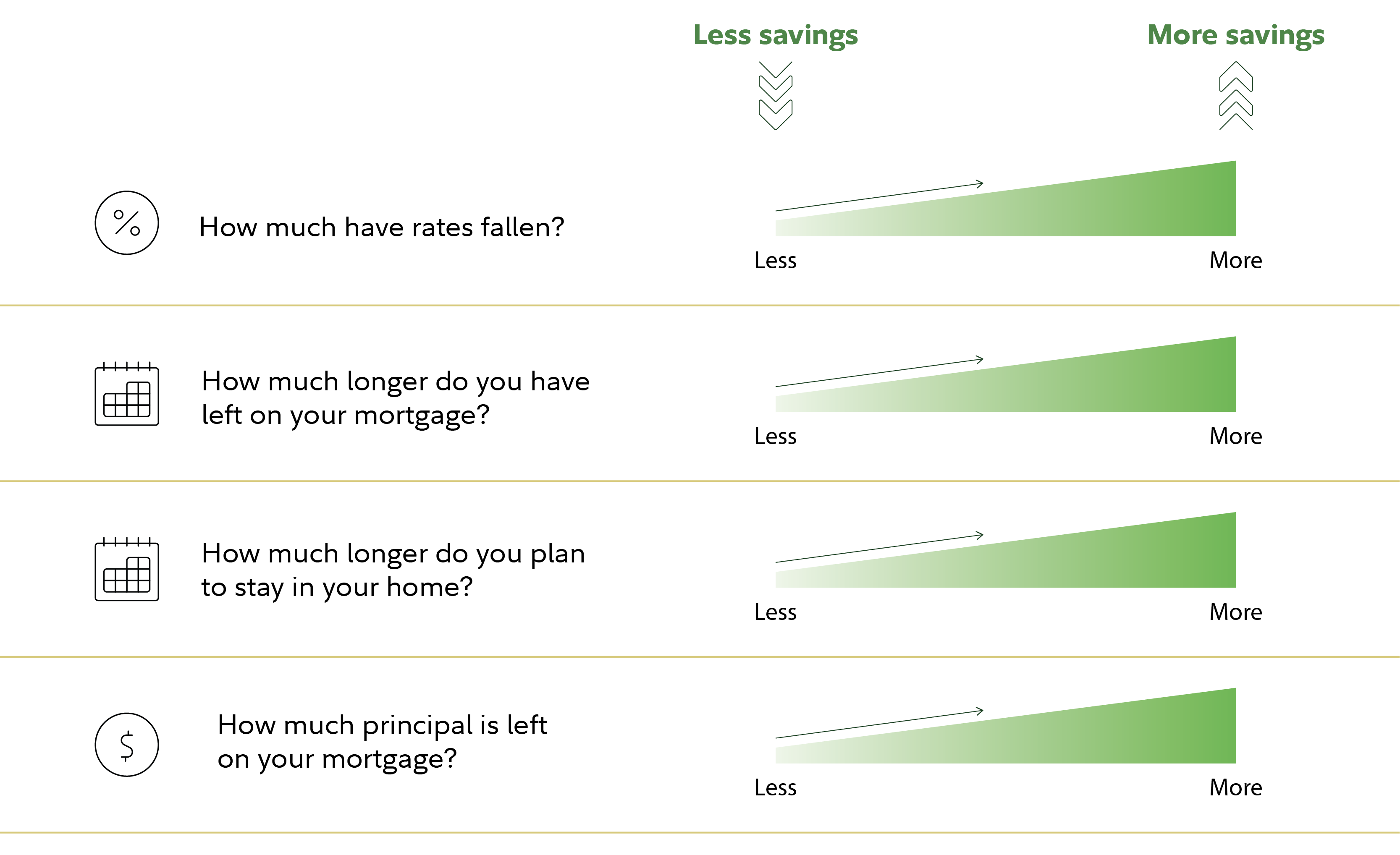
1. How much have rates fallen?
Needless to say, the more rates have fallen, the bigger your potential savings. It might also be possible to qualify for a more favorable rate if you've been able to improve your credit score since you first took out your mortgage.
2. How much longer do you have left on your mortgage?
Small differences in interest rates can still add up to big savings over long periods. On the flip side, even a large difference in interest rates might not be worth it if you’re close to paying off your mortgage in full and don’t have enough time to realize the savings.
3. How much longer do you plan to stay in your home?
This is important for similar reasons. Refinancing into a lower rate might not be worth it if you end up moving in a year or two. But if you know you’ll be staying put for at least the next decade, then even a modest decline in interest rates might be worth capturing.
4. How much principal is left on your mortgage?
All else equal, the larger your remaining mortgage balance, the more savings you can potentially reap from a lower interest rate (even after accounting for the fact that closing costs typically rise with higher loan amounts).
Of course, the more changes you consider making, the more complicated the picture becomes. For example, if you’re considering changing the term of your loan (such as refinancing into a new 30-year mortgage), or considering a cash-out refinance, then it’s a different comparison than if you’re only seeking a lower rate.
When is it worth it to refinance a mortgage for a lower rate?
There truly is no one-size-fits-all answer to refinancing a mortgage. For a look at the specifics of your situation, try Fidelity’s free refinancing calculator to estimate how much you might be able to save on interest with a refinance. Then, compare those estimated savings with an estimate of what you’d pay in closing costs for a refinance.
Here is what the monthly savings might look like for a hypothetical homeowner who is refinancing in order to capture lower interest rates—but who is not changing the remaining term of their loan or seeking a cash-out refinance.
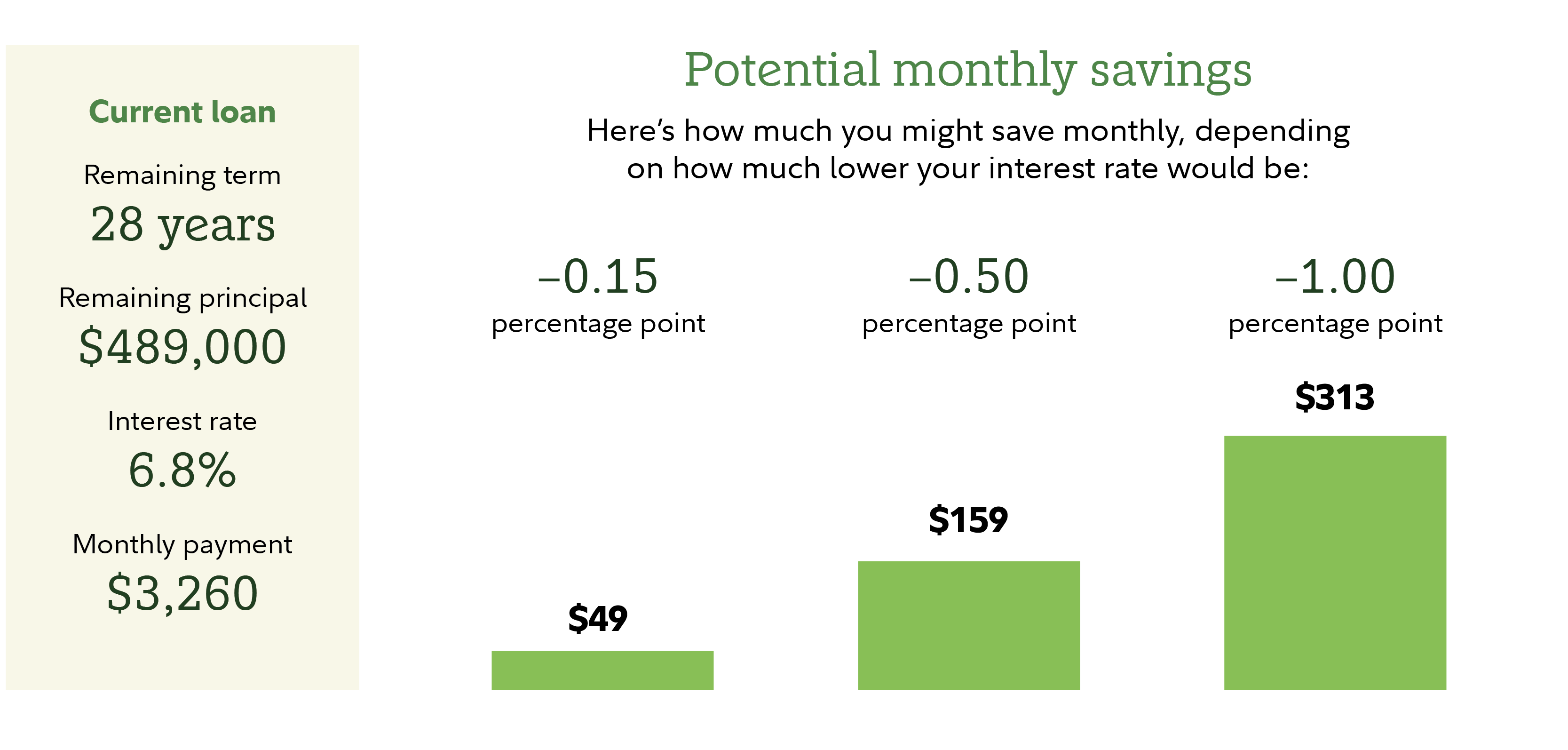
As the figures show, the more interest rates have fallen, the greater the potential monthly savings. However, it’s important to remember that refinancing isn’t free, since homeowners must pay closing costs on a new mortgage (in addition to the time consideration of shopping for a new loan). That’s why the key tradeoff to keep in mind is whether or not the interest you would save is enough to offset those closing costs.
How much can you save by refinancing a mortgage?
The potential dollar value of your savings from refinancing can vary widely with how much rates have fallen, how long you have left on your mortgage, and how long you stay put in your home.
Suppose you’re 2 years into a 30-year mortgage, with an original principal amount of $500,000 and an interest rate of 6.8%. Here’s how much you could save on interest in present-value dollar terms by refinancing, depending on what rate you can obtain and how much longer you stay in your home:
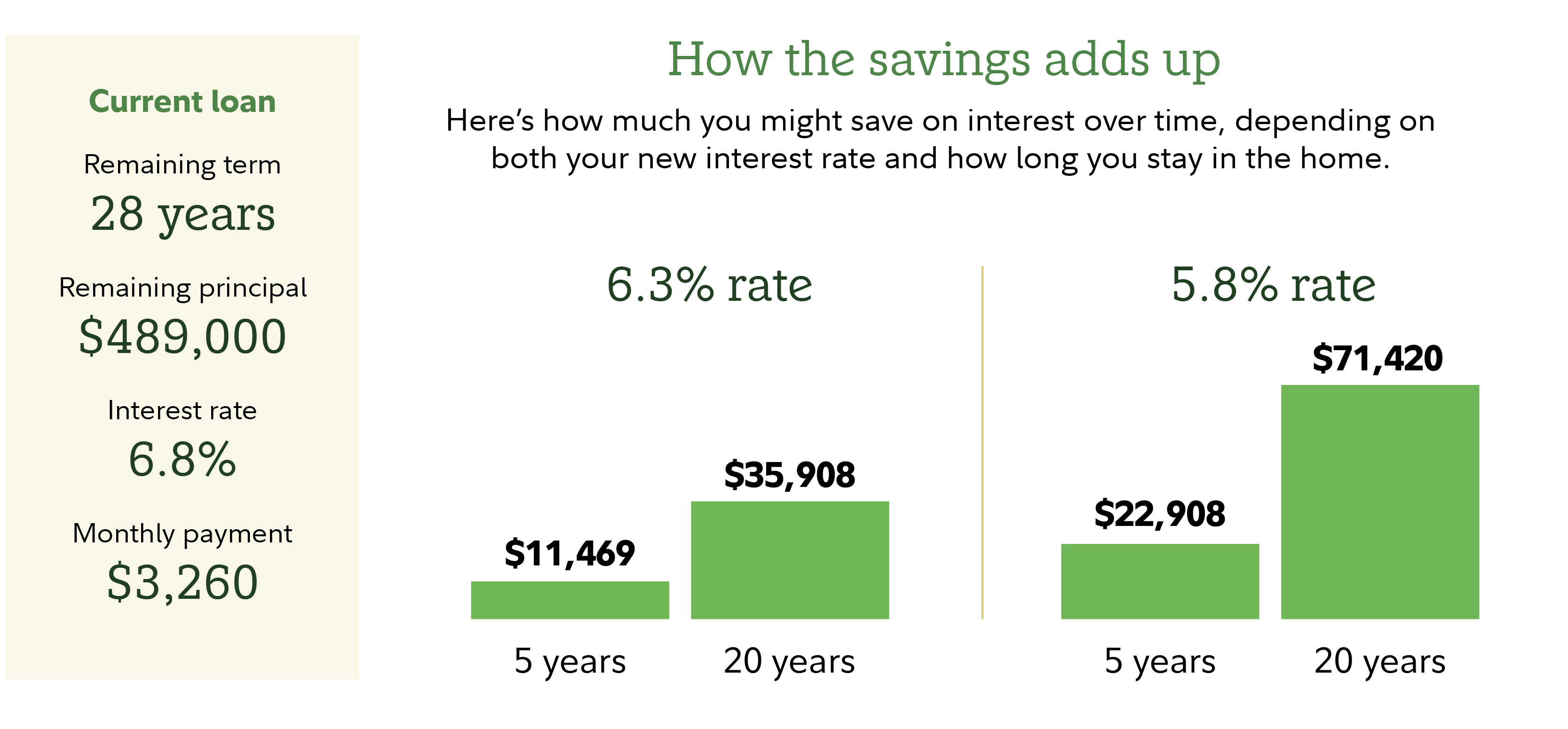
However, those figures show the importance of understanding what closing costs you may face.
Closing costs can vary widely. Some estimates suggest that homeowners should expect to pay 3% to 6% of their loan principal in total on refinancing costs.1 However, this percentage often decreases as the principal balance increases, so you may pay less than this estimate.
Getting a more personalized estimate of the costs you might face can help you make a more informed decision. Comparing multiple lenders may also help you find the best interest rates and closing costs for your situation. Keep in mind, when refinancing there is no obligation to stick with your original lender.
What about refinancing a mortgage to a different term?
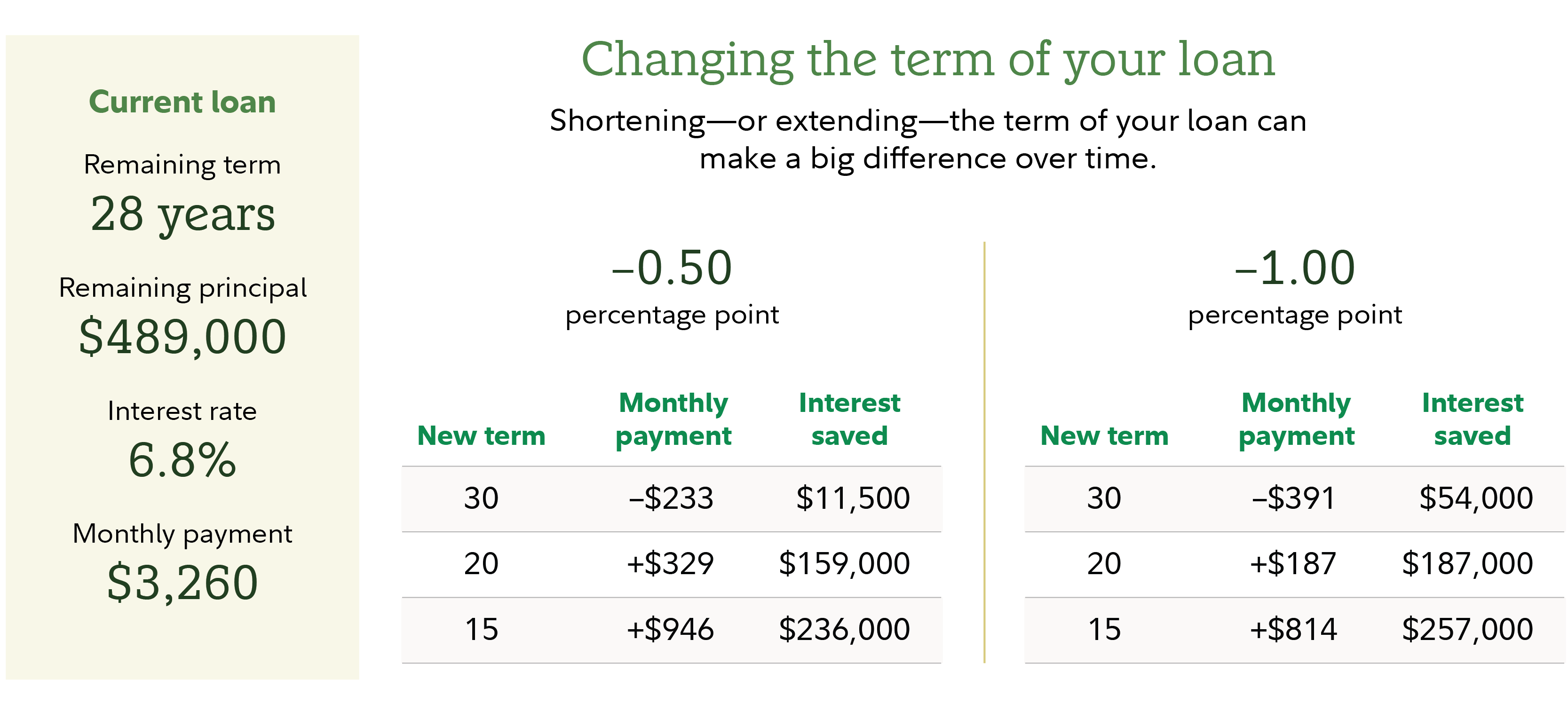
Changing the remaining term of your home loan can have major implications for both the total interest you pay and your monthly cash flow.
Refinancing to a shorter term could help you save significantly on interest, both because shorter-term loans typically come with lower interest rates and because you’d be accumulating interest on your loan for fewer years. However, reducing your loan term generally means you’ll face higher monthly payments, because you’re paying off your debt that much faster. If you have enough wiggle room in your budget to afford those higher monthly payments, it could be worth it in order to realize the interest savings. But it might not be worth squeezing into a shorter loan term if doing so would create a cash pinch in your monthly budget or force you to sacrifice other financial priorities, like saving for retirement.
On the flip side, refinancing to a longer term might cost you more in interest over the life of the loan (depending on the available interest rates), but typically results in a lower monthly payment. This can be a helpful way to gain some breathing room in your budget if you’ve been having trouble meeting your essential expenses.
What is a cash-out refinance?
A cash-out refinance is when you refinance for more than you currently owe on your home. It’s a way of converting part of your home equity into a cash lump sum. For example, refinancing a $350,000 remaining mortgage balance into a $400,000 new loan would convert $50,000 of the homeowner’s equity into cash (minus any closing costs, if you pay these up front).
That said, how much cash you can take out as part of a cash-out refinance may be limited by an 80% loan-to-value ratio that many lenders follow. In the example above, suppose the owner’s home is worth $500,000. In that case, they can refinance into the new $400,000 loan (and take out that $50,000 in cash), because the new loan of $400,000 represents 80% of the home’s $500,000 value. But they likely could not pull out $100,000 in cash, because doing so would require a new mortgage of $450,000 (which would represent a loan-to-value ratio of 90%).
In general, there are no restrictions on how you can use the funds. However, as with any other form of new debt, it’s important to think about what you would use the money for before considering a cash-out refinance. You wouldn’t want to increase your mortgage debt to pay for shopping sprees or vacations. But certain other uses—such as paying for home improvements or paying off other higher-interest debt—could potentially be worthwhile.
Refinancing a home loan: The bottom line
There’s no need to re-shop your mortgage every time interest rates move around. After all, in addition to closing costs you’ll face a toll to your time and energy. But if you know you plan to stay in your home for the long run, then even modest declines in interest rates could result in savings after accounting for closing costs—with bigger potential savings for bigger rate declines.
If you do refinance to a lower rate and see some savings in your monthly budget, make sure to put that extra cash to work. After all, every dollar you save on mortgage interest can help get you one dollar closer to retirement, financial freedom, financial security—or whatever that dream is you’re working toward. Learn more about deciding on the best uses for this newly freed cash, such as paying off debt, saving, or investing.
Ready to take the next step? Run the numbers with Fidelity’s free refinancing calculator. If the math checks out, learn about how Fidelity customers may earn a $1,500 credit on closing costs when they refinance through the Fidelity Mortgage Referral Program with Leader Bank.2