


Many of us spend our working years diligently building our retirement account balances, with the goal of feeling confident that it will be enough to support us throughout our later years.
Despite that, even investors with a comfortable level of savings often struggle to feel secure about tapping their retirement accounts. Justin Bailey, a Utah-based regional vice president of planning solutions with Fidelity, says many affluent clients tell him they want a portfolio that can generate enough interest and dividend income to meet their spending needs without drawing down principal.
“None of us want to see the balances on our accounts go down,” Bailey acknowledges. “But the reality is that most of us will need to spend down some principal in retirement—and it’s okay to do that as long as we have a plan.”
The risks of stretching for yield
While avoiding principal withdrawals may seem safer, a portfolio focused on yield comes with risks of its own.
You might need to allocate an outsized portion of your portfolio to income-producing assets, potentially overemphasizing higher-yielding, riskier investments and reducing overall diversification. A yield-focused portfolio may also lack the growth potential needed to maintain purchasing power over time. And a reluctance to tap savings can create a meaningful income shortfall, especially in years when expenses are larger, resulting in a significantly different retirement lifestyle than originally planned.
Instead of chasing yield, “A diversified retirement portfolio should include both growth-oriented and income-producing investments,” says Lauren Fabry, a Texas-based wealth planner with Fidelity Investments. Growth assets such as stocks generally help your savings keep pace with—or exceed—inflation. Income investments—typically bonds and dividend-paying stocks—provide cash flow for spending needs. Here are 5 steps she takes to help clients find the right balance.
1. Select an allocation
To determine the appropriate stock-and-bond mix, Fabry asks about a client's retirement date (time horizon), risk tolerance, withdrawal needs, and other aspects of their financial situation, including how much of their income covers essential expenses and how long they could cover those expenses in an emergency. Based on those inputs, she recommends an asset allocation. “We want to rely on factual data and remove emotions from the process,” she explains.
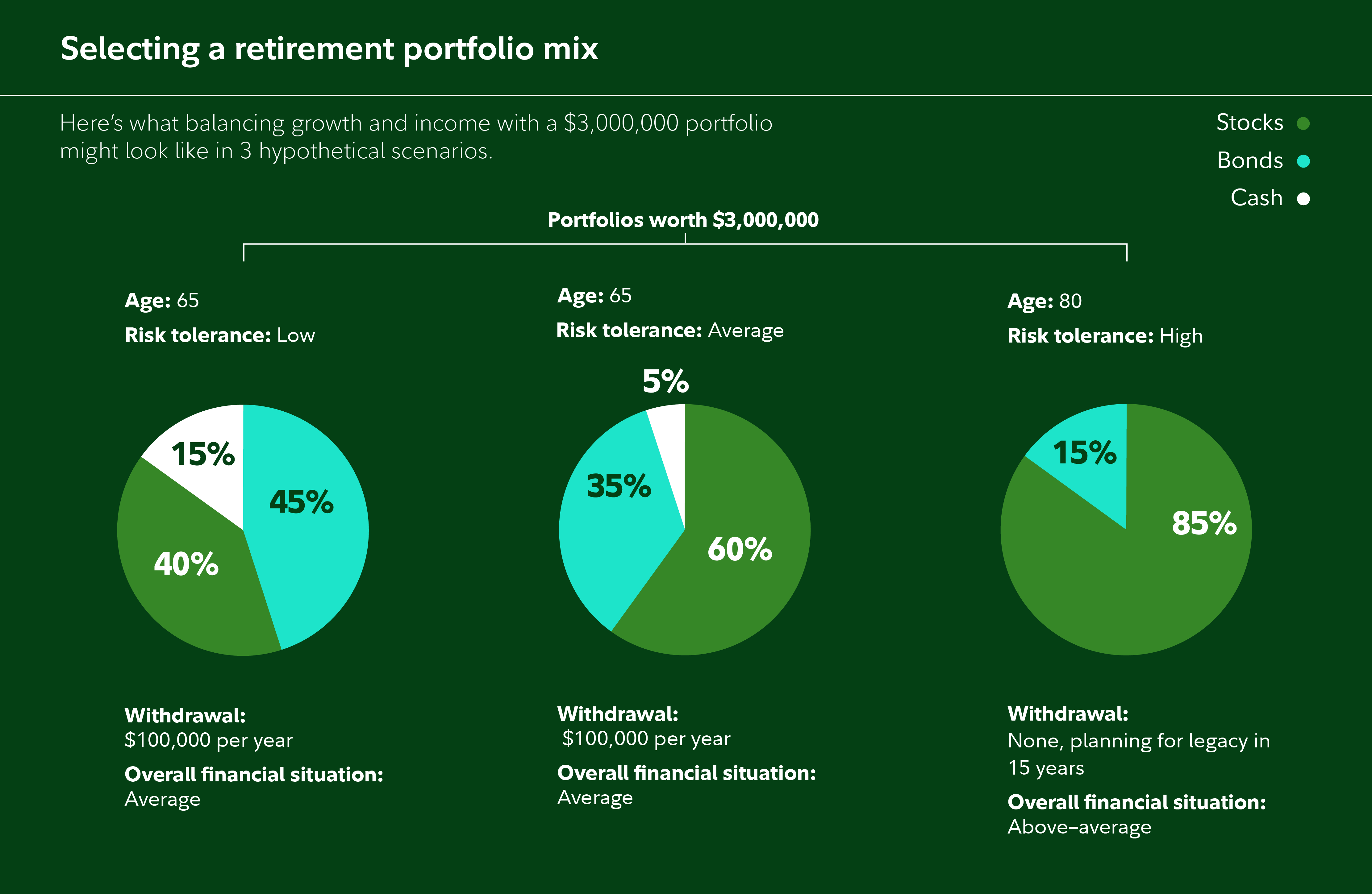
Once an individual retires or begins withdrawing assets from their retirement accounts, their investment horizon effectively shortens. At this stage, withdrawal needs and risk tolerance become increasingly important factors in determining the appropriate asset allocation. Here is how these factors might affect the suggested stock and bond mix:
- Withdrawal needs. Fabry assists clients in projecting their retirement expenditures and categorizing them into 2 main buckets: essential and discretionary. Fidelity recommends funding essential needs through guaranteed income sources like Social Security, pensions, and income annuities. Any remaining expenses must then be covered by portfolio withdrawals. As Fabry emphasizes, “The more a client relies on portfolio withdrawals to fund retirement expenses, the more important it becomes to limit stock market risk.”
- Tolerance for risk. A larger allocation to stocks can increase your potential returns but it can also raise the risk of losses (especially in the short term) and greater investment volatility. Retirees who can’t stomach volatility need to keep a healthy allocation toward fixed income, even at the expense of some growth, since staying invested is one of the most critical elements of a successful retirement plan.
- Other considerations. For some of Fabry’s clients, the end goal isn’t necessarily funding their own retirement. “The assets aren't necessarily intended to be spent in the clients' lifetimes,” she says, “For a portfolio with no immediate withdrawal needs that's intended for legacy, we’re planning for the next 3 or 4 decades. So even if a client is 80 years old, they could potentially have an aggressive allocation, provided they are comfortable with the risk and don’t need those funds to support their living expenses.”
Below are some hypothetical examples of what a suggested retirement allocation might look like for a retiree, based on their withdrawal needs, risk tolerance, and financial situation.
2. Plan for contingencies
Given the numerous factors that go into asset allocation choices, it’s critical to consider how your plan might need to evolve as your income needs, markets, or personal circumstances change.
As she works with clients, Fabry models the impact of various scenarios, such as a different retirement date, increased spending, or a change in Social Security projections. “It’s not about giving you one answer—it’s about stress testing the plan so you can make informed decisions,” she notes.
3. Select investments
For investors who want to craft their own portfolio, there are a number of options that may be well-suited to a retirement strategy, including target-date funds, target allocation funds, bond ETFs, and bond ladders.
Many of Fabry’s clients have some or all of their assets in a managed account, where an asset manager works to construct a portfolio of securities that matches the asset allocation recommendation, taking into account tax-efficiency as well as their unique situation, such as what stocks and bonds they already hold and whether they have any concentrated positions.
4. Consider the impact of taxes
Over time, your asset mix will change due to market performance and withdrawals, including required minimum distributions (RMDs). As you rebalance your portfolio to bring it back into alignment with your target mix, it's important to consider the tax implications, since managing taxes effectively can help preserve more of your retirement savings and support your legacy and wealth-transfer objectives.
Because selling assets within a tax-advantaged retirement account generally does not trigger taxes, you can rebalance those accounts as necessary. In a taxable account, however, the process can be more complex. Rebalancing means selling positions that have gotten too large—which can lead to capital gains.
For Fabry's clients who have a managed account, the investment management team works to bring the portfolio back to its agreed-on allocation while trying to minimize gains to the extent possible. For example, the team tries to avoid selling anything that would incur short-term capital gains. When assets need to be sold, they review the specific tax lots of each holding to identify those with the highest purchase prices.1
Finally, for qualified2 clients who have both taxable and tax-advantaged accounts assigned to their retirement goal, either individually or jointly owned, across a household, the investment team can rebalance across all of them together, preferably making adjustments to the tax-advantaged accounts. This allows a couple’s overall portfolio to stay aligned with the target mix while potentially reducing taxes.
5. Revisit the plan regularly
Finding a balance between growth and income needs in a retirement portfolio is complicated, especially given that expenses tend to shift over the course of several decades. Working with a financial professional to develop a thoughtfully designed investment strategy—reviewed periodically and followed consistently—can help provide you with confidence and peace of mind both as you approach retirement and throughout your retirement years.