


For decades, institutional investors, endowments, and family offices have allocated portions of their portfolios to private market investments. Today, eligible individual investors are increasingly able to access many of the same opportunities.
What are private market alternatives?
Private market alternatives generally include investments that are not traded on public exchanges and may offer exposure to areas of the economy beyond those typically represented in traditional stock and bond portfolios. These investments can include private equity, private credit, and private real assets.
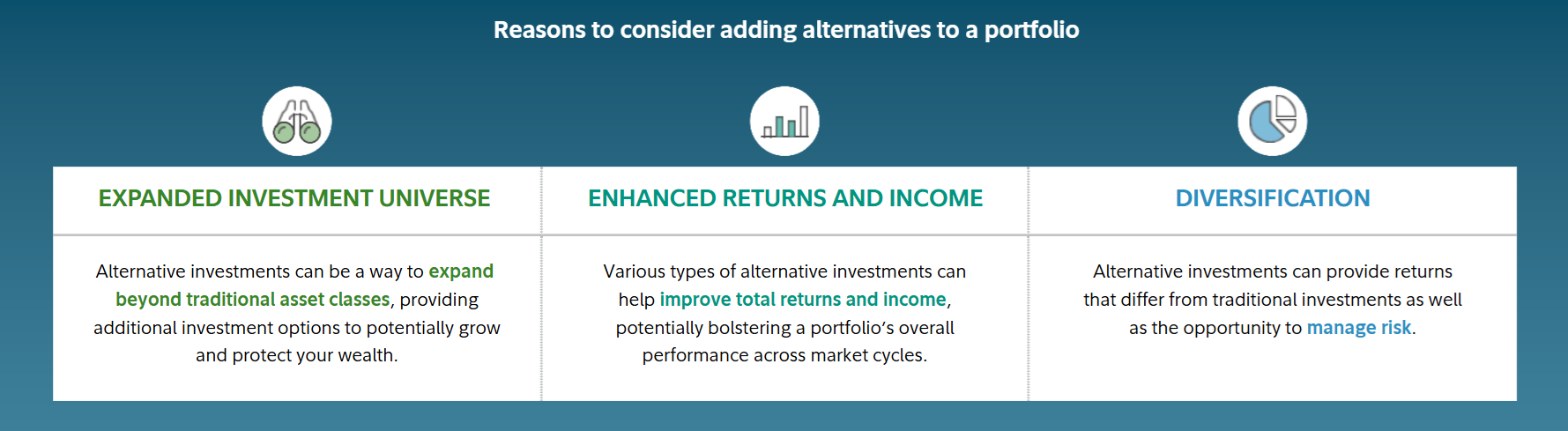
While these categories of alternatives have distinct characteristics and can play unique roles in a portfolio, alternatives may provide enhanced returns and income, risk management, and/or improve diversification. Because private market investments are not subject to the same market dynamics as publicly traded stocks and bonds, they have historically exhibited different return patterns over long periods of time.
Another reason investors have increasingly incorporated private market alternatives into their portfolios is because public markets are shrinking, with the number of publicly traded companies declining 24% over the last 25 years, from 7,194 in 2000 to 5,489 in 2025. 1
Types of private market alternative investments
Private market alternatives include investments in private equity, private credit, and private real assets.
Private equity funds generally seek to provide enhanced long-term capital gains by investing in private, non-traded companies. Private credit funds invest in privately negotiated loans, bonds, or higher-risk debt. Private real assets include private real estate, infrastructure, natural resources, renewable energy, and commodities.
Characteristics of private market alternatives
Private market investments have different characteristics compared to traditional investments. Among the most important are liquidity considerations. Unlike publicly traded stocks and bonds, which are bought and sold regularly on organized exchanges, private market transactions generally occur through privately negotiated arrangements and may not have active secondary markets. As a result, private investments are typically less liquid, and the investment vehicles that hold them are often illiquid or only intermittently liquid.
Because private market alternatives are often accessed via illiquid or intermittently liquid vehicles, that may limit the ability to take withdrawals from your investment. This often comes in the form of lock-up periods, which are periods during which an investment generally cannot be sold. Lock-up periods often extend for many years. However, in exchange for tying up your investment for longer periods of time, illiquid alternatives may offer the potential for higher returns. This is referred to as the "illiquidity premium."
In addition to liquidity considerations, private market investments may feature fee structures that differ from traditional investments, unique tax-reporting requirements such as Schedule K-1s, more complex monitoring needs, and relatively high investment minimums. While these characteristics can create additional complexity, they may also reflect the specialized nature of private market investing and the longer-term investment horizon often required to pursue potential investment opportunities.
The role of private market alternatives in a portfolio
Modern portfolio theory—which examines the tradeoff between risk and return—features the concept of the “efficient frontier.” The efficient frontier represents the optimal portfolios to maximize return for each level of risk that a rational, risk-averse investor would choose.
Research has found that the inclusion of alternative investments in a portfolio has the potential to shift the efficient frontier. Put more simply, allocating a portion of a portfolio to some combination of alternative investments has the potential to provide investors with enhanced returns without additional risk, or to reduce the amount of risk for a given level of return.
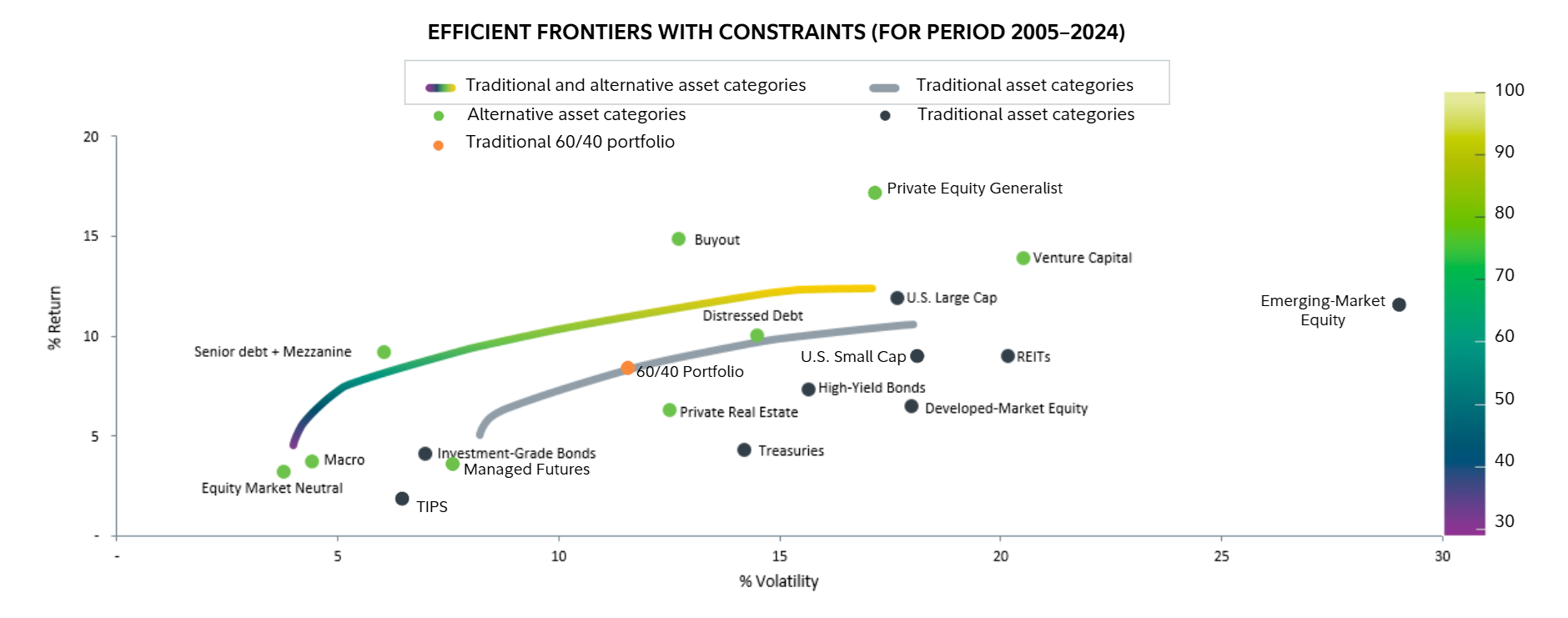
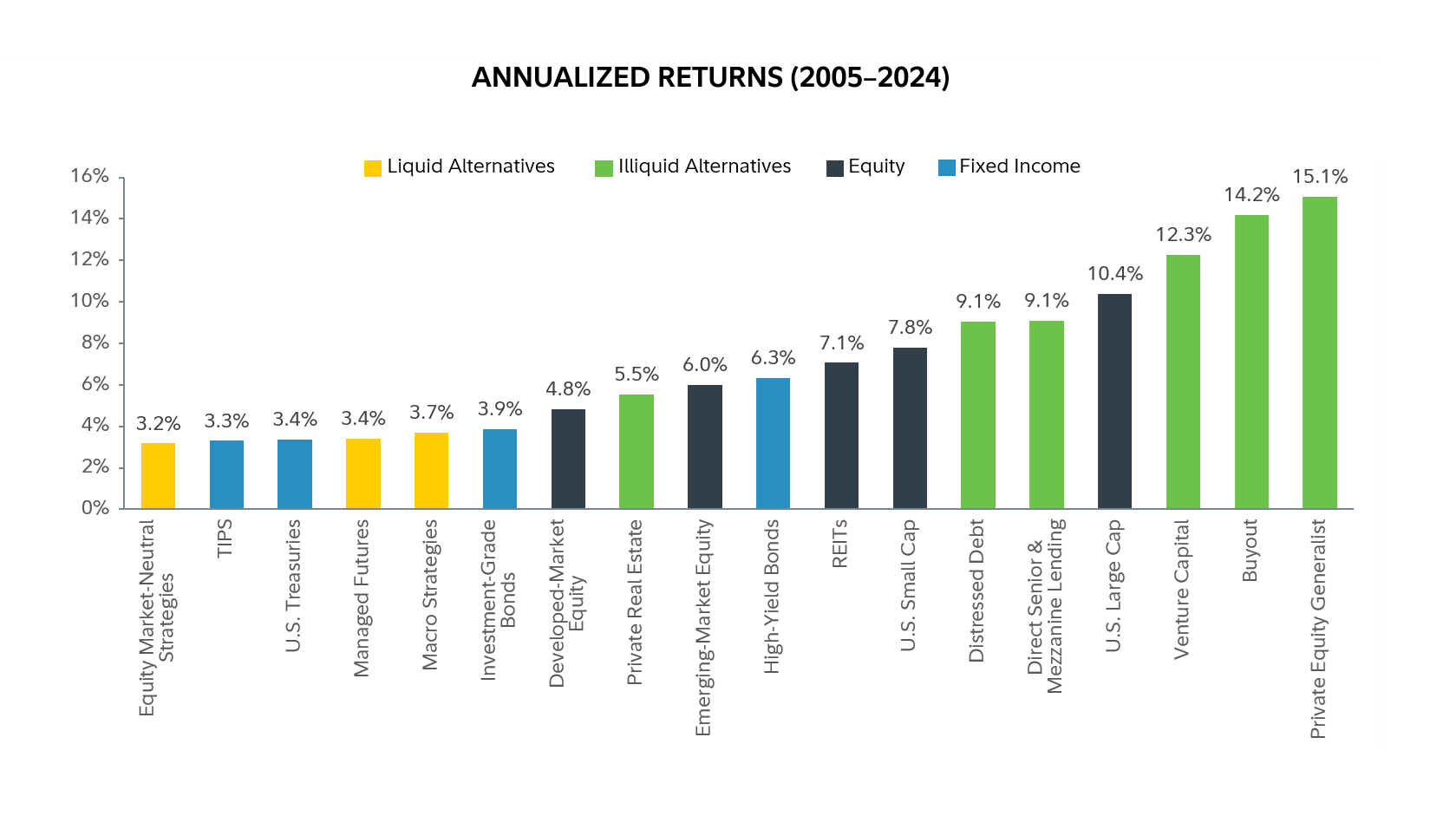
While past performance is not a guarantee of future results, the historical data below highlights how various private market strategies and certain liquid alternatives strategies have performed relative to traditional asset classes.
Because many private market investments are not continuously traded and may involve lock-up periods, they are often categorized as illiquid alternatives.
How much should eligible investors allocate to private market alternatives?
Asset allocation, or how you divide your portfolio between major asset classes, is one of the most important decisions an investor can make and is never a one-size-fits-all solution. Eligible investors who have long investment horizons and the ability to tolerate limited access to their invested capital may consider allocating between 10% and 20% of their overall portfolio to private market alternative investments.
To determine your specific allocation, you'll want to consider your objectives, which can include reducing overall portfolio volatility, pursuing higher long-term returns, providing a hedge against inflation, and/or generating additional income.
For example, private equity may be appropriate for investors focused on long-term growth potential due to typically longer lock-up periods, while private credit and real assets may appeal to those seeking income, in addition to diversification beyond traditional stocks and bonds that private market alternatives can provide.
You’ll also need to consider your liquidity needs and comfort level with risk. For example, a conservative allocation suggests a smaller allocation to riskier asset classes such as private equity, while a similar weighting of private equity, private credit, and real assets may be appropriate for a balanced portfolio with a medium level of risk. Fidelity experts typically suggest that no more than 3% to 5% of a portfolio’s investable assets be invested in a particular private market alternatives fund.
The chart below shows examples of how private market alternatives might be incorporated across a variety of investor profiles. These examples assume investors have a high capacity for illiquidity and do not anticipate needing access to the private market alternative portion of their portfolio for an extended period of time.
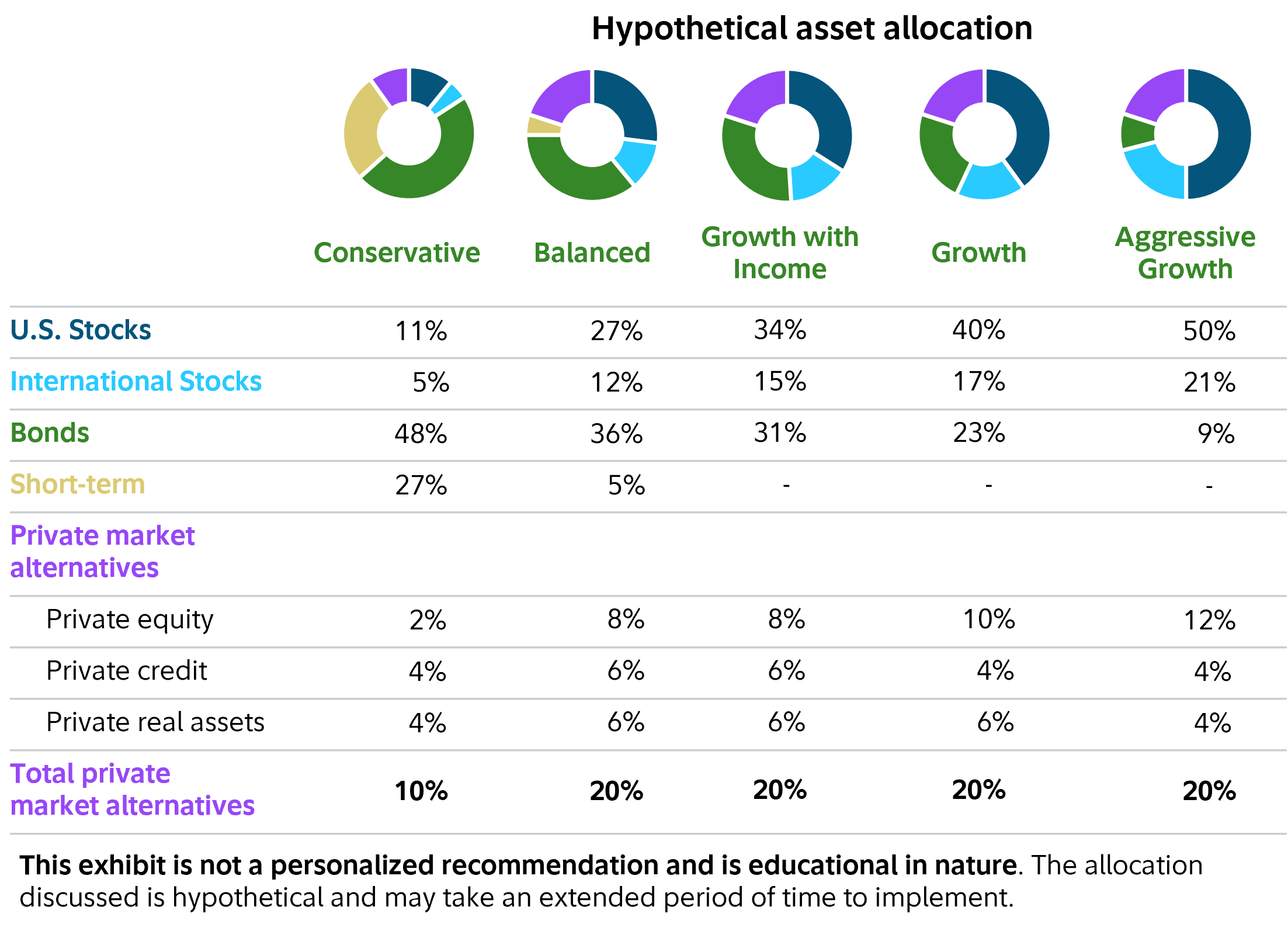
Diversification and asset allocation does not ensure a profit or guarantee against loss. The portfolios above reflect a high capacity for illiquidity where other allocations may be more appropriate based on an investor’s unique and specific profile and liquidity needs.
Funding framework is intended solely as a guideline for investors to consider and does not take into account individual situations or tax implications of funding the alternative investment allocation, nor is this a recommendation on how to implement.
Using research built by Strategic Advisers, Inc. (SAI), this set of target asset mixes ("TAMs") incorporate alternatives. These portfolios are designed to offer improved risk-adjusted return potential for investors with low liquidity needs and investment goals. Examples for illustrative purposes only. Currently not in use with Fidelity advisory solutions. For use with eligible investors only.
Important considerations for private market alternatives investors
Private market investments aren’t for every investor. When investing in private market alternatives at Fidelity, minimum income and asset levels typically apply, along with other suitability requirements.
If you’re considering private market investments, it’s important to evaluate your liquidity needs and your ability to meet future cash flow obligations in the event your investment capital is inaccessible (or accessible for an early withdrawal fee) for a long period of time. In addition, your asset allocation decisions should always be evaluated within the context of your broader financial plan, liquidity needs, and risk tolerance.
Incorporating private market alternatives into your asset allocation requires careful planning. Start with a clear understanding of your goals, timeframe, and risk tolerance, consider the role alternatives can play, and ensure your overall portfolio remains balanced and aligned with your needs.
Eligible investors interested in learning more may consult a financial professional to determine an appropriate allocation approach based on their personal circumstances. If you're interested in exploring your options, talk with your financial advisor, use Fidelity's Find an Advisor tool, or call 800-396-9118 to connect with a Fidelity representative.