


If you’re managing your own investment portfolio or trading with the intention of beating the market, it’s important to know whether or not your strategy is working. Enter: benchmarks. Here’s what a benchmark is and how benchmarking can play a role in your investing strategy.
What is a benchmark?
A benchmark is a reference point that could help you evaluate how investments are performing. It’s often used for judging the strength of your returns, but you could also use a benchmark to gauge a portfolio’s risk and volatility levels, or how much up and down there may be with a group of investments’ performance. Think of it like a league average in sports: It tells you whether your team (or in this case, your portfolio) is playing better, worse, or right in line with the rest of the league.
Investors commonly benchmark their portfolios against stock market indexes like the S&P 500,1 the Dow Jones Industrial Average (DJIA),2 and the Nasdaq Composite.3 They each serve as a proxy for the overall market. If an investor’s strategy is focused on a certain market sector or asset type, they may choose a more narrowly focused index as a measurement tool.
What is benchmarking?
Benchmarking is the process of measuring your portfolio (or a part of it) against a different set of investments, aka the benchmark. It involves:
- Selecting a relevant and accessible benchmark for your portfolio
- Comparing the performance of your portfolio against the performance of that benchmark
- Drawing conclusions about your investment strategy based on how your portfolio’s performance compares to its benchmark
Here are some questions you may ask yourself during the benchmarking process:
- Did your portfolio outperform the benchmark during a given time period?
- If your portfolio underperformed its benchmark, can you discern why?
- How does your portfolio’s risk and volatility compare to the benchmark?
- What adjustments to your portfolio or investment strategy might be warranted, considering how it compares to its benchmark?
Why is benchmarking important?
Benchmarking can help investors understand whether their investing strategy is working as expected, thus informing future investing moves. For example, if a portfolio is underperforming its chosen benchmark, an investor could choose to adjust their holdings. They may even decide their strategy isn’t working and turn to passive investing to simply invest in an index fund that aims to deliver similar performance to the benchmark.
Alternatively, if an investor’s portfolio is on pace with or even outperforming its benchmark, they may decide to carry on with their current strategy, though past performance can’t guarantee future results.
Types of benchmarks
There isn’t one single benchmark that works for all investors or portfolios. The ideal benchmark for you is the one that serves as a relevant comparison for your investment strategy. There are 2 main types of benchmarks:
Asset class benchmarks
Many investors who design and manage their own portfolios have a goal to beat the general market. If this sounds like you, you may want to choose a benchmark that approximates the market as a whole, which may include indexes that account for thousands of stocks, like the Russell 30004 or Wilshire 5000.5
If, on the other hand, your portfolio is focused primarily on a single asset class, you could choose a similarly constructed benchmark index. Some common benchmarks for different asset classes include:
- Large-capitalization equity benchmarks (translation: higher-value companies): S&P 500, Dow Jones Industrial Average, Russell 1000,6 and Nasdaq-1007
- Small-capitalization equity benchmarks (as in, lower-value companies): Russell 2000,8 S&P SmallCap 600,9 and MSCI US Small Cap 175010
- Emerging markets equity benchmarks (which include companies in developing countries): S&P Emerging Broad Market Index (BMI), MSCI Emerging Markets Index,11 and FTSE Emerging Index12
- Bond benchmarks: Bloomberg US Aggregate Bond Index,13 S&P Municipal Bond Index, and FTSE World Government Bond Index (WGBI)
- Commodities (aka raw materials) benchmarks: Bloomberg Commodity Index (BCOM),14 S&P GSCI, and CRB Commodity Index
Sector benchmarks
If instead you focus your portfolio, or a portion of it, on a particular sector or industry, you may want to choose a benchmark centered around the same segments. Some common sector benchmarks include:
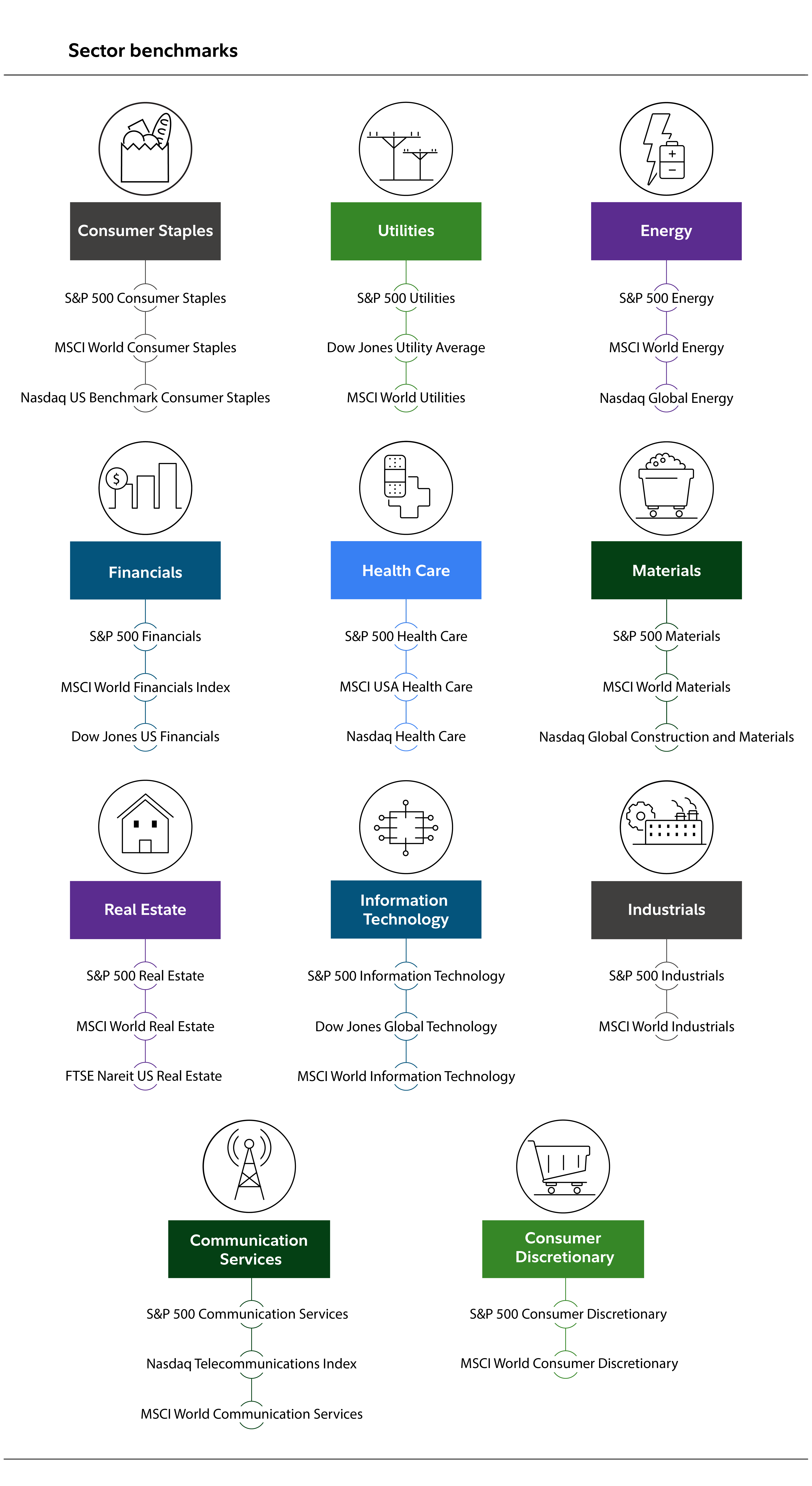
You may be able to drill down even further into sub-sectors and/or industries. This allows you to select more specifically focused indexes as your point of comparison.
Benchmarking strategies
You might use a number of different strategies depending on your goals and how your portfolio is constructed. Some common strategies include:
- Single-index benchmarking: This is when you benchmark your portfolio against a single index, which could represent the overall market or a single asset class or market sector.
- Risk-free returns benchmarking: Even though every investment carries some risk, this strategy calls for benchmarking your portfolio against a low-risk investment, like US Treasuries. This could help you understand your risk-adjusted return—or how much risk you take on in exchange for potential profit.
- Inflation benchmarking: Compare your portfolio’s returns against the current rate of inflation to help you understand how your purchasing power has changed during a given timeframe.
- Custom benchmarking: As the name implies, this is when you benchmark your portfolio against a blend of indexes or data points of your choosing that best mirror your investment strategy.
How to use benchmarks
If you’re interested in benchmarking your portfolio, you could take the following steps:
1. Select your benchmark
This benchmark should act as a relevant comparison for the key aspects of your portfolio, including its asset allocation, risk profile, and overall investment strategy.
Choosing the wrong benchmark might lead to a flawed analysis and misunderstanding of your portfolio’s performance. If your portfolio doesn’t align well with a single index, you can track your portfolio against a few indexes to get a general idea of its performance. If you prefer to be more exact, you could also create a custom benchmark by blending together multiple indexes. There are online tools that could help with custom benchmarking. If you wanted to do it yourself, you could take the average growth rate of the indexes you’re using and compare that to your own portfolio’s returns.
2. Identify a performance period
It can often be valuable to compare multiple performance periods—for example, 1 year, 5 years, and 10 years—so that your analysis can capture both short- and long-term performance. It may also be wise to evaluate your portfolio during periods of extreme volatility, such as the Global Financial Crisis or the COVID pandemic.
3. Perform your analysis
Compare your portfolio against your chosen benchmark.
You could consider using metrics like:
- Alpha, which measures how much growth your portfolio saw above its benchmark.
- Beta, which measures a portfolio’s or benchmark’s sensitivity to market movements, calculated by comparing a portfolio’s monthly returns over 36 months to those of the portfolio's benchmark. A Beta of less than 1.0 indicates the portfolio is less sensitive to market movements, while a Beta greater than 1.0 indicates a portfolio or benchmark that tends to be more sensitive to market movements.
- Sharpe ratio, which measures your portfolio’s risk-adjusted return. It’s calculated by dividing your portfolio’s excess returns (your portfolio’s average monthly returns minus your benchmark’s average monthly return) by the standard deviation of those returns. The higher the ratio, the better your portfolio’s return relative to the level of risk it’s assuming.
4. Adjust your investments as needed
If your portfolio underperformed your chosen benchmark, you may want to direct your money into different investments. These pointers for conducting stock analysis could help direct you to more fitting securities. Or you could rebalance your portfolio to keep the same investments but in different proportions.
If you need additional help, you could work with a financial professional to help evaluate your portfolio.