


Market volatility has been an unavoidable part of investing.
In recent months, worries about inflation, the economy, rising government debt, and geopolitical tensions have fueled swings in the Treasury market, which in turn have prompted fresh questions about the outlook for stocks and bonds. This uncertainty, heightened by concerns about AI development and upcoming elections, may even have some investors considering making changes to their portfolios ahead of further volatility.
History, though, suggests that trying to time the market has often reduced long-term returns. Investors may be so worried about what they can't control—the market's ups and downs—that they may overlook the things they can control, such as making tax-smart trades and avoiding emotional decisions.
Read on for 7 costly mistakes that some investors may be making today and how you can avoid them.
1. Avoiding investment decisions due to uncertainty
There’s no shortage of questions to keep investors second-guessing whether now is the right time to invest. Will the conflict in the Middle East escalate or de-escalate? Is the US economy at risk if energy prices remain elevated? Could high inflation come back?
Naveen Malwal, institutional portfolio manager with Strategic Advisers, LLC, an investment manager for Fidelity managed accounts, says he sees some investors make the mistake of staying out of the market in the hopes that the landscape will look less uncertain in the future.
"In almost any market environment, you can find a few factors that may give investors pause," says Malwal. "Today, investors may be focused on election uncertainty, volatility in interest rates and bond markets, or questions about how artificial intelligence could affect the economy and markets in the years ahead."
The trouble with waiting for total certainty is that investors will likely have to wait a long time, leaving them on the sidelines even as the market may still be rising.
Markets have historically tended to rise over the long term, usually amid uncertainty, which is why it’s important to stay disciplined and invested. Periods of heightened volatility, moreover, have often led to potential opportunities.
While there is plenty of uncertainty in the current environment, there are also many positive signals that investors should not overlook.
“The broader economic backdrop remains constructive,” says Kana Norimoto, managing director of research on Fidelity’s Asset Allocation Research Team. “The labor market remains healthy, consumer spending has proven resilient, and corporate profit growth has continued to defy expectations.”
The US economy generally appears to be in a mid-cycle expansion, she says, with few signs of near-term recession risk.
2. Responding emotionally to market volatility by selling investments
Market volatility can feel very unsettling when it's happening in real time.
Whether prompted by rising Treasury yields or concerns about the sustainability of earnings growth, sudden market declines can leave investors questioning whether they should hit the exits before things get worse.
Yet throughout history, markets have recovered from all manner of setbacks—crises that were nerve-racking in the moment—and gone on to eventually reach new all-time highs.
Investors who sell after a sharp decline may avoid losses in the short term, but they also run the risk of missing the recovery, which can hurt them more than if they had stayed invested.
"The mistake many investors make is assuming they can get out during a decline and then get back in at exactly the right moment," says Malwal. "Historically, market recoveries have often begun before the news feels reassuring again."
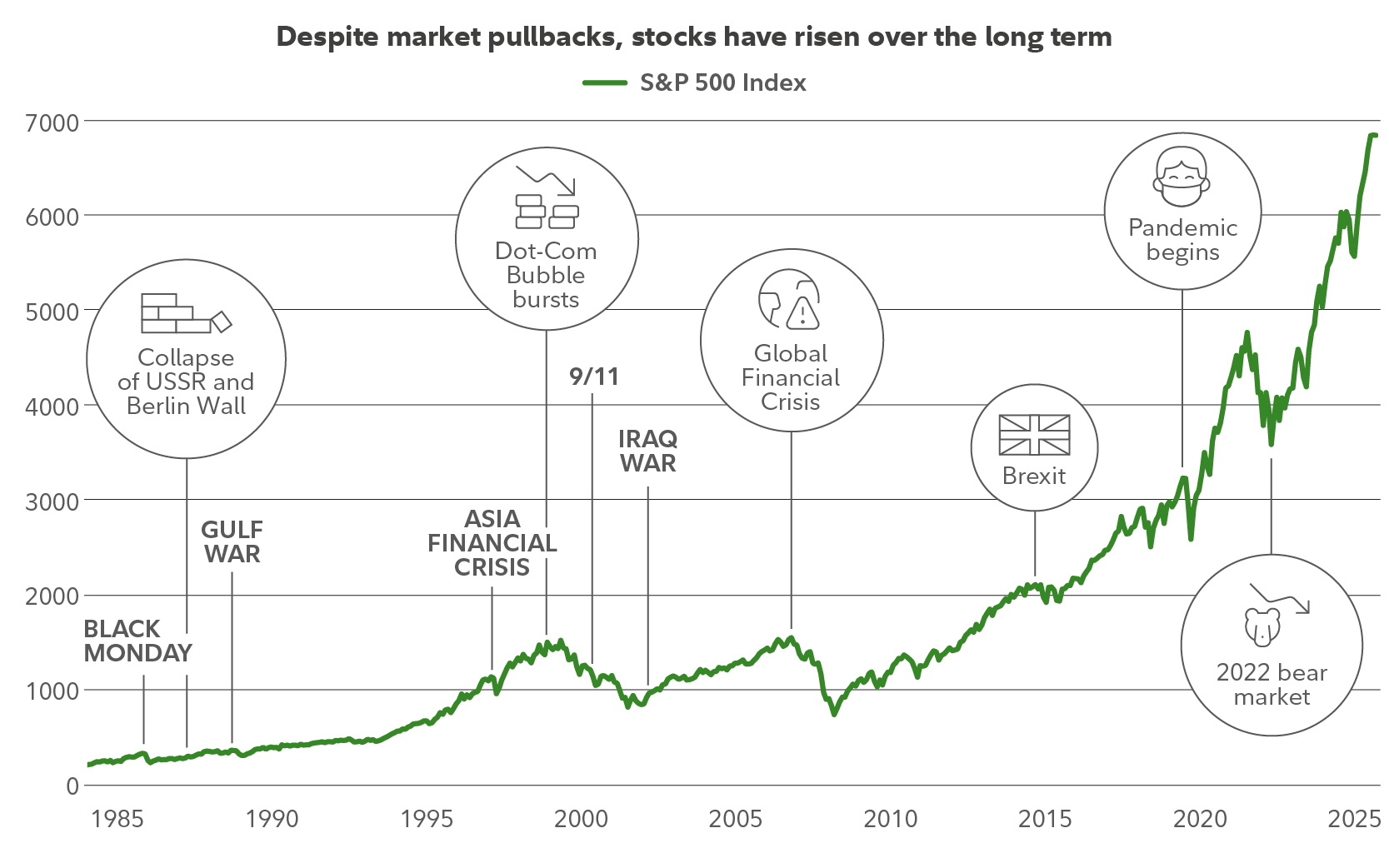
Past performance is no guarantee of future results. Source: FMRCo, Bloomberg, Haver Analytics, FactSet. Data as of December 31, 2025. The S&P 500® Index is a market capitalization–weighted index of 500 common stocks chosen for market size, liquidity, and industry group representation. S&P and S&P 500 are registered service marks of Standard & Poor's Financial Services LLC. You cannot invest directly in an index.
3. Waiting for cheaper stock valuations before investing
US stocks, up more than 11% this year through Sept. 14, 2026, have delivered positive double-digit annual returns for each of the past 3 calendar years. After such a strong extended run, some investors may assume that stocks have become too expensive and decide to wait for a better entry point.
What some investors may not realize is that today’s stock prices, by some valuation measures, may still be reasonable because revenue and earnings growth have been so strong. As profits rise, price-to-earnings (P/E) ratios can decline or hold steady even as stock prices climb.
“It’s true that valuation metrics such as forward P/E ratios are above their long-term average,” says Malwal. “And yet, that may not be a reason to avoid the market.” (A forward P/E ratio is the current stock price divided by consensus earnings estimates for the next 12 months.)
Malwal says that, historically, valuation metrics such as P/E ratios have not been reliable signals for when to get in or out of the market.
“Performance has usually been stronger following periods when valuations are low, but you don’t necessarily get negative returns when stocks are at higher valuations,” he says.
Stocks historically have delivered more modest returns after periods of high valuations, yet even then those potential returns have typically outperformed bonds or cash.
In other words, high valuations on their own shouldn't be a reason to sell stocks or avoid investing. Instead, they’re often simply a reflection of investors’ expectations of strong earnings growth.
That said, Malwal notes that high US stock valuations could be an additional reason for investors to make sure they are well diversified. Stocks in both developed and emerging international markets have recently had lower average valuations than US stocks. Valuation-sensitive investors can also find opportunities in the US by looking beyond some of the largest and most well-known stocks.
4. Holding too much in CDs and other short-term investments
Short-term CDs and Treasurys have become more attractive to investors as interest rates have risen. Many investors feel comfortable in these investments due to the potential protection they can provide in a down market, their low risk of default, and their predictable cash flows.
The tradeoff is that short-term investments have historically offered less growth potential than other investment vehicles. That potential tradeoff can become even more pronounced when inflation remains elevated. Though rates on these investments may look attractive, they may not be providing much growth after accounting for rising prices.
“While it’s true that stocks may be more volatile than short-term investments or bonds in the near term, over the long run, stocks have provided much higher returns,” says Malwal. “Historically, investors who have time on their side have typically benefited from having a broader exposure to stocks and bonds, or a combination of the 2, as opposed to staying in short-term investments for a long time.”
5. Chasing yesterday’s winners
Strong market gains can tempt investors to chase the hottest parts of the market, but that’s a fast-moving target, as history shows market leadership can turn on a dime. “Rather than trying to guess what’s going to be the next big thing, we have found what can help investors more over the long run is to diversify across a whole host of investments,” says Malwal.
Most recently, investors may be taking note of the significant gains among certain technology stocks, specifically companies that are driving the AI development boom. However, investors who concentrate too heavily on a small number of stocks or a single area of the market may expose themselves to greater risk if leadership shifts.
“Investors who are diversified may not experience as much of the booms or busts that might occur with a more concentrated set of investments," he says. "They tend to have an easier time sticking with their plan and historically have experienced healthier long-term growth.”
6. Not factoring taxes into investing decisions
Many investors focus on investment returns without fully considering the tax consequences of their decisions.
In taxable brokerage accounts, actions like trading frequently and holding tax-inefficient investments can increase investors’ tax bills.
“Generally speaking, in taxable accounts, investing tax-efficiently and making gradual changes may help investors keep more of what they potentially earn,” Malwal says.
Such actions can include choosing investment strategies or funds designed to minimize taxable distributions.
Some investors could also benefit from tax-loss harvesting in their taxable accounts, which can help reduce taxes by offsetting gains or income. If you’re already working with Fidelity, try the Tax-Loss Harvesting Tool for step-by-step guidance to see if you can save on taxes while staying invested.
7. Investing without a detailed long-term plan
Many investors have financial dreams, but they might not have a detailed, long-term plan for achieving them.
Without a plan, investors may find themselves making decisions based on fear, excitement, headlines, or whatever investment is getting the most attention at the moment.
A thoughtful investment plan starts with understanding your goals, time horizon, and tolerance for risk. Those factors can help determine how much to hold in stocks, bonds, and short-term investments.
Investors should also revisit their plans periodically. Changes in market conditions, interest rates, and personal circumstances can create new opportunities or require adjustments. For example, after several years of strong stock market performance and higher bond yields, some investors approaching retirement may find it worthwhile to reevaluate the balance between growth and income in their portfolios.
“Coming up with a plan isn't a set-it-and-forget-it exercise. A plan needs to be revisited at least once a year to see what's changed, whether it's your own situation, a windfall or unexpected expense, or changes in the market,” Malwal says. “There might be opportunities that were not available a year ago, or investments that may now be a better fit.”
Over long periods, investors have done better by staying in the market. If you’ve got a well-rounded plan that’s sensitive to your financial needs, then don’t let headlines or short-term noise derail you from your goals. If you need help developing a plan, learn more about how we can work together.