

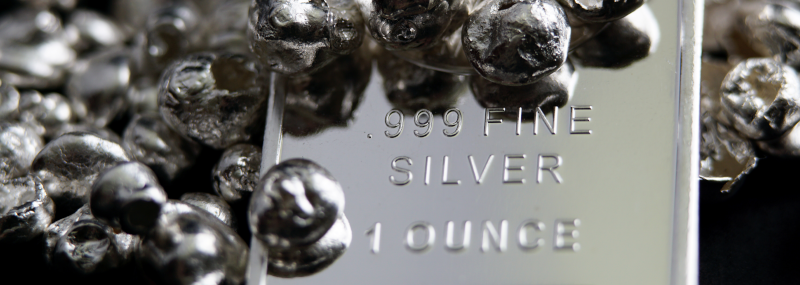
For a monetary asset with at least 5,000 years of history, it may seem ironic that gold has been capturing investors’ attention as seldom before. The precious metal is coming off a multi-year run that included a 65% surge in 2025 (its strongest annual gain since 1979), and a few days above $5,000 per ounce earlier this year.
While gold has recently given up some ground—with market leadership shifting significantly in recent weeks amid the Middle East conflict—escalating geopolitical uncertainty has many investors thinking more seriously about how to add diversifiers and safe‑haven assets to their portfolios. Even after the recent pullback, the price of gold is still up more than 100% since the start of 2024. Its cheaper precious-metal cousin, silver, has vaulted an even more remarkable 190% per ounce in the same period (though past performance is no guarantee of future results).
Precious metal prices now
Several long-term forces have been driving the surge in precious metal prices. Yet for investors who don’t already have exposure to precious metals, the magnitude of the recent gains poses a real dilemma: Get in now and risk buying near the top, or stay out and risk missing further upside if this bull market proves to be durable. For investors who decide the case is still compelling, there’s the added challenge of choosing the right vehicle and determining how much exposure is appropriate within a diversified portfolio.
Read on for more on navigating the rise in precious metals, and what investors should consider doing about it.
What has driven the surge in precious metal prices?
The stars really began to align for gold in 2022. The sharp rise in inflation that year, plus the start of the Russia-Ukraine War, catalyzed several long-term macro trends that have continued to fuel its rise.
Central banks seeking diversification
Boris Shepov, manager of Fidelity® Select Gold Portfolio (
Seeing how US-dollar assets could become vulnerable in a crisis, other central banks around the world, particularly in emerging markets, then began moving foreign reserve holdings from the dollar to gold. Global central bank demand for gold has roughly doubled since then, Shepov notes—from about 515 tons per year on average in the decade preceding 2022 to more than 1,000 tons a year—and now accounts for around 20% of global demand (annual gold production from mines hasn’t expanded since 2018, he says, due to limited new discoveries, declining grades, and more complex extraction and metallurgy).
For example, over the past decade China cut its holdings of US Treasurys in half and doubled its ounces of gold held, to about 10% of reserves, Shepov notes. In 2024, Poland, which borders Ukraine, was the largest buyer of gold among central banks. “As central banks look for ways to diversify assets, gold is the most widely accepted store of value,” he says.
Interest rates, deficits, and inflation
Historically, gold has shown a strong inverse relationship with real interest rates (i.e., inflation-adjusted interest rates), Shepov says, since rising real yields make it relatively less attractive to hold an asset that does not pay interest or generate earnings. But that connection has weakened in recent years. Since 2022, as central banks doubled their annual purchases, gold has continued to rise even as real yields climbed, as other forces have become more dominant.
One of those forces is growing concerns about the scale and persistence of US federal deficits and debt. “Government policy is driving a lot of this in terms of the reliance on ongoing deficit spending,” says Ashley Fernandes, manager of Fidelity® Natural Resources Fund (
Trade policy and geopolitics
Finally, heightened policy uncertainty—particularly around tariffs and sanctions—has contributed to a global trend of dollar diversification, which has seen some money flowing out of the dollar and certain other currencies, into gold and silver. “There’s a backdrop of geopolitical turmoil, deglobalization, and changes to the social fabric of many countries. This has all led to a parabolic rally in gold, which has kindled other commodities like silver and copper,” says Fernandes.
Shepov describes it as a “new paradigm,” in which investment flows and demand from central banks account for over half of annual demand for gold.
Ways of investing in precious metals
Investors who decide to add exposure to precious metals can gain access in a few ways, including the following.
Bullion
Most investors probably don’t want to store gold coins or bricks in their basements. Another way of gaining exposure to gold bullion is through exchange-traded funds (ETFs) that hold gold, silver, or a combination of precious metals (investors can explore Fidelity’s ETF research and screening tools). This is a simple way to invest in bullion and generally reflects spot market movements of the underlying metal, though typically entails management and/or storage fees.
Gold mining stocks
Investing in gold mining stocks can offer greater potential reward—and risk—than holding gold bullion. This is because mining stocks are more sensitive, or leveraged, to changes in the price of gold. Historically, Shepov says, gold miner stocks have moved at about twice the rate of change of the price of gold bullion. This heightened sensitivity is due to the relatively fixed cost structure of mining. When the price of gold rises, miners’ revenues rise but their costs do not rise at the same rate—so the increase has a large impact on earnings. Last year’s market action was even more dramatic: While gold prices rose 65%, the FTSE Gold Mines Index surged 166%.
That said, investing in individual precious-metal mines isn’t for the faint of heart and can require substantial research and expertise. Besides the normal company characteristics like quality of management, strength of balance sheets, and free cash flows, there are considerations like exploration optionality, grades, production profiles, and operational costs for individual miners. In managing their funds, Shepov and Fernandes spend time visiting actual mines, as well as evaluating political risk of mine jurisdictions (many mines are situated in high-risk emerging markets).
For instance, Shepov has found a favorable mix of characteristics with Canada’s Agnico Eagle Mines (
Shares of gold royalty and streaming companies
Companies that focus on gold-mining royalties and streams may have higher risk/return potential than gold bullion, but lower risk/return potential than gold miners.
Essentially financiers, they provide upfront financing for exploration and development of gold mines in exchange for a percentage of future revenue or metal produced. Since they’re not the actual mining companies, they avoid operational and production risk and capital expenditures.
As an example, Shepov cites Franco-Nevada (
What investors should know when investing in gold and silver
While some investors may be drawn to gold and other metals by the recent price gains, in fact they may be better considered not for speculating on short-term potential gains, but for long-term potential diversification when added to a portfolio of traditional stocks and bonds.
Historically, precious metals have tended to move out of sync with stocks and bonds. For example, Shepov notes that during the stock market correction in April 2025, gold (which tends to perform well in periods of stress) gained in value.
But precious metals are inherently volatile assets and there are differing views on how much exposure is appropriate for a long-term investor. “Even though last year was a stupendous one for precious metals, it’s extremely hard to know how long that rally may last,” says Naveen Malwal, institutional portfolio manager with Strategic Advisers, LLC, the investment manager for many of Fidelity’s managed accounts.
One approach is to invest in a broadly diversified commodity fund that includes an allocation to precious metals. Malwal anticipates that inflation in the economy “may still remain relatively warm or perhaps even accelerate." Historically, commodities such as precious metals, base metals (like copper), energy, and even agricultural products have performed well in inflationary periods. “A professional manager of a diversified fund may lean toward or away from different parts of the commodity market based on the specific fundamentals of each market,” Malwal says, potentially allowing for greater nimbleness through a variety of market environments.
Malwal’s team is cautious in its approach to incorporating commodities in client accounts, he says, due to their inherent volatility. He points out that a well-diversified stock portfolio will already have some exposure to natural resources. For example, the S&P 500® Index weighting in materials and energy was nearly 6% as of the end of February. Considering the ongoing risk of higher long-term inflation and historical volatility of commodities, his team has held a little less than a 1% exposure to a commodities fund in many of their well-diversified portfolios over the last few quarters.
The bottom line on gold and silver
While the long‑term forces supporting gold and silver appear durable, no one can reliably predict where prices go next. For many investors, the stronger case for precious metals lies not in chasing recent gains but in their potential to diversify a long‑term portfolio, given their tendency to move differently from stocks and bonds. Even so, any allocation should be approached carefully: Investors need to consider how much exposure truly fits their objectives, how best to gain that exposure, and whether the added volatility aligns with their overall risk tolerance.