


The phrase “4-year cycle” gets mentioned frequently in the cryptosphere, partly because some investors believe crypto’s macro price movements can be timed. But does this cycle really exist, and could crypto investors use it to plan their buys and sells?
Let’s explore the details, and which considerations investors should take into account before incorporating this concept into a trading strategy.
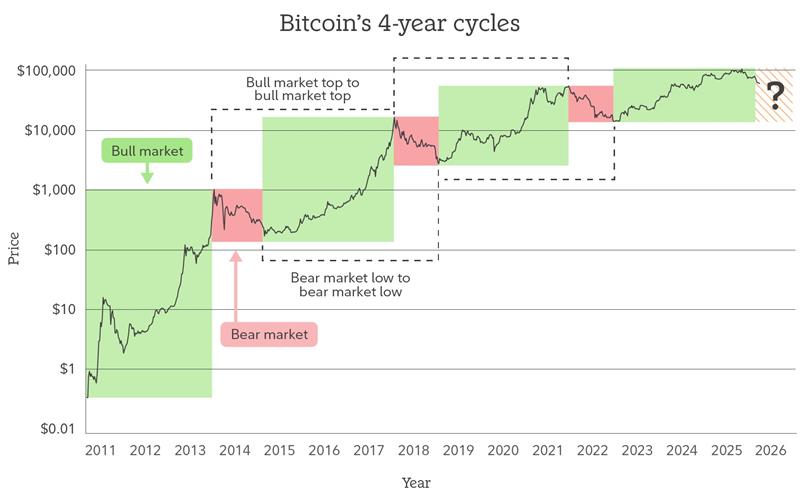
What are 4-year cycles in bitcoin and crypto?
Since 2011, bitcoin’s price has moved in intervals of approximately 4 years. Specifically, its bull market tops and bear market lows have tended to form around 4 years apart from each other. And as bitcoin moves, the total crypto market cap follows.
For example, bitcoin formed bull market tops in November 2013 ($1,150), December 2017 ($19,800), and November 2021 ($69,000). From top to top, each cycle has spanned approximately 4 years. The same 4-year intervals appear with its bear market bottoms, which have formed in January 2015 ($152), December 2018 ($3,200), and November 2022 ($15,500). If this cycle continues to play out, bitcoin’s next bull market top would’ve occurred on October 6, 2025, at just above $126,200. This would be slightly under 4 years from its previous bull market top in November 2021.
As of February 2026, bitcoin’s price has been dropping since October in a manner many investors might call bear market-like price action. In each of its previous bear markets, bitcoin’s price has dropped by at least 77% from its all-time high, while its recent low is 52% below its October all-time high. This doesn’t mean price must fall at least 77% to be considered a bear market—just that the relative magnitude of the current drop hasn’t yet approached what we’ve seen in previous bear markets.
Why have 4-year bitcoin and crypto cycles occurred in the past?
While it may not be possible to discover exactly why crypto prices move the way they do, there are several factors that likely contribute to the cyclical pattern phenomenon.
- Bitcoin halvings. Approximately every 4 years, Bitcoin is programmed to cut its mining rewards in half. The goal of halvings is to curb bitcoin’s inflation by gradually reducing the rate at which new supply of bitcoin tokens is released to the market. Bitcoin advocates hold that if the rate of new supply decreases, but overall demand increases, the price of bitcoin is more likely to go up.
- As mentioned earlier, the total crypto market cap tends to follow bitcoin’s lead. Thus, Bitcoin halvings often coincide with the early stages of a new crypto bull market. The next halving is projected to take place in 2028.
- Monetary policy. Historically, crypto prices have tended to rise when the Fed cuts interest rates, or injects new money into the economy. For example, bitcoin’s 2018–2021 bull market coincided with government policies aimed at boosting the economy during the coronavirus pandemic. Note, however, that it doesn’t always play out this way. For example, bitcoin’s price failed to rally when the Fed cut interest rates in December 2025.
- Investor psychology. Once a new bull market gets going, the same boom-bust dynamics that drive most markets take over. Optimism, momentum, and greed from market participants drive prices up until they reach a top. Panic and fear send prices falling until they reach a low.
Could 4-year bitcoin and crypto cycles be over?
During bitcoin’s 2023–2025 bull run, some investors believed the 4-year cycles were likely over.
Specifically, some held that while there might still be pullbacks in price, any drops would be substantially less volatile than they have been in the past, and could be small enough that they won’t feel like full-blown bear markets. Others believe we could be entering a supercycle, where the bull market is sustained for a long period of time. For reference, a supercycle in commodities in the 2000s spanned nearly a decade.
These views were influenced by the fact that bitcoin has become increasingly mainstream over the last few years. It is rapidly becoming a mature asset, driven by adoption from institutions, corporations, and world governments, the arrival of crypto-friendly regulations in the US, and new investor-friendly products like spot crypto ETPs. In particular, a significant portion of the bitcoin supply is now held by ETP investors and public companies.
However, as of February 2026, it is possible that the traditional 4-year cycles will continue after all. Bitcoin’s current drop in price from its October all-time high isn't a dynamic you typically see in bull markets.
Can investors use bitcoin’s 4-year cycles as a strategy?
Assuming 4-year cycles continue to play out, it may seem reasonable to build an investing strategy around their occurrence.
However, investors may want to use them solely as one of many reference points, rather than as a framework for specific strategies. Remember, the cycles are not precisely 4 years long, and have varied in length during each cycle. If, for example, you bought bitcoin during the 2018–2021 bull market and planned to sell it exactly 4 years from its previous bull market top, you would not have sold until the price had already dropped over 30% from its current bull market high.
Instead, it may make more sense to use your knowledge of cycles as one of many considerations for deciding when to take some profit. For example, if time is approaching that 4-year mark, you might choose to sell a portion of your holdings in case a bull market top is approaching.
Also keep in mind there is no guarantee 4-year cycles will continue to play out as they have in the past. Those who believe the cycles are over could eventually be right in a future bull or bear market. For example, crypto could get stuck in an extended bull or bear market that lasts longer than 4 years.
As always, in light of these uncertainties, it’s important to note that crypto is for investors with a high risk tolerance. Given the ups and downs, only invest what you can afford to lose.