


After making a new all-time high above $126,200 in October 2025, bitcoin and the broader crypto market descended into a bear market. Despite a short-lived rally from March to May earlier this year, bitcoin is currently trading back below $69,000, the high it made during its 2019 to 2021 bull market.
What is a crypto winter and why do many say we’re in one?
A crypto winter is simply another term for a bear market. Some may debate whether the last several months of price action is truly a bear market in a technical sense, as in each of bitcoin's previous bear markets, its price has dropped by at least 77% from previous its all-time high. In contrast, its recent June 2026 low is roughly 53% below its last all-time high.
However, what’s clear is that we’re far from being in a bull market. And the enthusiastic market sentiment that was present during the bull run has been completely absent in 2026.
What might end the crypto winter?
Since 2011, bitcoin has been through and emerged from 4 bear markets. While no one knows for sure whether another bull market will happen, it can nevertheless be helpful to understand which factors have helped catalyze one in the past.
Let’s explore 5 elements that have previously ended crypto winters and brought new bull markets to life.
1. Bitcoin's historical 4-year cycles
Throughout most of its history, bitcoin has tended to form both bull market tops and bear market bottoms roughly 4 years apart. If this pattern were to continue (note there is no guarantee it will), it could mean the current bear market will bottom some time around November 2026, as its last bear market bottom occurred in November 2022.
A key driver of these 4-year cycles is bitcoin's halving mechanism. Approximately every 4 years, the Bitcoin network is programmed to cut its mining rewards in half. This reduces the rate at which new bitcoin enters circulation. If demand holds steady or increases while new supply decreases, the price of bitcoin may go up as a result. And since crypto tends to follow bitcoin's lead, new bitcoin bull markets have historically lifted the broader crypto market along with it.
That said, crypto investors may only want to use 4-year cycles as a form of big-picture analysis, rather than a mechanical way to time a trade. The cycles aren’t exactly 4 years long. Some have been longer, while others have been shorter. And even though the cycles have played out since 2011, there’s no guarantee the pattern will continue.
2. New regulatory developments
The start of previous crypto bull markets have at times coincided with the passing of crypto-friendly regulations. Near the beginning of the 2015 bull market, for example, New York’s Department of Financial Services created a formal licensing requirement for crypto businesses. This helped restore confidence in the markets after a prominent crypto exchange collapsed in 2014.
Regulations have also at times added fuel to an existing bull market. One example is the Securities and Exchange Commission’s (SEC) approval of spot bitcoin ETPs in January 2024, which helped push bitcoin’s price to new all-time highs.
One piece of legislation the crypto industry has been watching for a long time is the CLARITY Act, which would establish a legal framework for digital asset markets in the US. Historically, domestic crypto businesses have operated in an uncertain legal environment. Supporters hope CLARITY will provide clear, well-regulated guidelines that ultimately boosts domestic activity if it becomes a law.
As of June 2026, however, the CLARITY Act is still being debated among lawmakers. Nevertheless, it’s a significant area to watch closely.
3. Changes in government monetary policy
In the past, crypto prices have tended to rise when the Federal Reserve cuts interest rates. Crypto is a risk asset, and like most risk assets, it has historically benefitted from looser monetary conditions. Lower interest rates means borrowing becomes cheaper and investors feel more comfortable taking on risk. The opposite has often been true when interest rates rise.
As of June 2026, a lot of uncertainty remains regarding how the Fed might handle interest rates going forward. Given the current state of inflation, some believe it’s possible interest rates could be raised later in the year. Historically, the expectation of higher interest rates has negatively affected bitcoin’s price. But if the unexpected happens and inflation cools, leading the Fed to cut interest rates, history suggests it could potentially provide a meaningful boost to crypto markets.
Of course, note that this isn't guaranteed, as the relationship between monetary policy and crypto prices is correlational, not causal, and past performance is no guarantee of future results. Investors should also note that any appreciation in crypto prices could take place in anticipation of rate cuts, well before they're actually announced.
4. A crypto use case unexpectedly catches on
Crypto bull markets can also be catalyzed by a wildly popular use case that brings a new wave of investors into the market. For example, the 2019 to 2021 bull market was driven in part by mainstream frenzy over non-fungible tokens (NFTs) and memecoins (cryptocurrencies named after a popular internet trend or joke that typically don’t have any real utility).
Could a wildly popular use case end the crypto winter and drive the next bull market? Currently, some of the most talked-about trends in crypto include:
- Real-world asset tokenization, where the ownership of physical assets like real estate, commodities, and private credit is tracked and transferred on a blockchain
- Stablecoins, cryptocurrencies whose value is "pegged" (meaning tied) to another asset, often a traditional fiat currency like the US dollar. Stablecoins are seeing rapidly growing adoption and have benefitted from 2025’s GENIUS Act.
- AI-related crypto applications, which provide support for machine learning functions, GPU computing networks, agentic AI use cases, and other AI-related infrastructure
But a catalyst for a crypto bull market could also be something no one sees coming. In either case, widespread adoption could trigger a new wave of investor excitement and drive new money into crypto.
5. Growing institutional adoption
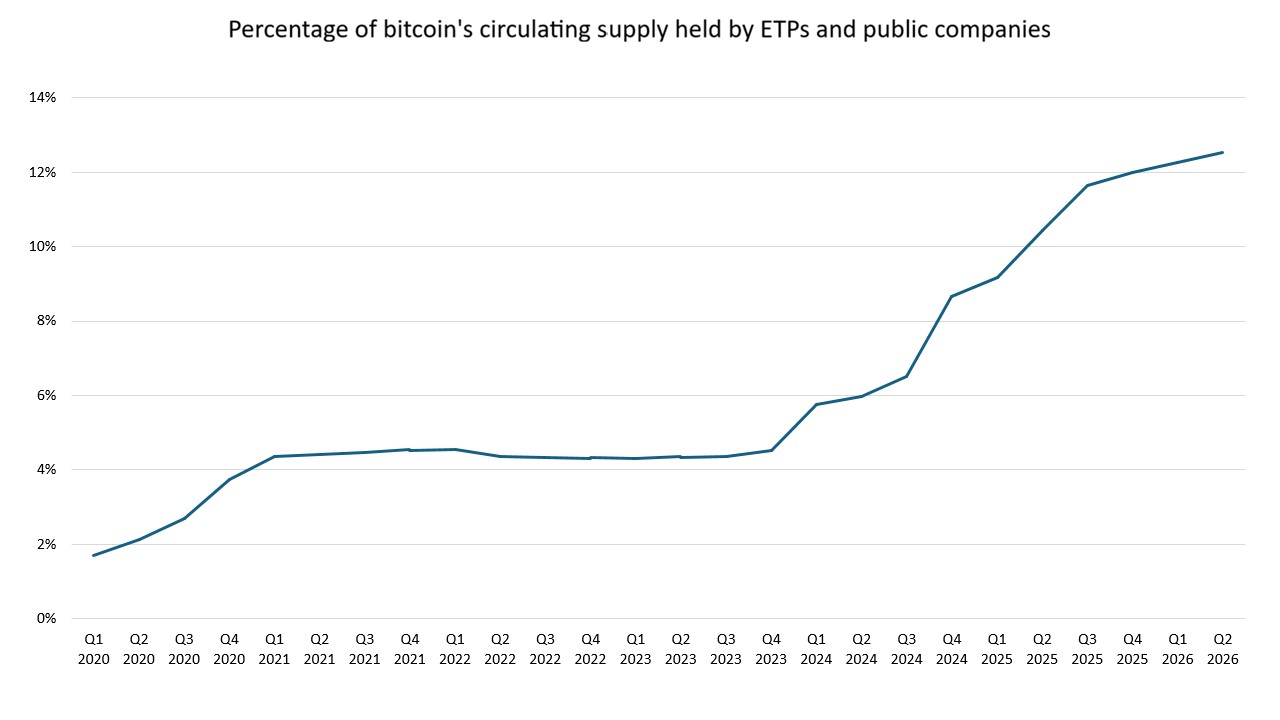
In the past, announcements that an institution was buying crypto has helped stoke the fires of existing bull markets. In 2020, several publicly traded companies disclosed they were adding crypto to their balance sheets—an important catalyst for the bull market at the time, which ended up running until late 2021. Likewise, 2024’s approval of spot crypto ETPs and 2025’s announcement that the US would be creating a strategic crypto reserve helped push bitcoin up to its most recent all-time high above $126,200.
However, in 2026, institutional adoption of crypto is no longer a fresh narrative. Adoption has continued to grow steadily even throughout the current bear market, with no signs of a new bull market in sight.
Nevertheless, it may still be possible for a new, unforeseen level of institutional involvement to spark a new narrative. A hypothetical example might be if a Magnificent Seven company announces they’re adding a significant amount of crypto to their balance sheet. Note that while Tesla (
Another example might be if a world event drives institutions to use crypto as a hedge (so far throughout the conflict in Iran, we have not seen institutions view crypto this way).
The future of the crypto winter remains uncertain
No one can predict when or if the current crypto bear market will end. The factors discussed above represent a few possible catalysts, but markets can defy expectations in both directions. Any one of these developments could spark a new bull run, or all of them could materialize without producing the recovery investors are hoping for.
On a big-picture level, crypto still has some tailwinds going for it, like the growing adoption of stablecoins. But this does not guarantee a new bull market will happen.
In light of this, if you are considering investing in crypto, you might only invest an amount you are willing to lose. As always, remember that crypto is highly volatile and may be more susceptible to market manipulation than securities. Crypto holders don't benefit from the same regulatory protections applicable to registered securities, and holdings aren't insured by the Federal Deposit Insurance Corporation or the Securities Investor Protection Corporation. The regulatory environment remains uncertain and continues to evolve.