
Estimate Time5 min

Stock ideas in staples

Key takeaways

  • Consumer staples don’t get as much attention as other parts of the market, but they can be potentially attractive parts of your investment mix.
  • Staples may be able to resist inflationary pressures more than other parts of the market.
  • These stocks have historically offered relatively healthy dividend yields.

While tech and AI get a lot of investor attention these days, there are other parts of the market that can offer overlooked opportunities because they may not be as in vogue. Consider consumer staples, which have offered potentially attractive yields relative to the broad market as well as relatively stable revenues and earnings historically speaking. That can be particularly important if you are concerned about inflation and other market risks.

Stocks in good spirits

Consumer staples stocks include companies that produce essential goods such as food, beverages, household products, and personal care items. You'll recognize many of these companies as familiar names in groceries, cleaning products, and basic health items that people rely on regardless of economic conditions.

Within the consumer staples sector, Ben Shuleva—manager of the Fidelity® Select Consumer Staples Portfolio ()—thinks alcohol-related companies with strong brand equity and international exposure may be well positioned.

“I remain bullish on distillers, which are companies that make and sell hard alcohol such as vodka, gin, whiskey, and rum,” Shuleva says.

These companies faced meaningful headwinds last year, some of which have persisted into this year. These include declining consumption among younger consumers due in part to the impact of GLP-1 drugs as well as economic pressures on low- and middle-income households.

“But I think some of these cyclical headwinds will ease at some point,” Shuleva points out. “The market is pricing those businesses as if the headwinds are 100% structural, whereas I think it is more like 50% structural and 50% cyclical. If cyclical headwinds ease, I think the market narrative will shift for many of these stocks.”

Potentially attractive yields in consumer staples

Consumer staples companies have historically generated stable and recurring cash flows. Since their products are purchased frequently, revenue streams tend to be highly predictable. From an income perspective, steady cash flow can underpin dividend sustainability. Companies that consistently generate excess cash can be better positioned to return capital to shareholders through dividends and share buybacks, and consumer staples stocks are often associated with reliable and attractive dividend income.
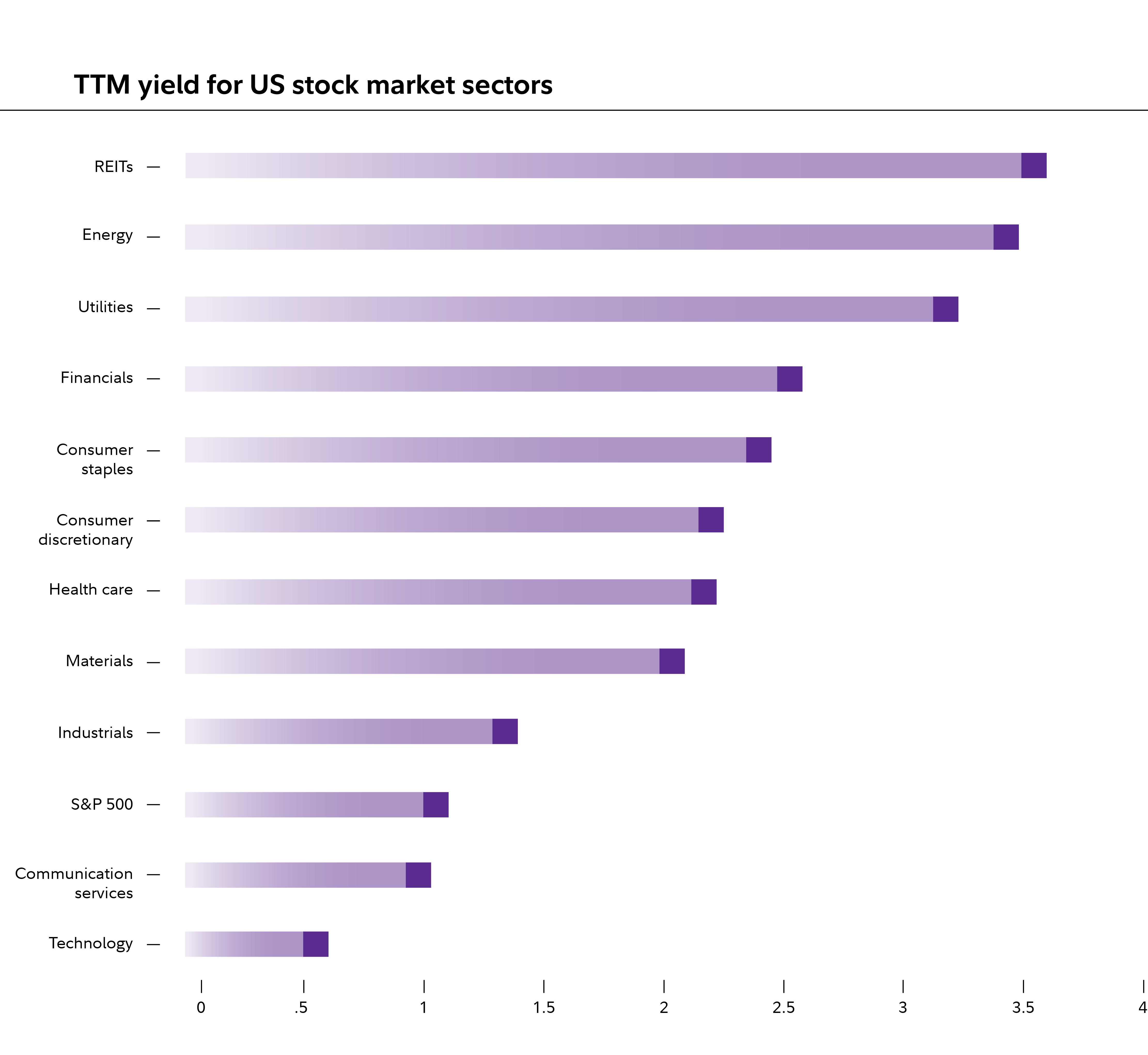
Chart describes dividend yields across the 11 stock market sectors.
Source: Fidelity.com, as of May 28, 2026. TTM = Trailing 12 months.

“For instance, Coca-Cola ()—which is my fund’s largest holding—has increased its dividend for more than 60 consecutive years, through good economic times and challenged times,” Shuleva says. “The asset-light, highly profitable, highly recurring nature of their business allows for stability in free cash flow generation, which in turn allows for increasing dividends. That also proved to be true through periods of heavy inorganic investments, like the Costa acquisition and the more recent investment to consolidate Fairlife.”

An inflation buffer?

If you’ve been monitoring markets, you know that inflation has been heating up. Another potential advantage of consumer staples companies relative to some other sectors is the capacity to pass on higher costs to consumers.

“Coca-Cola is also an example of a business that operates in consolidated market structures with real barriers to entry, and thus it has the ability to consistently pass through higher costs to help keep profits stable and/or growing,” according to Shuleva. “So too is British American Tobacco (). This is true both in the US market and internationally. Keurig Dr Pepper () also plays into this theme, as they generally ride the coattails of Coca-Cola’s leadership in soft drink pricing.”

Strong brands and everyday necessity products can give these firms a degree of pricing power. In inflationary environments, this pricing power becomes particularly valuable. Companies can raise prices to offset higher input costs (such as raw materials, packaging, or transportation), preserving profit margins over time. As prices rise, revenues and earnings can keep pace, supporting both stock prices and dividend payments.

Staples for potentially less investing volatility

Another factor to consider in favor of consumer staples stocks is their defensive nature, which may help investors weather volatility and offer the ability to be resilient across economic cycles. Their steady demand and predictable earnings can make them less sensitive to macroeconomic shocks and market speculation. Consequently, consumer staples stocks generally exhibit lower volatility than the broader equity market.

Shuleva sees a lot of opportunity here for investors to consider. “Kenvue () and Kimberly Clark () are good examples of firms that have a history of exhibiting lower demand volatility. Their primary products are diapers, toilet paper, pain relief products, and allergy medication, which can all be things you need regardless of your economic situation.” For investors, this can mean lower portfolio drawdowns during downturns and potentially more consistent returns.

Consumer staples stock investing

While other parts of the market may continue to capture more headlines, you may want to keep an eye on other opportunities that can help you build an investment mix that can potentially stand the test of time. For investors seeking stability as well as relatively attractive income and value compared with other parts of the market, consumer staples might be worth a second look.

Fund top holdings

Top-10 holdings of the Fidelity® Select Consumer Staples Portfolio (), as of April 30, 2026:1

  • Coca-Cola () – 13.9%
  • Proctor & Gamble () – 10.5%
  • Costco ()– 9.2%
  • Walmart () – 8.1%
  • Keurig () – 7.3%
  • Kenvue () – 5.0%
  • Mondelez () – 4.8%
  • Target () – 4.1%
  • Energizer () – 2.7%
  • British American Tobacco () – 2.7%

(See the most recent fund information.)

Research stocks, ETFs, or mutual funds

Get our industry-leading investment analysis, and put our research to work.

More to explore

Get started trading

Get industry-leading research, guidance, tools, and pricing. Open an account.
Before investing, consider the funds' investment objectives, risks, charges, and expenses. Contact Fidelity for a prospectus or, if available, a summary prospectus containing this information. Read it carefully. 1. Any holdings, asset allocation, diversification breakdowns or other composition data shown are as of the date indicated and are subject to change at any time. They may not be representative of the fund's current or future investments. The Top Ten holdings do not include money market instruments or futures contracts, if any. Depository receipts are normally combined with the underlying security. Some breakdowns may be intentionally limited to a particular asset class or other subset of the fund's entire portfolio, particularly in multi-asset class funds where the attributes of the equity and fixed income portions are different. Under the asset allocation section, international (or foreign) assets may be reported differently depending on how an investment option reports its holdings. Some do not report international (or foreign) holdings here, but instead report them in a "Regional Diversification" section. Some report them in this section in addition to the equity, bond and other allocation shown. Others report international (or foreign) holding as a subset of the equity and bond allocations shown. If the allocation without the foreign component equals (or rounds to) 100%, then international (or foreign) is a subset of the equity and bond percentage shown.

Views expressed are as of the date indicated, based on the information available at that time, and may change based on market or other conditions. Unless otherwise noted, the opinions provided are those of the speaker or author and not necessarily those of Fidelity Investments or its affiliates. Fidelity does not assume any duty to update any of the information.

References to specific securities or investment themes are for illustrative purposes only and should not be construed as recommendations or investment advice. This information must not be relied upon in making any investment decision. Fidelity cannot be held responsible for any type of loss incurred by applying any of the information presented. These views must not be relied upon as an indication of trading intent of any Fidelity fund or Fidelity advisor. Investment decisions should be based on an individual's own goals, time horizon, and tolerance for risk. This piece may contain assumptions that are "forward-looking statements," which are based on certain assumptions of future events. Actual events are difficult to predict and may differ from those assumed. There can be no assurance that forward-looking statements will materialize or that actual returns or results will not be materially different from those described here.

Past performance is no guarantee of future results.

Investing involves risk, including risk of loss.

Stock markets are volatile and can fluctuate significantly in response to company, industry, political, regulatory, market, or economic developments. Investing in stock involves risks, including the loss of principal.

Because of its narrow focus, sector investing tends to be more volatile than investments that diversify across many sectors and companies. Sector investing is also subject to the additional risks associated with its particular industry. The S&P 500® Index is a market capitalization-weighted index of 500 common stocks chosen for market size, liquidity, and industry group representation to represent US equity performance.

Fidelity Brokerage Services LLC, Member NYSE, SIPC, 900 Salem Street, Smithfield, RI 02917

1266062.1.0