


A lot of financial planning for retirees revolves around how to minimize the tax bite on the money you may need to withdraw from pre-tax retirement assets. Once you reach age 73,1 you must start drawing down these accounts to satisfy required minimum distributions (RMDs), which are taxed as ordinary income.
But a little-known SECURE 2.0 Act rule allows individuals who purchase a qualified income annuity with all, or a portion, of their retirement account assets to then use the annuity payment that exceeds the RMD amount for the annuity to also help satisfy RMD requirements for the purchasing account and any accounts that are allowed to be aggregated for RMD purposes.2 This includes traditional IRAs and workplace retirement plans that were used to fund the qualified annuity. That means more money can potentially stay invested and grow in your investment portfolio. What’s more, the rule change applies to an annuity you may have purchased today or years ago.3
What is a qualified income annuity?
Briefly, a qualified income annuity is a contract with an insurance company where you exchange a portion of your tax-deferred retirement savings for steady payments from the annuity. These payments can be either for as long as you live or for a set period of time; the annuity payments can also start right away or at a point in the future that you determine. The amount of annuity payments you receive generally does not change over the specified time frame and provides steady cash flow, which can help fill any income gaps you may have once you stop working.
Good to know: Annuities can be funded either with qualified (pre-tax) dollars held in a retirement account, or with nonqualified dollars held outside of a retirement account. The little-known RMD rule applies to qualified income annuities.
RMDs and income annuities: What’s changed
Prior to the SECURE 2.0 Act, payments from income annuities purchased with traditional IRA or other qualified assets satisfied the RMD requirement only for that annuity. Since the passage of SECURE 2.0, annuity payments that exceed the calculated RMD for the annuity can also be used to help satisfy your RMD from the originating account.
In some cases, the excess annuity payments can also be used to satisfy your RMD for other qualified accounts. For example, if you own more than one IRA, your RMD must be calculated for each account, but you may aggregate your IRA RMDs and withdraw the total from a single account or any combination of IRAs you own. It’s important to note that’s not the case if you have more than one workplace plan. RMDs must be calculated and withdrawn separately from each account. Spousal IRAs also would be calculated separately, although they may be aggregated with other spousal IRAs.
Since the excess cash flow—or the amount of annual annuity payments minus the RMD associated with the annuity—can help satisfy your RMD for your IRAs or retirement plans, that means more of the money in your retirement portfolio can stay invested. In turn, that gives your assets the potential to grow tax-deferred for longer.
How annuity payments can be used for RMDs
The fair market value (FMV) of your annuity is determined at the end of each calendar year by the insurance provider. It is similar to the market value of other financial assets and takes into account the present value of the contract’s future cash flows. This FMV amount is reported on Form 5498 by your financial institution. If you are responsible for an RMD this form can be used to help determine the remaining RMD, if any, for the account used to purchase the annuity.
Important to know: Calculating your RMD can be complicated, so it’s a good idea to consider working with a tax professional who can help you calculate how much you need to withdraw from your IRAs, workplace accounts, or both.
Let’s assume a hypothetical scenario where a person named Anne transfers $100,000 from an IRA to a qualified deferred income annuity. At 73 when annuity income is scheduled to begin, she must also start taking RMDs from her IRAs.
Anne’s situation
Age: Anne will turn 73 this year.
The annuity: At age 68, Anne used $100,000 from an IRA to purchase a deferred income annuity (DIA). She chose a 5-year deferral period, starting her annual lifetime income on January 1 of the year she turns 73.
DIA income: Anne's annual lifetime income from the DIA is $10,644, which she intends to use to cover her yearly expenses.
IRA assets: Anne also has $100,000 in other IRA assets.
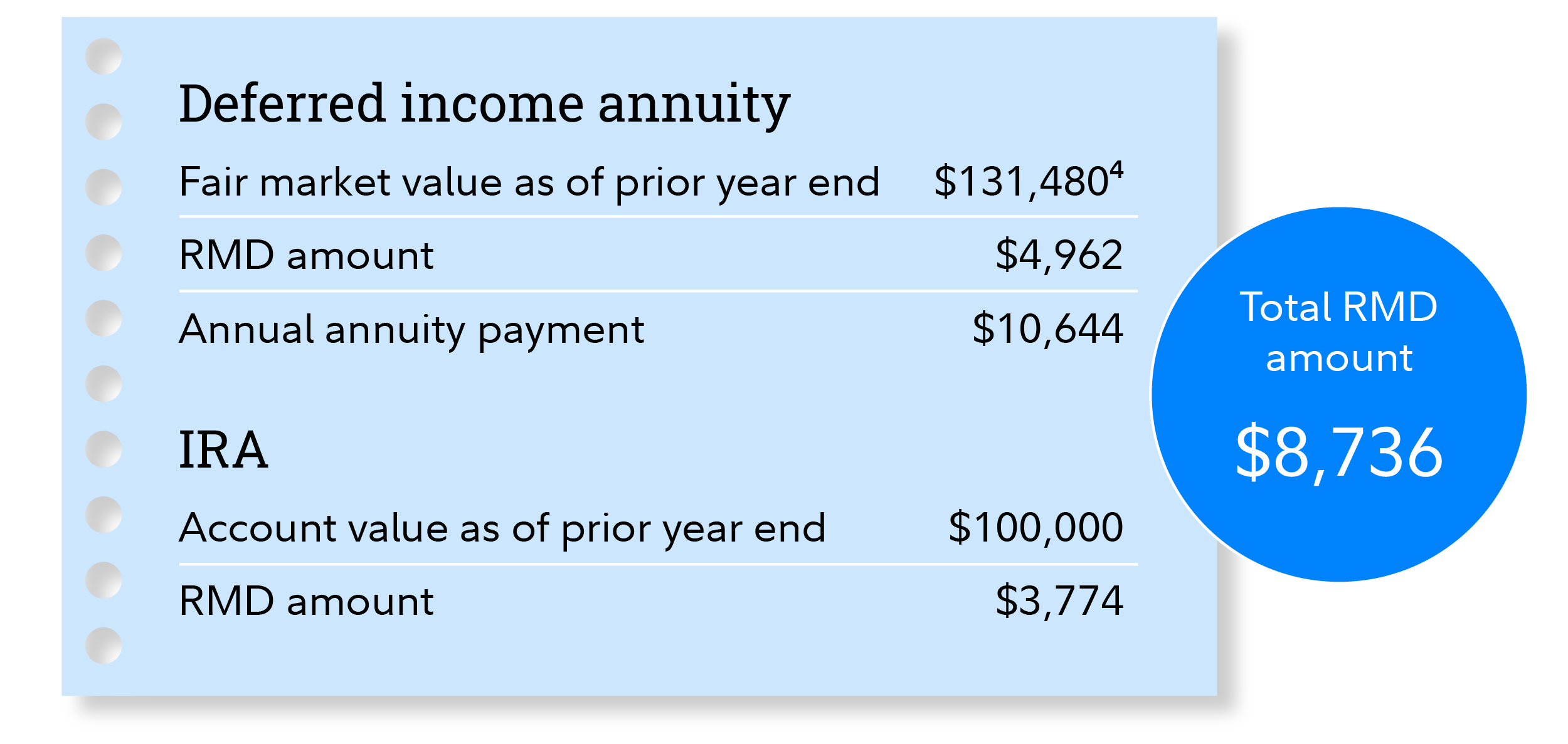
Anne’s RMDs: The annuity payment of $10,644 from the DIA can be used to satisfy the RMD of both the DIA and Anne's other IRA assets.
In other words, since the payment from Anne's DIA exceeds her total RMD amount for her qualified income annuity and IRAs, she is not required to withdraw any additional amounts from her IRA.
Annual considerations
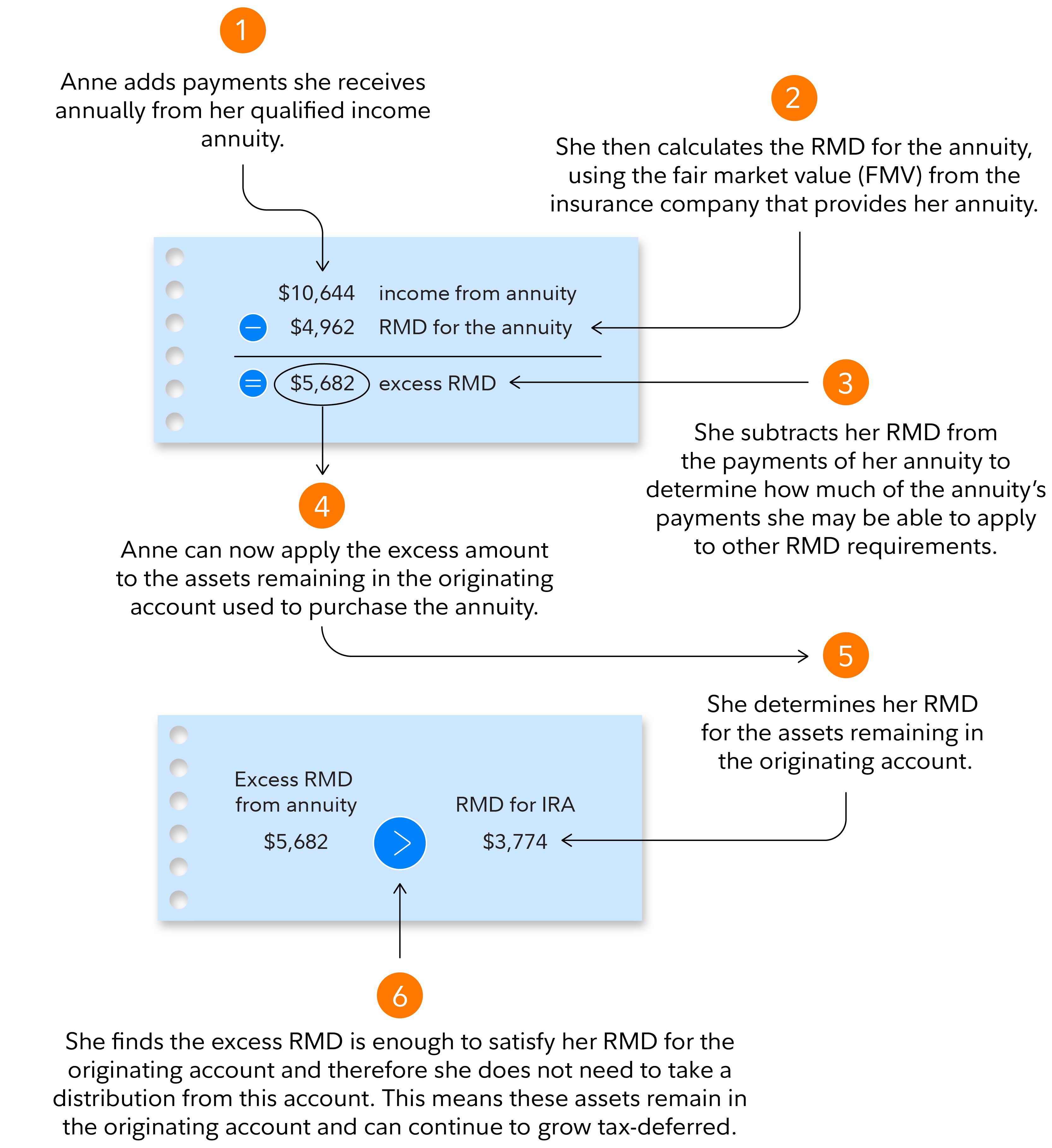
The FMV of your annuity will change every year.5 While your financial institution will provide you with information documenting your annuity’s FMV, it’s important to remember to determine your RMD based on the FMV as of December 31 of the prior year. You also may need to take RMDs from other accounts, so consider meeting with a tax or financial professional to discuss the best way to manage your RMDs.
The following steps are required each year to determine how much of the cash flow from your qualified income annuities you may be able to apply to your overall RMD calculation. We suggest meeting with your tax advisor to calculate this amount.
Along with Social Security benefits, annuities can be an important part of your retirement plan, helping to add guaranteed income after you stop working. The SECURE 2.0 Act has potentially added more flexibility to how you take RMDs for your qualified accounts, giving your retirement portfolio the potential to grow tax-deferred for longer.