


As US voters prepare for the midterm elections in November, they will have a big stake in determining not only who controls Congress, but legislative direction and policy decisions for the next 2 years.
While history tells us the incumbent party often loses ground during the midterms, there are no guarantees for the 2026 elections, and it’s possible neither party will gain a decisive majority. That may result in divided government, which could affect what and how much legislation gets passed.
The 2026 midterm elections and the stock market
Historical data suggests markets may tend to outperform in the 12 months following midterm elections. And although markets tend not to like policy uncertainty, legislative gridlock and deregulation may work in their favor.
But the potential lack of governing unity matters as there is a growing sense of urgency surrounding critical pocketbook issues ranging from continuing inflation, the solvency of Social Security and Medicare, and the strength of retirement plans. These concerns are perhaps heightened as they play out against a backdrop of geopolitical conflict and high day-to-day and energy costs.
At the same time, the outcome of the midterms may determine whether the current administration can further advance its legislative and policy agenda. Over the past 2 years, voters have seen the most sweeping changes to tax policy in almost a decade, not to mention broad tariff expansion and efforts to roll back regulations across environmental, energy, financial services, and other sectors.
With narrow governing margins likely regardless of which party prevails, legislating could continue to be difficult, and the focus may increasingly turn to regulatory levers to achieve policy goals.
Here are some things to look out for in the midterms and the years ahead.
Which party will have control after the 2026 midterm election?
All 435 seats are up for a vote in the House, and approximately one-third of the seats in the Senate, are in play. Currently, Republicans hold a slim lead in both chambers, with 218 seats in the House to 212 for Democrats and 53 seats in the Senate to the Democrats’ 45 (not including independents and vacancies for both houses). In addition to several special elections to fill vacant seats, numerous close races—such as the Senate contests in Maine, Ohio, and Texas—are expected.
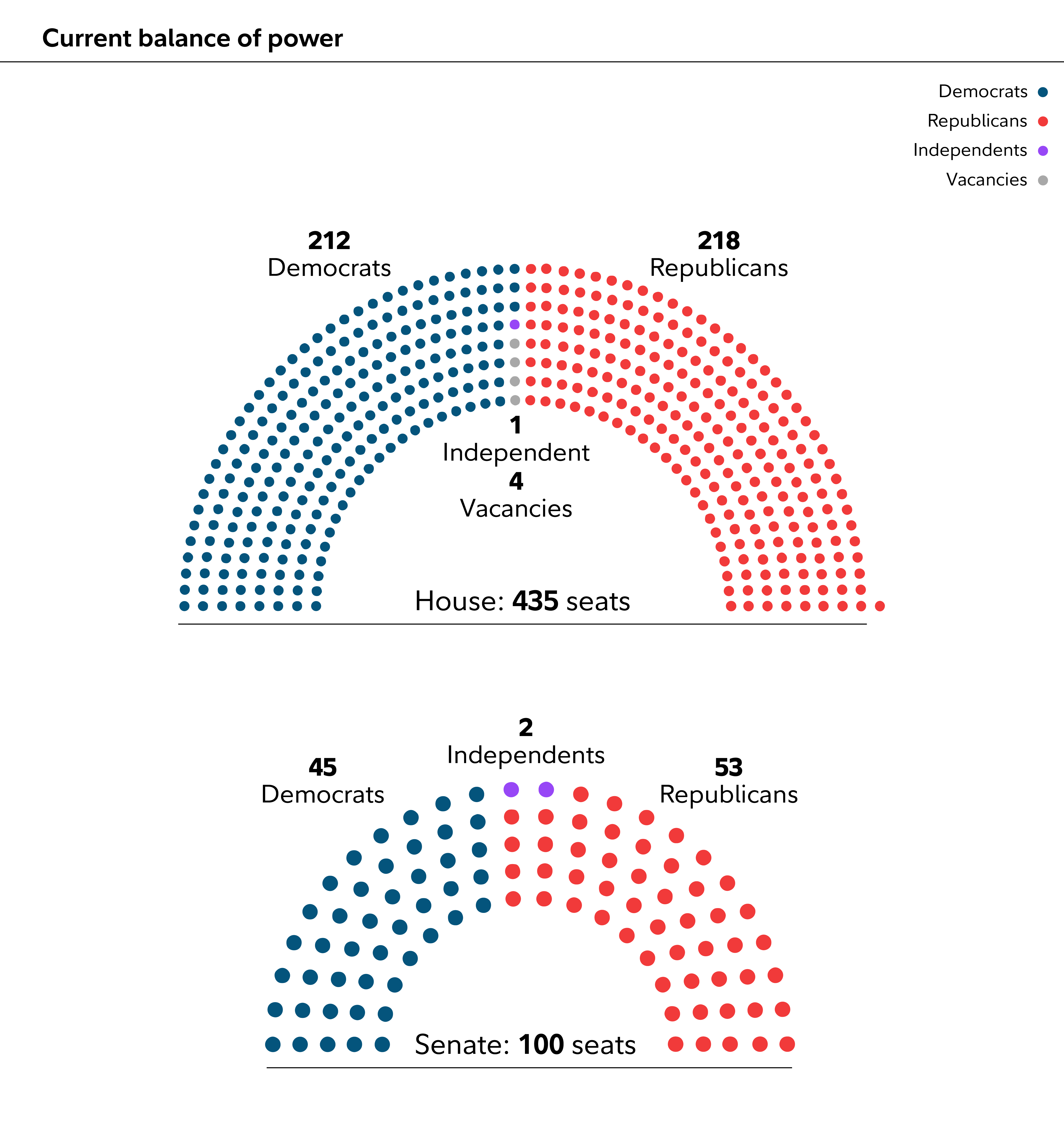
In both houses, Republicans must only maintain the seats they have, while Democrats must keep their current seats and pick up a handful of Republican-held seats to prevail, says Greg Lowman, vice president of advocacy and policy communications for Fidelity. In the Senate, “Democrats would have to hold on to what they have and flip 4 seats” to win control, he adds.
Over the past few weeks, however, the competitive landscape appears to have changed, and chances of a "blue wave" appear to have risen in the House, although the number of competitive seats there is at historic lows due to redistricting, Lowman says.
How the 2026 midterm election could drive regulatory changes
Assuming the balance of power in Congress remains closely divided, it’s possible the biggest changes over the next 2 years might come from executive orders and regulatory actions involving federal agencies. The Trump administration has used hundreds of executive and regulatory actions to advance its policy priorities in areas such as immigration and border control, energy production, cryptocurrencies and digital assets, and tariffs, among many others.1
Possible executive and regulatory actions in the next 2 years could affect many aspects of Americans’ lives, making it difficult to predict exactly which issues will emerge as priorities. When it comes to personal finance, areas to watch may include whether alternative investments can be offered to more everyday Americans, how Trump Accounts evolve, expanding access to health savings accounts, and the impact of continued trade and tariff policies on the inflation outlook. Meanwhile, the Department of Labor will likely re-evaluate how environmental, social, and governance (ESG) factors may be considered in investment products. And while Congress continues to deliberate a broad bipartisan framework for digital assets such as cryptocurrency, regulators overseeing that industry have signaled that they will move forward with rules absent legislative action.
In all events, expect a continued push for deregulation as the administration seeks to reduce the size of the federal government and cut red tape for business. These changes often have an institutional impact but could also affect consumers in areas including financial services, health care, and trade policy.
The 2026 midterm elections and major tax reform
Little can boost or diminish your spending power faster than tax cuts and tax increases. But after the passage of the One Big Beautiful Bill Act (OBBBA) in 2025, another sweeping round of tax legislation remains uncertain. Absent a Republican-driven reconciliation package following the election, Congress could consider more limited bipartisan reform focused on provisions that could range from tax breaks scheduled to sunset, to Internal Revenue Service (IRS) modernization and fraud protection measures.
For taxpayers, OBBBA firmly established tax brackets and capital gains brackets, as well as increases to the standard deduction, which could make tax planning more predictable. However, some of OBBBA’s most significant provisions for taxpayers will expire between 2028 and 2029, such as the increase to the state and local tax (SALT) deduction, the new $6,000 senior deduction, and no tax on some tipped income.
A new tax package could address the sunsetting of these additional deductions and credits after 2028, even though there may be little political will to address these phaseouts in a divided Congress. If you’re using any of these deductions, it might be wise to stay aware of when they are slated to end.
Social Security fixes unlikely after the 2026 midterm elections
Social Security benefits play a critical part in many people’s retirement plans, but the program’s long-term solvency remains a major concern. A report from the board of trustees for the Old-Age and Survivors Insurance (OASI) fund says that the trust fund will begin running out of money toward the end of 2032, several months earlier than previously forecast. The senators elected in 2026 will serve until January 2033, meaning they may be among the lawmakers responsible for addressing the Social Security funding shortfall if current projections prove accurate.
Numerous bills have been introduced in the House and Senate to address the shortfall in recent years, with proposals that include raising the benefit-receiving age, raising the FICA tax threshold to include some higher earners, or reducing benefits. Nevertheless, Social Security reform has historically struggled to gain momentum in Congress until the 11th hour, making major reforms unlikely in the aftermath of the midterms.
“For a long time, we've talked about Social Security as the ‘third rail’ in Washington,” says Jillian Enoch, vice president of public policy for Fidelity. “But it is coming down to the wire now.”
Read more in Viewpoints: Planning for Social Security changes
The 2026 midterms and health care changes
Meanwhile, sharp increases in the cost of health care have given younger and older consumers alike a dose of sticker shock.
Millions of Americans have had to pay more for their health insurance in 2026 as enhanced tax credits that lowered the cost of Affordable Care Act (ACA) marketplace plans expired. For many early retirees and individuals without employer-sponsored health care plans, this has meant thousands more in annual premiums.
A single 65-year-old retiring in 2026 can expect to spend $185,000 on health care in retirement, according to the latest Fidelity Annual Retiree Health Care Cost Estimate, a 7.5% increase from 2025.
While it’s unlikely that the supplemental credits for ACA plans will be restored, other health care legislation could still emerge over the next 2 years. For example, legislation is being considered that could expand participation in health savings accounts (HSAs) and broaden the kinds of health care spending and health expenses for which these accounts can pay, Enoch says. Other initiatives might include so-called site-neutral payment reform that would allow Medicare to pay the same rate for care regardless of venue, and a push for greater transparency from pharmacy benefit managers, the middlemen who negotiate drug prices for health insurance prescription plans.
Retirement, a possible area of bipartisan agreement after the 2026 midterms
Strengthening the retirement prospects of older Americans has had some bipartisan agreement for years (for example with the SECURE 2.0 Act) and there could be further action—if only incremental—in the next 2 years.
One area of possible bipartisan cooperation could be for expanding access to workplace retirement plans such as 401(k)s, Enoch says.
For example, Senators Bill Cassidy (R-LA) and Tim Kaine (D-VA) have introduced a bill called the Helping Young Americans Save for Retirement Act, which would lower the retirement plan participation age to 18 from 21. Among other things, the bill would exempt these workers from certain administrative testing requirements, which could make it easier for employers to let younger workers access their plans.
Remember to create a long-term plan
Regardless of the election outcome, it’s important to plan for many different scenarios that could arise. A financial or tax professional could help you build a sensible plan to weather a variety of economic situations for the current election cycle and beyond.
If you need assistance developing a financial plan or making sure that the plan you have could withstand a variety of market, economic, and policy environments, learn more about how we can work together.