


When you take out a mortgage, the interest rate greatly affects the total cost. Your monthly mortgage payment is based on 3 main factors: the loan amount (principal), the interest rate, and the length of the loan term. Because you’re borrowing so much money for so many years, even a slight rate reduction can save you thousands throughout the life of the loan. Mortgage points allow you to buy down the rate and give you a discount on your loan interest rate to save money over the long term.
What are mortgage points?
Mortgage points are an optional fee you can choose to pay the lender when you set up your mortgage. They generally work like paying some of the interest upfront. In return, the lender may offer a lower interest rate.
A lower rate can reduce your monthly payments and the amount of interest you pay over the life of the loan, depending on your situation. This is why mortgage points are sometimes called discount points or prepaid interest.
How do mortgage points work?
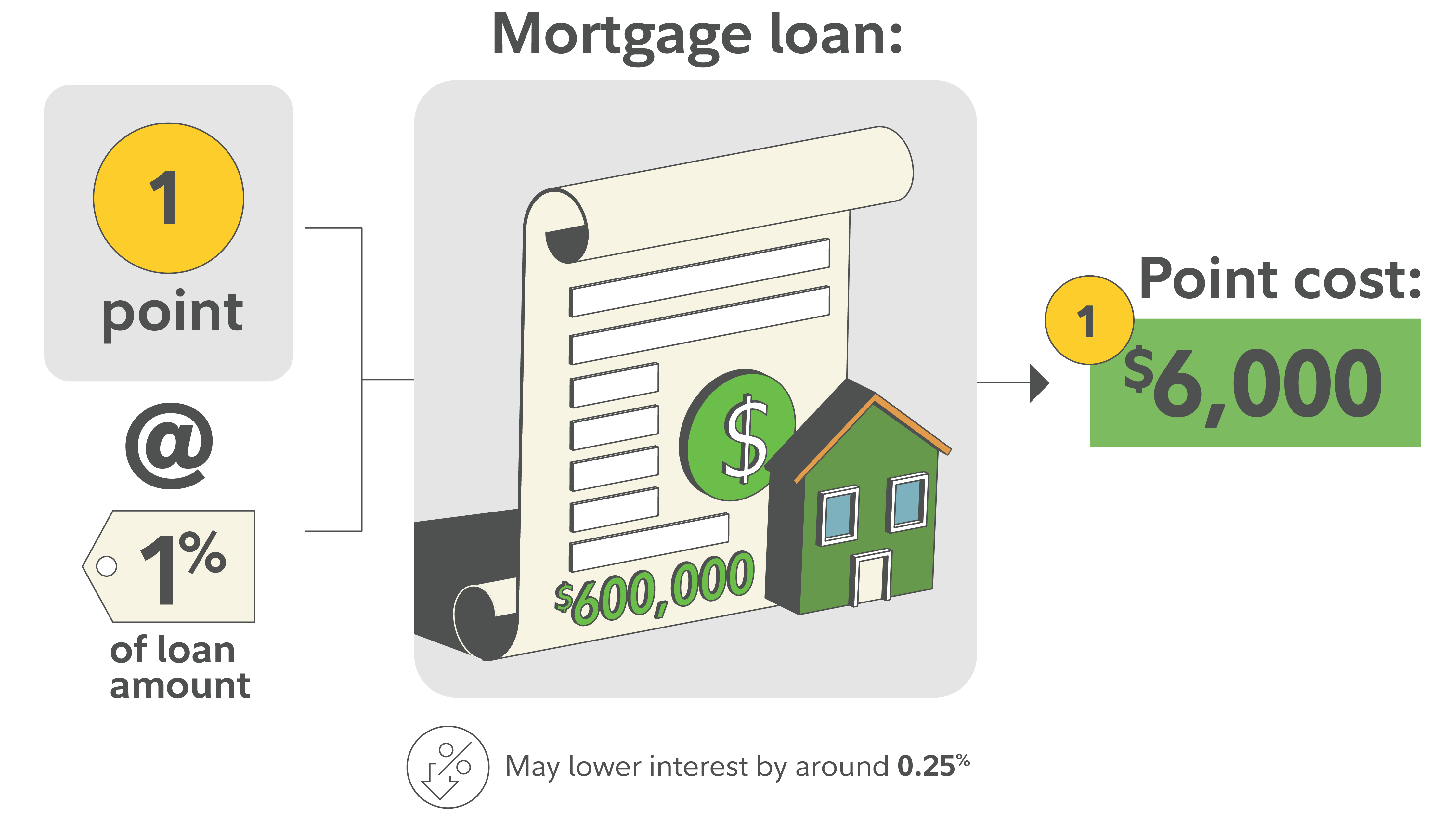
If a lender offers mortgage points, they will explain the specific terms of what type of interest rate discount you might get in exchange for the prepaid interest. In many cases, 1 point costs about 1% of the principal amount and may lower the interest rate by around 0.25%. For example, on a $600,000 loan, one point would cost about $6,000. You can pay for points upfront at the mortgage closing or roll the cost into the loan, depending on the lender’s rules.
Lenders often limit how many points you can buy—usually up to 4—so the rate reduction is capped. For instance, if you qualify for a 30‑year loan at 6.5%, buying 4 points might lower the rate to roughly 5.5%.
With a fixed‑rate mortgage, any rate reduction from points typically lasts for the entire loan term. With an adjustable‑rate mortgage (ARM), the lower rate usually applies only during the initial fixed period, such as the first 5 or 7 years. Because of this, buying points for an ARM is less common.
Potential advantages of buying mortgage points
Now that you know what mortgage points are, here are some reasons people consider buying them.
Lower your monthly payment
Buying points can lower your interest rate, which may reduce your monthly mortgage payment. For example, on a 30-year term $500,000 loan, lowering the rate from 6.75% to 6.5% could reduce the payment by about $83 per month. Over a year, that adds up, and the lower payment stays in place for the whole 30‑year loan.
Can reduce total interest paid over time
A lower interest rate usually means paying less interest over the life of the loan. If you stay in the home long enough to benefit from those smaller payments, the savings can add up compared with not buying points.
| Points | Present value of interest paid | Cash outlay at closing for points |
|---|---|---|
| 1 | $590,623 | N/A |
| 2 | $563,959 | $6,000 |
| 3 | $537,555 | $12,000 |
| 4 | $511,418 | $18,000 |
| 5 | $485,556 | $24,000 |
Present value calculations are based on an assumed inflation rate of 2.5%. Cash outlay excludes any additional closing costs.
Might help you qualify for a larger loan
Lenders look at your monthly debts compared to your income to figure out how much you can borrow. If buying points lowers your monthly mortgage payment, you may qualify for a slightly higher loan amount, depending on your finances.
Possible upfront tax benefit
Mortgage interest—including prepaid interest from points—may be tax‑deductible, depending on your situation. Because of this, points can sometimes lead to a deduction in the year you buy your home. Tax rules vary, so it’s important to check current IRS guidelines or speak with a tax professional.
Potential disadvantages of buying mortgage points
Increases your upfront costs
Mortgage points can be expensive. Even 1 point can cost several thousand dollars. This adds to the many other costs you face when closing on your home—like closing costs, your down payment, and moving expenses.
You’d put money toward mortgage points instead of a larger down payment when your priority is to lower your interest rate and monthly payment more effectively than a small increase in down payment would.
May reduce your savings
If you pay for points with cash, it may take a noticeable amount out of your savings. Make sure you can afford the points and still have some money set aside for emergencies, home repairs, and other ongoing expenses.
Takes time to break even
It can take years before the potential savings from points make up for what you paid upfront. If you move, refinance, or pay off the mortgage early, you might not reach the break‑even point.
Leaves less money for your down payment
Money used to buy points could instead be applied to a larger down payment. Increasing your down payment may lower your monthly payment and help you build equity sooner, and in some cases, it can reduce or eliminate the need for private mortgage insurance (PMI), which typically applies when you borrow more than 80% of the home’s value. Because PMI adds an ongoing cost, it’s often not financially advantageous to pay upfront for points while also carrying PMI, though the best option depends on your loan terms and how long you expect to keep the mortgage.
How much money might mortgage points save you?
Here’s a simple example to show how mortgage points could change a mortgage over time.
Imagine a 30‑year mortgage for $400,000 with a 7% fixed interest rate. At that rate, the monthly payment would be about $2,661, and the total interest paid over 30 years would be around $558,036.
Now imagine having the option to buy mortgage points. Each point costs $4,000. Buying 4 points would cost $16,000 upfront and could lower the interest rate to 6%. With this lower rate, the monthly payment would be about $2,398, which is roughly $263 less per month.
Over the full 30‑year term at the lower rate, the present value of interest saved would be about $463,353. In this scenario, paying $16,000 upfront leads to a lower interest cost over time if the mortgage is kept for the full length of the loan.
| Points | Upfront cost | Interest rate | Monthly payment | Present value of interest paid |
|---|---|---|---|---|
| None | $0 | 7% | $2,661 | $429,799 |
| 1 | $4,000 | 6.75% | $2,594 | $411,692 |
| 2 | $8,000 | 6.5% | $2,528 | $393,749 |
| 3 | $12,000 | 6.25% | $2,463 | $375,973 |
| 4 | $16,000 | 6% | $2,398 | $358,370 |
Present value calculations are based on an assumed inflation rate of 2.5%.
How to buy mortgage points
If you’re considering mortgage points, here are some basic steps to understand how the process usually works.
Talk about points when reviewing loan offers
Mortgage points must be arranged before the loan is finalized. Ask each lender whether they offer points and how many you’re allowed to buy. You can also request examples showing your monthly payment and total interest with and without points so you can compare.
Consider how many points you can afford
Look at your overall budget to see what you can comfortably afford after covering your down payment and closing costs. Some lenders also offer partial points, which cost less and provide a smaller interest‑rate reduction.
Check the break-even point
Ask the lender to estimate how long it might take for the upfront cost of points to be offset by lower monthly payments. This can help you think about whether you’re likely to stay in the home long enough for points to make sense for you.
Finalize the loan with points
If the terms work for you, you can move forward with the mortgage application. If you qualify and accept the offer, the loan documents will show how many points you’re buying and the interest‑rate adjustment. After closing, you’ll make regular mortgage payments as usual.
Refinance an existing loan
If you already have a mortgage and decide to refinance, you may have another opportunity to buy points for the new loan.
Should you buy mortgage points?
Before buying mortgage points, it’s helpful to think about your future plans. Points tend to be more useful the longer you keep the same mortgage. In many cases, it can take several years—sometimes 5 to 10—to reach the break‑even point, depending on the loan details and whether you’re paying PMI. If you expect to stay with the same mortgage for a long time, points may be more worthwhile.
However, if you think you might move within a few years, buying points may not be a good fit. The same applies if you expect to refinance soon—for example, if interest rates are currently high but could drop later. Paying off the mortgage early can also limit the benefit of points.
In these situations, you might not keep the loan long enough to get much benefit from the lower interest rate. In that case, using the extra money for your down payment instead of buying points may be more practical.
A financial planner can help you review your mortgage options and figure out what approach might work best for your home purchase.