


The US economy added 29,000 jobs during September. That was below consensus estimates for an 84,000 gain. This follows 162,000 jobs added in August, which was the second best number of 2026. The unemployment rate ticked up from 4.1% to 4.2%.
While payrolls came in below expectations, the number was within most estimates of breakeven job growth—the minimum number of jobs needed to keep the future unemployment rate steady. Initial market reaction after the report's release on Friday was mostly positive.
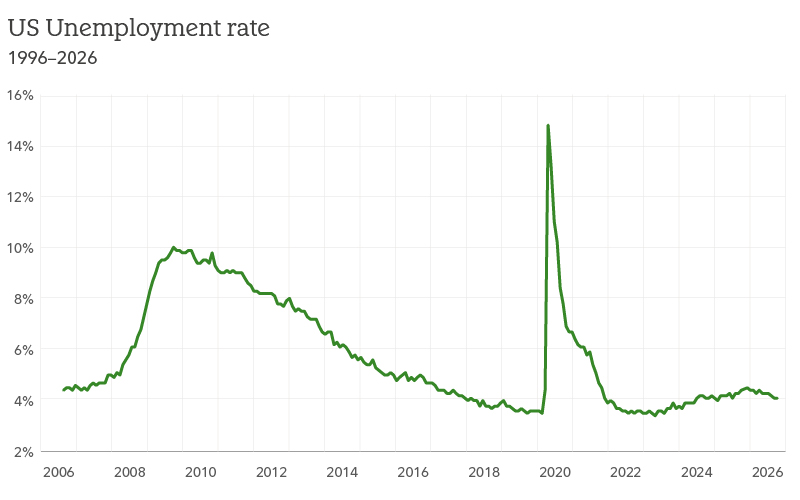
What is the jobs report?
Commonly referred to as the “jobs report” or the “labor report,” this data from the US Bureau of Labor Statistics (BLS) provides an overview of the US jobs market. It is typically released on the first Friday of each month.
The data in the jobs report is based on the establishment survey and household survey. The establishment survey tracks 650,000 worksites to produce the nonfarm payroll and average hourly earnings headlines. The household survey interviews 60,000 households to produce the unemployment rate.
When new jobs data is reported in the news, the monthly change in nonfarm payrolls and the unemployment rate is probably what you hear about. Several other pieces of jobs data are included in the report. Fidelity offers the Econoday economic calendar, where key information from the labor report is collected. Here is some of what you’ll find:
| Nonfarm Payrolls monthly growth | Number of part-time and full-time employees in both business and government. |
| Unemployment Rate | Number of unemployed as a percentage of the labor force. Unemployed refers to persons who do not have a job and want one (i.e., have looked for a job in the past 4 weeks or are on temporary layoff). |
| Private Payrolls monthly growth | The monthly change in the number of all employed wage and salary workers in the private, non-government sector. |
| Manufacturing Payrolls monthly growth | The monthly change in all paid workers in the manufacturing sector. |
| Participation Rate | The percentage of the civilian non-institutional population that is a part of the labor force (actively employed or seeking work). |
| Average Hourly Earnings monthly growth | The monthly change in average wage earned per hour worked across employees on nonfarm payrolls. |
| Average Hourly Earnings yearly growth | The yearly change in average wage earned per hour worked across employees on nonfarm payrolls. |
| Average Workweek | The total hours worked by nonsupervisory employees divided by the total number of those employees. |
Why do investors care about the jobs report?
The labor report is widely regarded as one of the most important economic data points released by the US government. Employment is a consequential gauge of economic strength. Trends in the labor market provide valuable insights into the state of the economy, and investors can use jobs data as a gauge of where the economy is heading. For example, if the unemployment rate is accelerating, that can be a sign that the economy is close to a contraction. Alternatively, if the unemployment rate is decreasing, that can be a sign that the economy is growing.
In combination with other economic data, the labor report can influence the economy in a number of ways—including the US central bank's policy on interest rates.
Critiques of the jobs report
While there are other widely monitored labor reports, including the ADP report and the Challenger, Gray & Christmas jobs report, the US government's jobs report is considered to be the gold standard because it is larger, includes a more representative sample size, and is statistically rigorous.
With that said, there are critiques of the US government’s jobs report. Given that the report is based on surveys using sample data, the reported results are estimates, where the accuracy of the data is dependent on respondents relaying employment information promptly and in full.
It's also important to note that the data is frequently revised (up or down) as new information becomes available. Data is revised up to 2 years out from its initial release during the BLS' annual benchmark revisions, and the methodology behind economic reports—including the labor report—can be adjusted.
Investing and the labor report
Jobs are a crucial component of the economy, and the monthly US jobs report is critical information for investors and traders. By understanding what’s included in the jobs report, how it impacts the economy, and the potential investing implications, you may be able to better position your portfolio.