


Changes could be coming to the real estate sector if the 21st Century ROAD to Housing Act goes into effect. As affordability becomes one of the buzzwords for 2026, what might this proposed bill mean for real estate investors?
What's happening with real estate stocks?
After real estate was the worst-performing sector on a price return basis in 2025—when this group eked out a less than 1% gain versus a 17% rally for the S&P 500—it has outpaced the broad market thus far this year. Industrial REITs, health care REITs, retail REITs, and hotel & resort REITs have outperformed, while real estate management REITs, office REITs, and residential REITs have depreciated.
REITs typically offer a bit more for income-oriented investors but tend to lag the broader stock market when growth-oriented stocks are thriving, which was the case in 2025.
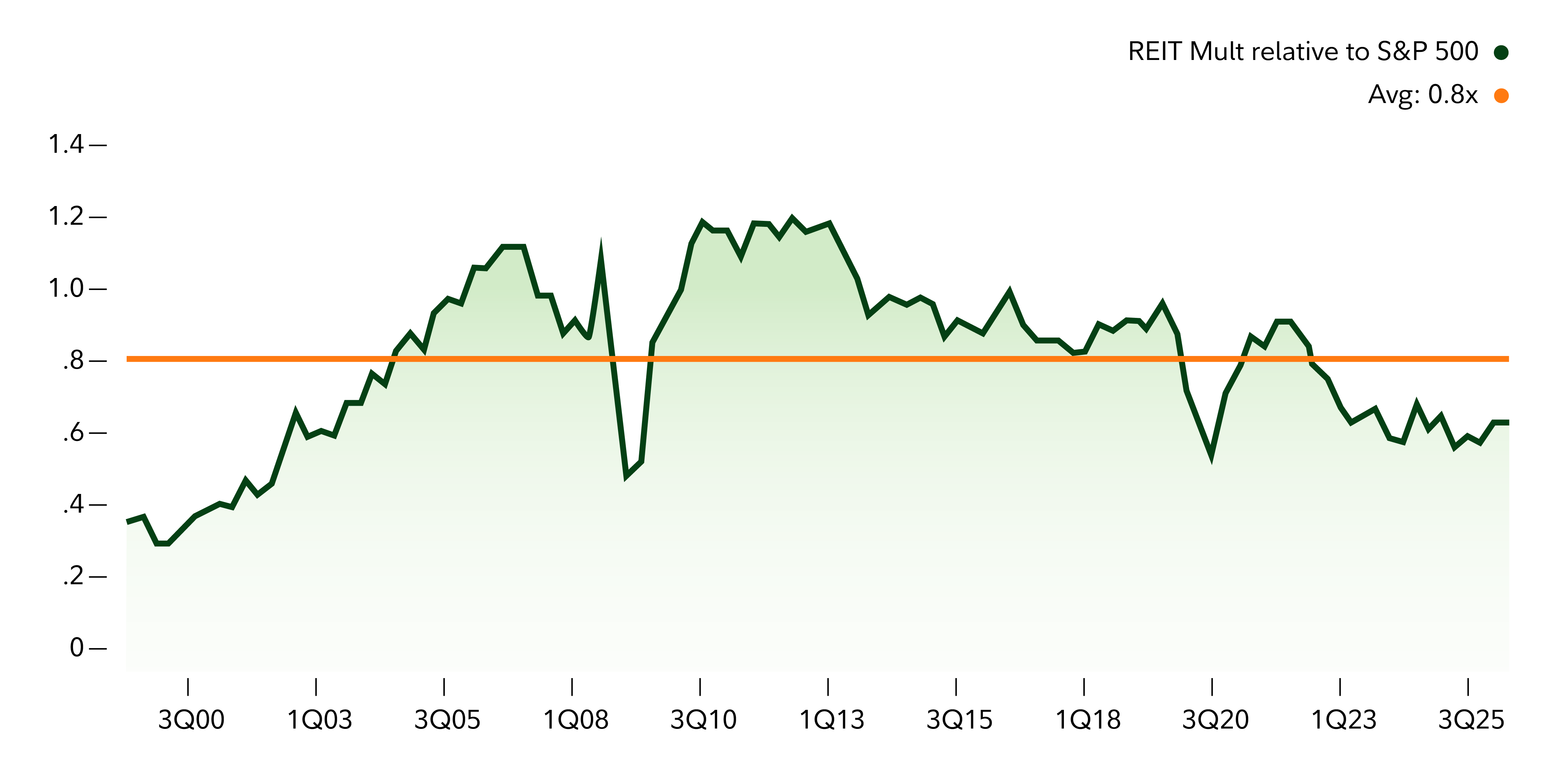
Andy Rubin, institutional portfolio manager at Fidelity, points to valuation as a key reason why REITs could maintain their momentum. “REITs' price to funds from operations (P/FFO) ratio relative to the S&P 500 price to earnings (P/E) ratio since 1999 has averaged roughly 0.8. It’s closer to 0.6 now, and it’s only been that low a few times over the past 20 years,” Rubin notes.
REIT FFO multiple to S&P 500 P/E multiple
A new road for housing?
Valuations, interest rates, and what some have called an affordability crisis are among the factors that could influence the real estate sector this year.
Rates have come down from their near-term peak, although they recently jumped to a 7-month high in the wake of the Iran conflict. Higher rates can reduce borrowing activity. Additional rate cuts in 2026 would be a positive factor for REITs if they lead to lower long-term rates, as housing investments depend on the affordability and availability of capital for long-term growth.
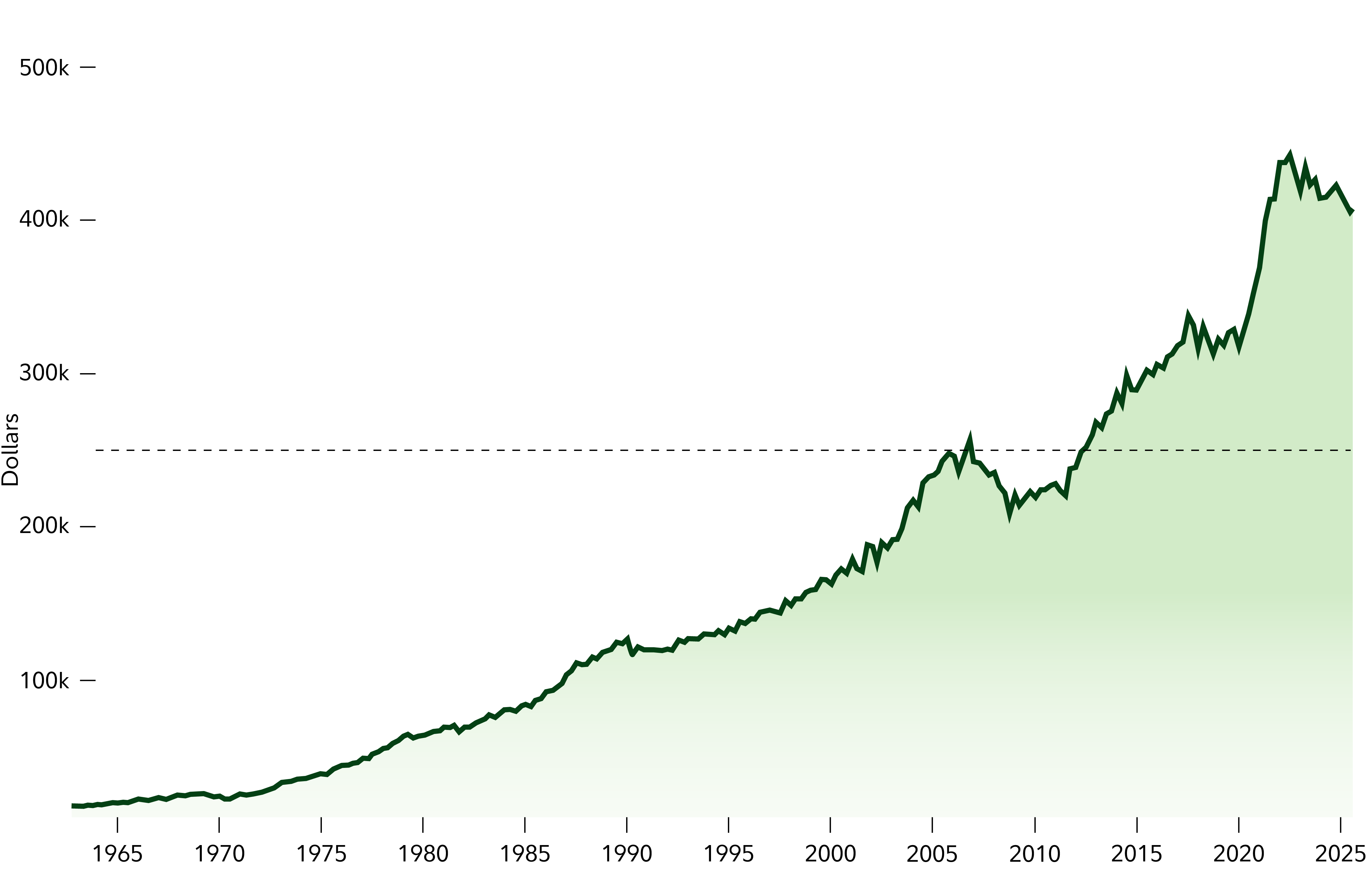
Affordability and efforts to address it by Washington, DC., may also impact the real estate sector. The median price for a single-family home surpassed $400,000 in the aftermath of the pandemic (although it’s down from the Q4 2022 peak above $442,000).
Median US sales price of houses sold for the US
The rapid increase in home prices this decade has been in part a function of limited housing supply. Some estimates indicate the US has a shortage of 4 million homes. Additionally, supply chain disruptions during the pandemic pushed building material prices through the roof, exacerbating the affordability issue.
To that end, the US Senate recently passed the ROAD to Housing Act last month, which has more than 40 provisions in it that are intended to lower housing costs and enable more new home construction. While the bill still faces hurdles before potentially becoming law (it is currently making its way through the House and then has to go back to the Senate), several parts have garnered bipartisan support as well as industry support.
The feature of the bill that has captured the most headlines is a proposed ban on institutional investors from buying single-family homes. Proponents point to other provisions of the bill that they think will have the most impact on addressing affordability. These include:
- Regulatory overhaul that would enable faster and cheaper construction of new housing
- Modernization and redefining of factory-built housing
- Updates to zoning laws such as reducing environmental barriers
Rubin notes that roughly one-third of US households rent, and he thinks that rental housing operators—like apartment and single-family rental REITs—may actually be a beneficiary of some of the proposals in the bill.
“Some business models may need to pivot, but certain proposals could be supportive of those operators’ in-place assets,” Rubin says. “It’s also possible that a ban specifically on institutional ownership of homes could have the opposite outcome of its intent, where fewer homes may be built, which could sustain the relative affordability advantage of rental housing and keep homeownership out of reach for many households.”
A blueprint for real estate stocks
Amid the potential shift in the housing foundation, Rubin thinks senior housing REITs remain compelling due to constrained supply and robust demand, the latter of which is being driven largely by the demographic tailwind of an aging baby boomer population.
“Plus, senior housing rental rate growth remains strong, which has been tenable for tenants in large part due to many seniors selling homes that they had built up a lot of equity in as home values appreciated,” Rubin says.
Rubin has also favored digital infrastructure (e.g., data center) REITs. “While there has been a great deal of supply that’s come online nationally, it’s still insufficient to meet current and future demand,” Rubin notes. “Data center REITs could benefit from their exposure to primary data center markets like northern Virgina, where tenant demand is high and supply is constrained by land scarcity and limitations on power and water usage.”
Finally, industrial REITs—which were real estate darlings post COVID and then weathered a few years of excess supply pressure—could be building momentum. “Industrial REIT rent growth pressure may be behind us, as we are coming off peak supply there and occupancy may be set to inflect positively.”
Fund top holdings
Top-10 holdings of the Fidelity® Real Estate Investment Portfolio (
- Prologis (
) – 9.9% - Equinix (
) – 9.9% - Welltower (
)– 8.7% - American Tower (
) – 8.4% - NNN REIT (
) – 4.3% - Kimco Realty (
) – 4.3% - Public Storage (
) – 4.1% - Digital Realty (
) – 4.0% - Stag Industrial (
) – 3.3% - Ventas (
) – 3.3%
(See the most recent fund information.)