


Investors often worry that rising interest rates will hurt bond prices. Floating-rate loans offer a potential upside: They can pay more income when rates rise. Because their interest payments adjust with short-term rates, they generally have less interest-rate sensitivity than traditional bonds.
That advantage could be especially valuable now. Floating-rate loans currently offer yields above 7% as of November 2026, according to data from the Morningstar LSTA US Leveraged Loan Index, and a resilient economy may help companies keep making their payments. But the added income comes with added credit risk: These loans are generally made to companies with below-investment-grade credit ratings, making defaults the biggest concern.
“People need to understand that this is not their money market account,” says Kevin Nielsen, co-portfolio manager of Fidelity® Floating Rate High Income Fund (
For investors comfortable with that risk, floating-rate loans may offer a way to increase portfolio income without adding as much interest-rate sensitivity as traditional bonds.
What are floating-rate loans?
Floating-rate loans are a form of corporate debt, typically issued by companies with significant debt and weaker credit. They are also commonly called leveraged loans, bank loans, or senior loans. Each name highlights a feature of the investment: The companies generally carry substantial debt, banks historically arranged the loans, and the loans take priority over certain other debts if a company defaults.
Investors typically access floating-rate loans through mutual funds or exchange-traded funds rather than buying individual loans.
Floating-rate loans at a glance
- Potential appeal: Relatively high income and limited interest-rate sensitivity
- How the rate works: The interest rate is set by a benchmark rate plus extra interest to compensate investors for the risk of not being repaid
- Main risk: Borrowers generally have below-investment-grade credit ratings
- What may help: A healthy economy and stable corporate cash flow
- What may hurt: A recession, rising defaults, or a sharp decline in interest rates
- Best suited for: Investors who can tolerate credit risk and hold for the medium or long term
- Not a substitute for: Cash, emergency savings, or high-quality core bonds
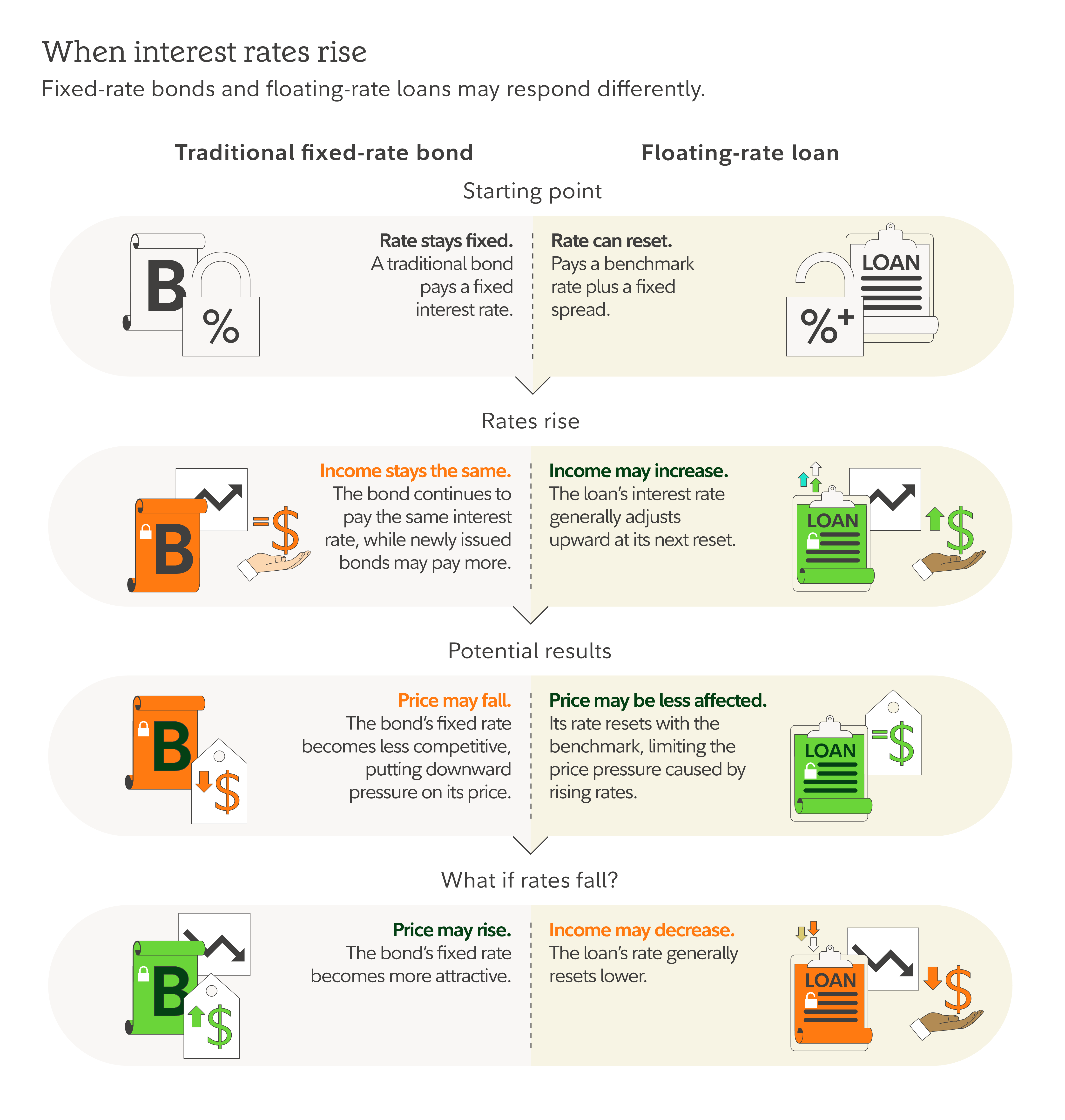
Floating-rate loans typically pay an interest rate based on the Secured Overnight Financing Rate, or SOFR, plus a fixed spread. SOFR tends to track the federal funds rate, so when the Fed raises rates, the interest paid by these loans generally resets higher. For example, if SOFR is 4% and the fixed spread is 3 percentage points, the loan would pay about 7%.
As SOFR changes, so does the company’s interest payment—and the income the loan generates.
“If rates go up, we get paid more. If rates go down, we get paid less,” explains Eric Mollenhauer, co-portfolio manager of Fidelity® Floating Rate High Income Fund.
Floating-rate loans are also typically senior and secured. That means they may be backed by company assets and generally have a higher priority for repayment than unsecured bonds if the company runs into financial trouble.
An overlooked inflation fighter
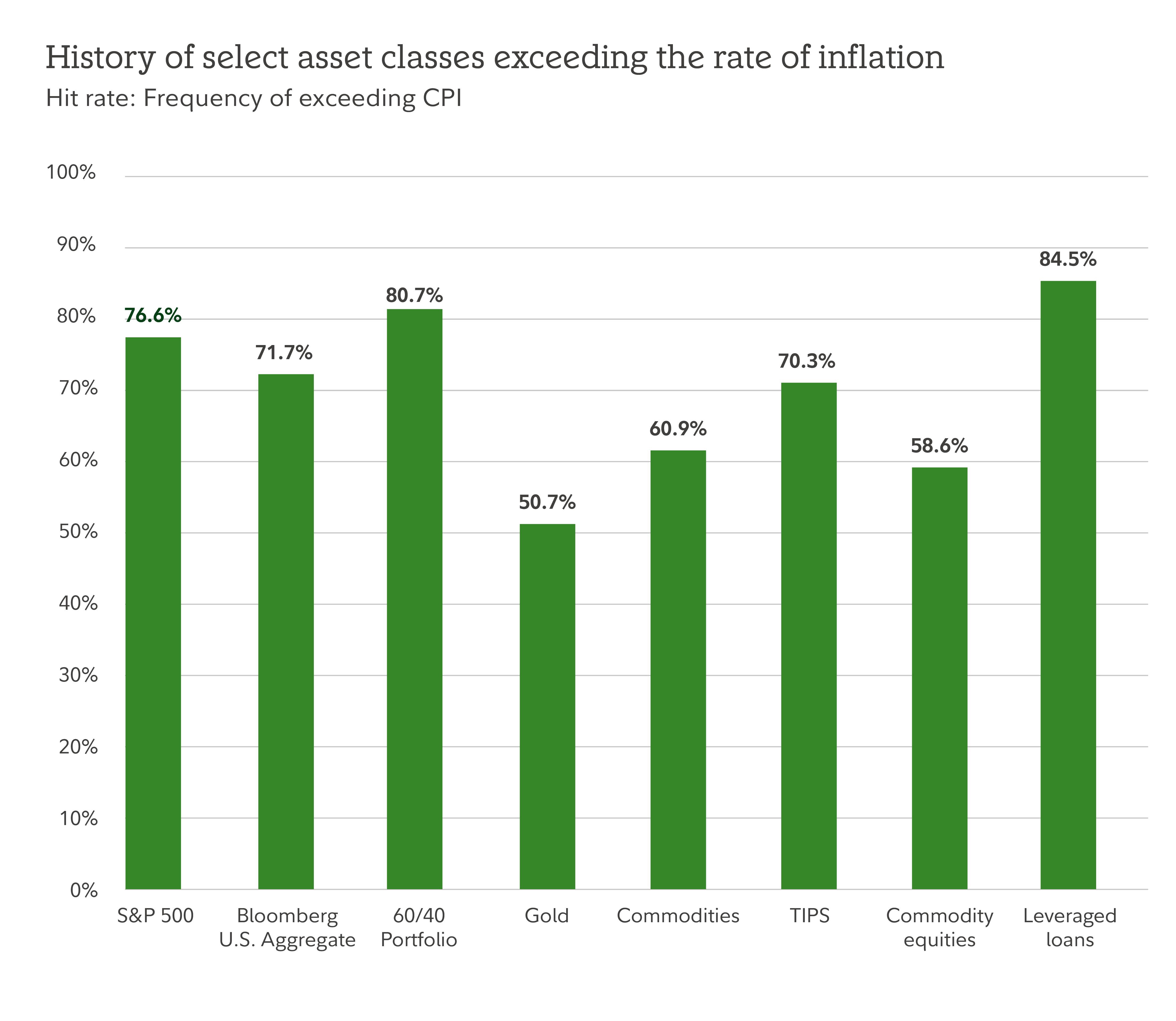
Treasury Inflation Protected Securities (TIPS) may be the best-known investment for fighting inflation, but floating-rate loans have historically outpaced inflation more frequently over rolling 12-month periods.
Their ability to adjust with short-term interest rates helps explain why. If inflation leads to higher short-term rates, loan income can adjust upward. And because loans have very limited sensitivity to interest-rate changes, they may avoid some of the price pressure that rising rates can put on traditional bonds.
Loans still carry meaningful credit risk, and their past performance does not guarantee future results. But their history suggests that investors looking for income that may keep pace with inflation could have reason to consider floating-rate loans alongside other inflation-fighting investments.
Leveraged loans have been a consistent inflation fighter
Why consider floating-rate loans now?
Floating-rate loans don’t need interest rates to rise to remain appealing. With floating-rate loans currently offering yields above 7% as of November 2026, according to data from the Morningstar LSTA US Leveraged Loan Index, investors are starting with a relatively high yield. That income could continue to support returns if short-term rates hold steady, rise, or decline gradually.
Falling rates would cause loan income to decrease as interest payments reset. But the direction of rates is only part of the story. Just as important is whether the companies behind the loans can keep paying their debts.
If companies continue generating enough cash to make interest payments and refinance upcoming debt, investors may keep collecting attractive income. A weakening economy, however, could strain highly indebted companies and lead to credit losses.
A history of positive returns, with one major exception
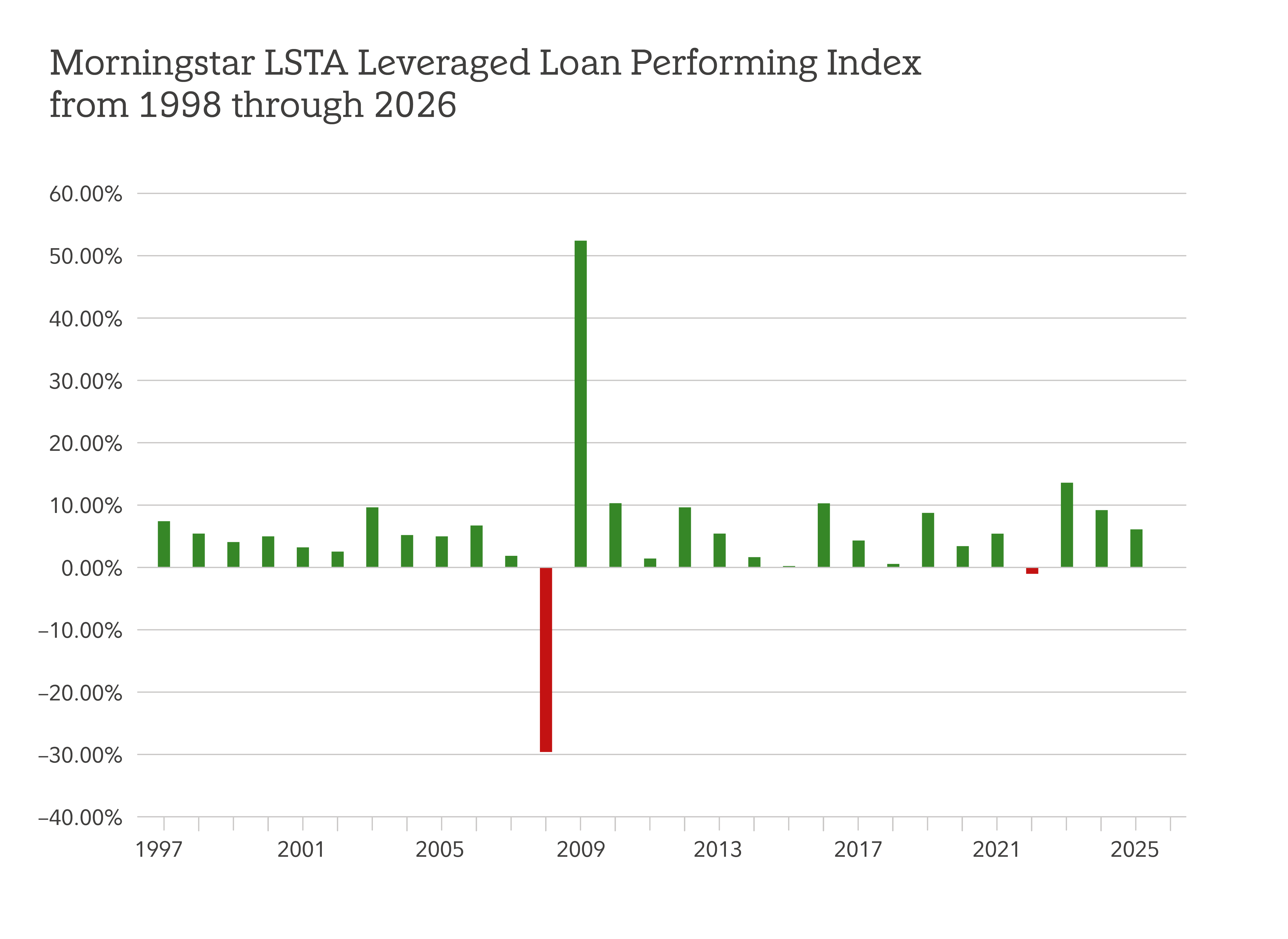
Leveraged loans have produced positive returns in 27 of the 29 calendar years from 1997 through 2025 as measured by the Morningstar LSTA US Leveraged Loan Performing Index. But the historical record also shows how sharply the category can decline during an extreme period of financial stress.
The steepest loss occurred in 2008, when the financial crisis led investors to sell loans and other risky assets rapidly. The only other down year, 2022, saw a smaller decline.
Annual leveraged loan returns since 1997
Morningstar LSTA Leveraged Loan Performing Index from 1997 through 2026 (note that chart shows performance for every other year only)
What are the risks of floating-rate loans?
The clearest risk is that a borrower may be unable to make its interest payments or repay the loan.
Recent default rates among borrowers have been relatively low. As of June 2026, less than 1% of the leveraged loan market had defaulted over the previous 12 months, based on the dollar value of affected loans. Those figures could rise if the economy weakens.
A default doesn’t necessarily mean investors lose the entire value of the loan. Floating-rate loans are generally senior and secured, meaning investors may recover part of their principal through the borrower’s assets or a restructuring. And in a diversified portfolio, the income generated by the broader portfolio may help absorb losses from a loan that defaults.
Credit losses aren’t the only concern. Loans can also fall in price when investors grow concerned about economic weakening. “We’ve rarely had an issue with liquidity in our market,” says Mollenhauer. “It’s just what price you’re willing to accept.” In other words, a buyer may still be available, but a fund might have to accept a lower price to sell the loan.
How Fidelity approaches the market
Because Fidelity® Floating Rate High Income Fund invests in loans to companies that typically carry substantial debt, understanding each company’s finances is especially important.
Mollenhauer, Nielsen, and co-manager Chandler Perine evaluate each loan individually, drawing on sector analysts to assess the borrower’s cash flow, debt load, competitive position, management, collateral, and loan terms.
The fund’s managers look for borrowers with:
- Reliable free cash flow
- Recurring or predictable revenue
- Assets that may help support the loan
- A durable competitive position
- Manageable upcoming debt maturities
- Loan terms that provide lender protections
Businesses with long-term customer contracts and essential products or services can provide lenders with a clearer sense of whether the company will be able to keep making its debt payments. The team also considers whether the company could withstand a recession and refinance its debt if capital became more expensive or difficult to obtain.
The fund invests across industries including software, technology, chemicals, business services, retail, and restaurants. Some borrowers are public companies. Others are owned by private-equity firms and use leveraged loans to help finance acquisitions.
For each loan, the team considers whether the potential income and purchase price justify the risk that the borrower may not repay in full.
Could floating-rate loans fit your portfolio?
| They may be worth considering if you: | They may not be appropriate if you: |
|---|---|
| Want more income from the fixed-income portion of your portfolio | Need the money for near-term expenses |
| Want to limit the effect of changing interest rates on your investment | Want a stable cash substitute |
| Can accept below-investment-grade credit risk | Cannot tolerate periodic declines |
| Have a medium- or long-term investment horizon | Expect a severe recession or sharp increase in defaults |
| Already have cash reserves and a foundation of higher-quality bonds | Want an investment that may rise more in price when interest rates fall |
For investors seeking more income and willing to accept the added credit risk, floating-rate loans may be worth a closer look. The key is understanding that their returns ultimately depend on the financial health of the companies behind them.
Explore Fidelity® Floating Rate High Income Fund to see how floating-rate loans may fit in your portfolio.