


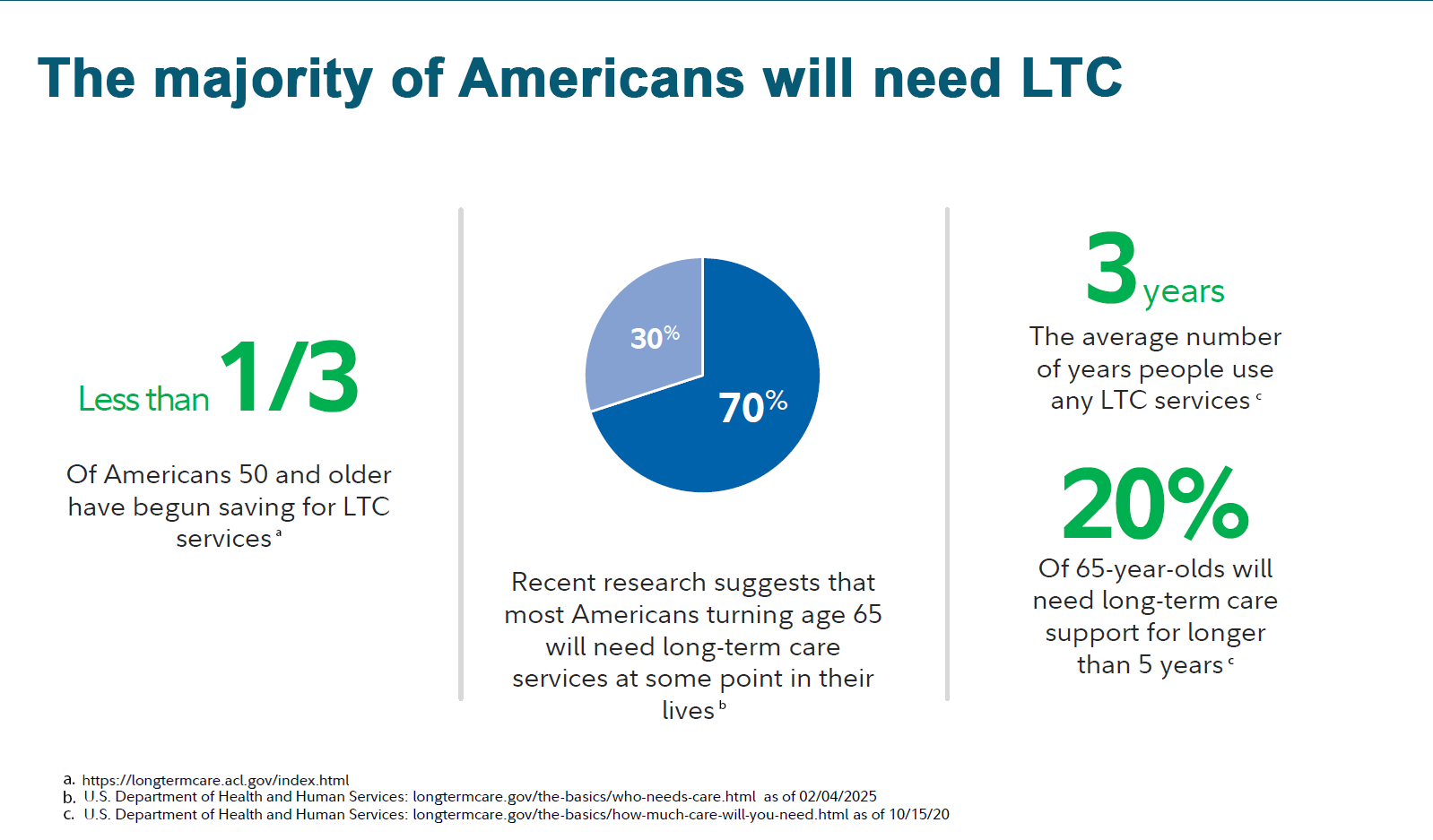
Long-term care is one of the most common yet least-planned-for expenses facing US households. Many people recognize that they may eventually need some form of long-term care plan, but discomfort about discussing the realities of aging and health decline—along with the potential cost of both the care itself and the insurance designed to help cover it—often leads to hesitation. Today, only an estimated 3% of adults over age 50 carry any type of long-term care insurance, according to LIMRA, the life insurance and financial services research organization.1 Without a plan, however, long-term care needs can pose a significant threat to financial security, with costs that may climb into the hundreds of thousands of dollars for multiple years of care. The US Department of Health and Human Services reports that nearly 70% of people who reach age 65 will need some form of long-term care, which could include assistance with bathing and dressing, to full-time nursing home help. At the same time, the national median cost of care in a nursing home is nearly $130,000 annually for a private room,2 putting financial pressure on households who may struggle to afford it.
Nevertheless, it’s important to acknowledge that long-term care may take multiple forms, including help around the house, adult day care, or assisted living. Each kind of care comes with its own costs and considerations, so it’s important to keep these in mind when formulating your long-term care plan.
How to plan for long-term care costs
While in the past the most common way to fund long-term care was through a traditional long-term care insurance policy, such policies have become increasingly difficult to find—or to find at reasonable price points—as many insurers have exited the traditional long-term care market. These policies have often come with drawbacks, such as premiums that are not guaranteed and may increase over time and the “use it or lose it” dilemma, where a policyholder might pay premiums for years and then pass away without ever needing access to funds for care.
Today, however, many alternative funding options exist to help pay for long-term care. These approaches can offer more flexibility than standalone long-term care insurance and may be easier to integrate into a broader financial plan. Options include:
- Hybrid life insurance long-term care policies, which combine a death benefit with the ability to access funds for care.
- Home equity arrangements, such as through a reverse mortgage equity sharing agreement.
- Hybrid annuity long-term care policies, which can provide access to multiples of your contract value for long-term care needs.
Together, these strategies—and others—can help households create a more personalized and sustainable plan for their future long-term care needs.
Here are 6 ideas to consider to help fund long-term care.
1. Hybrid life insurance long-term care policies
Hybrid life long-term care policies are typically life insurance policies with a focus on linked long-term care benefits. These policies tend to solve the quandary consumers may face with traditional long-term care insurance policies, where they forfeit unused benefits. Hybrid life insurance long-term care policies, like some traditional long-term care policies, accumulate a cash value and can offer tax-free benefit payouts.
Hybrid life insurance long-term care policies may also offer greater long-term-care focus than other types of hybrid policies, such as hybrid annuity long-term care policies. They can provide long-term care benefits that can be worth up to 4 times the premium paid. If long-term care benefits are not used, the policy will provide a death benefit to beneficiaries.
Good to know: Some traditional life insurance policies that are not hybrid policies may also allow access to part of the death benefit to pay for long-term care, often through an accelerated death benefit rider.
Nevertheless, some drawbacks for hybrid life long-term care might include higher upfront costs compared to traditional long-term care policies and the reduction or elimination of a death benefit if the cash value is tapped for care. Further, these plans are typically not eligible for Medicaid partnership, although higher-asset households are unlikely to qualify for Medicaid.
2. Home equity solutions to pay for long-term care
Home equity solutions might be appropriate for people who are able to live at home, have a substantial amount of their resources tied up in the value of their house, and who are open to in-home care. Options include reverse mortgages, home equity lines of credit (HELOCs), and home equity sharing agreements.
Reverse mortgages
Most reverse mortgages today are Home Equity Conversion Mortgages (HECMs), which are federally insured products backed by the Federal Housing Administration. Borrowers can access the proceeds in several ways, including monthly payments, a variable-rate line of credit, or a lump sum. The loan comes due only when the borrower moves out, sells the house, or passes away, at which point heirs can also sell the home and keep any remaining equity.
Potential benefits of a reverse mortgage include tax-free payouts and no monthly payments from the borrower. In the case of HECMs, heirs never owe more than the value of the house as FHA insurance would cover the difference between the value of the house and the remaining balance of the loan. Since 2017, new rules allow spouses of the borrower to remain in the house after the borrower has passed away. Good to know: Origination and closing costs of a reverse mortgage can be high, however, and loan rates depend on prevailing interest rates. Borrowers must also be age 62 or older and not delinquent on any federal debt. HECM borrowers must also be the primary owner of a single-family home, 2- to 4-unit residential housing, or a Housing and Urban Development (HUD)-approved dwelling and must participate in an educational session with a HUD-approved HECM counselor prior to receiving funds.
Home equity lines of credit (HELOCs)
HELOCs can offer flexible borrowing without age restrictions. They are typically revolving lines of credit with a variable rate, secured by the borrower’s home, allowing the borrower to access funds up to a predefined limit, and then repay them over time. There is often no requirement for the borrower to live in their house.
While interest payments are generally tax-deductible for home improvements, they are not when used to pay for long-term care. Origination and closing costs also tend to be less than for mortgages, but can nonetheless drive up costs. The loans are also subject to potential interest rate increases due to their variable rate structure, with compounding frequency that depends on the lender and product, typically either daily or monthly. Additionally, they may be subject to bank freezes and may lack important consumer protections, such as flood disaster protection, Home Mortgage Disclosure Act reporting, and some Truth in Lending requirements, among other things.3
Home equity sharing agreements
These loans are offered by more specialized private lenders. They don’t charge interest and there are no monthly payments, but borrowers repay the investor later with a share of the home’s future appreciation. Homeowners with lower credit scores may find this type of agreement easier to qualify for. But they involve a balloon-style repayment after a set number of years and may require the sale of a home or refinancing to access money for repayment. Lenders may also under-appraise home values, which can make such loans costly in the long run.
3. Hybrid annuity long-term care policies
A common type of hybrid annuity long-term care policy is a single premium deferred annuity (SPDA). Like a typical SPDA, these contracts offer a specified fixed interest rate on the contract value. If you qualify for long-term care, based on the conditions in the contract, you can receive up to 2 to 3 times your contract value over a specified benefit period. If there is any remaining contract value at death, it would be paid to your beneficiaries. Policies are typically available for someone up to age 80. Some health underwriting is required, but these policies typically have a lower threshold to qualify compared to traditional or hybrid life long-term care policies. However, these policies also may offer comparatively lower long-term care benefits.
Good to know: Hybrid annuity long-term care policies funded with nonqualified sources may be eligible for tax-free payouts.
4. 1035 exchanges to pay for long-term care
One underutilized and overlooked way to fund long-term care is through something called a 1035 exchange. It’s a provision of the federal tax code that allows someone to swap certain existing insurance or annuity contracts into a new contract, tax-free.
The Pension Protection Act of 2006 expanded the eligibility of 1035 exchanges to include long-term care insurance from existing life insurance, annuity, and long-term care contracts. With a 1035 exchange, you must apply for the new contract and pay any applicable surrender charges on the old contract, while the funds move directly from one insurer to the other as part of the swap. However, it’s a tactic to consider to upgrade outdated contracts, or to shift to a policy that might be better suited to your long-term care needs. Good to know: It’s possible you may not qualify for long-term care insurance when you’re considering a 1035 exchange. Also, not all contracts can be exchanged. For example, you cannot exchange an annuity for a hybrid life long-term care insurance contract.
5. Government programs to pay for long-term care
Various federal and state programs may help you or your loved one pay for all or a part of long-term care.
PACE
The Program of All-Inclusive Care for the Elderly (PACE) offers a way to remain in your home and community instead of entering a nursing home. It’s a program administered by Medicare and Medicaid to provide medical care, social support, and coordinated services related to long-term care through dedicated PACE centers. Enrollment is voluntary, but participants must live in a service area, be eligible for nursing home-level care, and be able to live safely at home. PACE is in 32 states plus the District of Columbia. Waitlists can be long, however, and PACE does not provide 24-hour care.
Medicare
Medicare does not provide long-term care coverage. Instead, it provides very limited near-term care coverage, including 100 days of skilled nursing facility care following a qualifying hospital stay, up to 8 hours a day for up to 28 hours a week for in-home skilled nursing or home health aide care if homebound, and hospice care if terminally ill.
Medicaid
Medicaid covers nursing home services, room and board, and in many states, certain home and community-based services. But qualifications are strict and vary by state. Some nursing homes don’t accept Medicaid, and benefits differ widely.
For those who have too much income to qualify for Medicaid, but still can’t afford care, an additional way to enter Medicaid is through your state’s Medically Needy program (if available). This program may offer a spenddown option, allowing medical expenses to lower income to the eligibility threshold—though applicants must still meet Medicaid asset limits.4
6. Additional funding considerations for long-term care
Self-funding long-term care may be another option for some people. In addition to other assets, such as those held in taxable accounts, assets held in health savings accounts (HSAs) potentially can be used to fund long-term care. Withdrawals from an HSA to pay for qualified medical expenses are tax-free,5 and long-term care expenses qualify generally.
Paying for long-term care remains both an emotional and financial challenge for many people. However, there are far more funding options available now than in the past, giving individuals and their families greater flexibility to tailor both care and costs to their unique needs. It’s a good idea to consult a financial professional who can help you build a comprehensive plan that reflects your situation and goals. Planning early for care and its costs can help ensure you have the broadest range of options possible.