

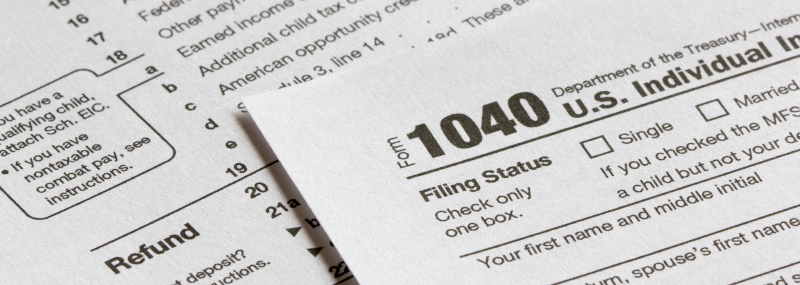
Many working people use Form 1040 or one of its variations to file their tax return. After you complete the form, you’ll know if you owe taxes or are due a refund. Even if you don’t prepare your own taxes, it’s helpful to understand what information is on this form. Consider this your comprehensive 1040 guide. Here’s what Form 1040 is, how it works, and why the right form matters.
What is Form 1040?
Form 1040 is the US Individual Income Tax Return. Taxpayers use this federal tax form to calculate and report how much they owe to—or are owed by—the IRS each year. State governments may have their own separate income tax forms for individuals.
Types of 1040s
There are a few different variations on Form 1040:
- Regular Form 1040: Individual tax filers can use this form to prepare their annual return, including married couples filing jointly. There are no restrictions based on age, income, or filing status.
- Form 1040-SR: This form is for folks who are 65 or older. The 1040-SR is nearly identical to the regular Form 1040, but it’s published in larger print and has larger boxes for filling in information. It also includes a standard deduction table for determining how much you’d be entitled to deduct.
- Form 1040-NR: This form is for US nonresidents who earned income in the US.
- Form 1040-X: If you need to make changes to your return after you’ve filed, you can submit an amended tax return using Form 1040-X.
Who has to use Form 1040?
Most people working and earning taxable income in the US have to file a tax return each year, and many have to use Form 1040. The IRS only allows you to opt out of filing if your income is below a certain threshold. For tax year 2025, people didn’t need to file a 1040 tax form if they were:
- Single with income below $15,750 (or $17,550 if 65 or older)
- Married filing jointly with a combined household income below $31,500 if both spouses are younger than 65 (or $33,100 if one spouse is 65 or older; $34,700 if both spouses are 65 or older)
Keep in mind that these thresholds include investment income. Someone who isn’t working, but is earning income from investments, could still have to file a tax return using Form 1040.
Business partnerships, LLCs with at least 2 partners or who choose to be taxed as corporations, and S corporations are a few examples of entities that don’t use Form 1040. Entities issue to each owner a Schedule K-1 that reports their share of profits, losses, and deductions. Owners must report this information when they file their individual tax return using Form 1040.
What’s on Form 1040?
Form 1040 is a 2-page document that asks for:
- Your personal information (name, address, Social Security number, and your spouse’s information if you’re married)
- Your tax-filing status
- Your standard deduction if you’re not itemizing
- The age of any dependents you’re claiming, along with their relationship to you
- All your income for the year
- Any deductions and credits you’ll be claiming, to reduce your taxable income
- Any tax payments you already made through paycheck withholding or quarterly estimated tax payments
- Your net tax owed or refund, including payment instructions if you’re receiving money from the IRS
- Your signature and information from your tax preparer, if you work with one
Form 1040 schedules
The word “schedule” refers to an additional tax form you might include with your tax return. You only use Form 1040 schedules that apply to your situation. Here are some of the most common schedules.
Schedule A, Itemized Deductions
You only need this form if you’re itemizing your deductions rather than claiming the standard deduction. You can add up expenses such as home mortgage interest, charitable contributions, and state and local taxes.
If you’re unsure which approach to use, you can calculate the total of your itemized deductions using Schedule A and compare it with your standard deduction. Generally, it makes sense to claim the larger amount on your 1040, but consider consulting a tax professional for personalized guidance.
Schedule B, Interest and Ordinary Dividends
You’ll likely need to fill out Schedule B if you earned interest or dividends from investments.
Schedule C, Profit or Loss from Business (Sole Proprietorship)
Freelancers, independent contractors, and anyone else running a 1-person business report their income and expenses on Schedule C. This allows you to calculate whether you have a taxable profit or deductible loss.
Schedule D, Capital Gains and Losses
If you sell capital assets, like investments, for a capital gain or loss you’ll calculate the net result on Schedule D to see whether you owe taxes or can claim a deduction.
Schedule E, Supplemental Income and Loss
Schedule E reports earnings and losses from various entities, including:
- Rental properties
- Estates
- Trusts
- Royalties
- Businesses run as partnerships or S corporations
Schedule EIC, Earned Income Credit
If you’re eligible for the earned income tax credit, use this form to provide information about your qualifying children.
Schedule R, Credit for the Elderly or the Disabled
Schedule R calculates a credit for people who were age 65 or older or are retired on a permanent and total disability.
Schedule SE, Self-Employment Tax
People who worked for themselves could owe an additional self-employment tax for Medicare and Social Security benefits. Schedule SE allows them to calculate it.
Form 1040 instructions
Start at the top and go line by line, number by number. The income calculation begins at line 1a and walks you through the necessary information to fill in. Form 1040 mentions where a specific schedule may be needed. Skip any parts of the 1040 that don’t apply to your situation. If you aren’t sure, consider asking a tax professional.
If you have a relatively simple tax situation, you might only need to complete and submit Form 1040. Schedules are used for more complex situations, like self-employment income and itemizing your deductions. If you use a schedule, include it with your completed return when filing.
For more help, check out IRS.gov, consider working with a tax preparer, or use tax software. The IRS provides free guided tax preparation software for people with adjusted gross income (AGI) of $89,000 or less.
How to use Form 1040 to find your AGI and MAGI
You can use Form 1040 to calculate your AGI. It’s listed on line 11. However, Form 1040 doesn’t calculate your modified adjusted gross income (MAGI). To do so, take your AGI and add back certain deductions, such as IRA contributions and student loan interest.
Your MAGI can determine your eligibility for certain federal programs and tax-advantaged retirement accounts. For example, you can’t directly contribute to a Roth IRA in 2026 if you’re single and have a MAGI of $165,000 or more. If you have a health insurance plan through HealthCare.gov, your MAGI can also determine your eligibility for premium tax credits and Medicaid.