


If you think investing in private equity is only for large financial institutions and sophisticated investors, think again. While investing in private equity still has some restrictions, PE opportunities are increasingly available to and considered by high-net-worth individuals, family offices, and individual investors.
Here’s what you need to know about investing in private equity.
What is private equity?
Private market alternative investments are nonpublic investments generally offered privately to a limited number of eligible investors. Private market alternatives are offered across several asset classes, including private equity, private credit, and private real assets.
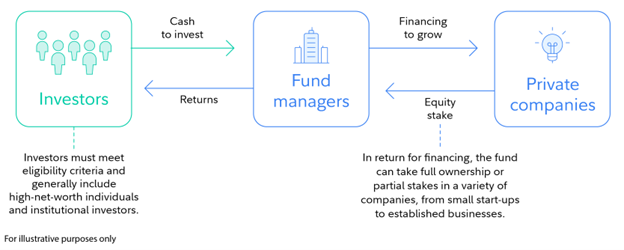
Private equity firms acquire meaningful ownership positions in companies that are not publicly listed on a stock exchange and take an active role in guiding the business. They raise money from investors and pool that capital into funds.
These funds then acquire or invest in businesses, typically for several years. Private equity investments can occur at any time during a target company’s life cycle—from startups to established revenue-generating businesses.
Eventually, PE firms look to exit their investment, typically by selling to another company, another private equity firm, or by taking the company public through an IPO.
There are a variety of private equity strategies that include buyout, growth equity, venture, and secondary investments. It’s worth noting that a PE firm can utilize several of these in a multi-strategy approach.
- Buyout represents the most common private equity strategy. It is the acquisition of majority stakes or full ownership positions in established companies.
- Growth equity often involves a significant equity interest with governance/management rights in mid-stage companies that are seen as having potential for accelerating earnings growth.
- Venture capital involves acquiring a minority stake in startups or early-stage companies that are identified as having high growth potential.
- Secondary investments entail buying existing interests in private equity funds from other private equity firms.
Who invests in private equity?
Private equity investing has been dominated by institutional investors, including pension funds, endowments and foundations, insurance companies, and sovereign wealth funds. High-net-worth individuals and family offices have also become prevalent private equity investors.
Historically, individual investors have not been able to invest in private equity because minimum investment amounts are relatively high and many funds are available only to accredited investors (an individual earning over $200,000 per year, or $300,000 jointly with a spouse, and with $1 million in net worth, excluding primary residence) or qualified purchasers (an individual who owns at least $5 million in investments individually or held jointly with a spouse). The emergence of new strategies, vehicles, and platform technology is now changing that dynamic and offering retail investors more options to access the asset class.
How does a private equity fund work?
A private equity fund is usually structured as a limited partnership. The private equity firm acts as the general partner (GP) and manages the fund’s investments, while investors act as limited partners (LPs) and supply most of the capital.
Here’s a look at the lifecycle of private equity:
- Fundraising. The private equity firm raises capital from investors, committing them to provide a certain amount of money over time. The firm doesn’t take your investment money upfront. Rather, it obtains an agreement from you for funding capital in installments via what is known as capital calls.
- Investment period. Rather than investing all the money immediately, the firm issues capital calls as needed for specific deals. After the firm identifies targets, it deploys investor capital to acquire companies it believes hold value to be unlocked.
- Value creation. In partnership with the company, the private equity firm works to improve operations, profitability, or strategic positioning of its acquisition.
- Exit and distribution to investors. Typically, the private equity firm sells its stake after several years, ideally at a higher value than their investment. Proceeds are distributed to investors after carried interest and other fees are paid to the firm.
Private equity firms seek to create value primarily by improving the fundamentals of a business. This includes improving operational efficiency and cost structures, investing in technology, systems, and cybersecurity, expanding products, services, or geographic reach, strengthening management teams and governance, and enhancing financial discipline and strategic focus. With a long-term approach, private equity investments are not as sensitive to short-term economic cycles.
Benefits of investing in private equity
Private equity can be a compelling investment choice for several reasons. These include:
Potential for higher returns. Historically, private equity has delivered higher long-term returns than public equity markets, particularly when measured over full market cycles.1 Long-term investing horizons allow private-equity-backed companies to have less sensitivity to short-term performance expectations that could hinder long-term value creation.
Diversification. Private equity investments are less correlated with public markets in the short term. Including private equity in a portfolio can help diversify risk, particularly during periods of public market volatility.
Access to nonpublic investments. Many attractive companies never go public or do so only after significant growth. Private equity provides access to businesses and industries that may not be available through public markets, expanding the investable universe.
Risks of investing in private equity
Of course, private equity investors should have a full understanding of what this type of investment entails. In addition to the risks associated with the underlying investments, private equity risks include:
Illiquidity. Private equity can reward investors for committing capital over relatively longer periods, giving managers time to build value before exiting. However, this illiquidity for the investor means they typically cannot sell their stakes at all or without incurring penalties and thus must commit capital for many years. The relative lack of liquidity can be particularly problematic if cash is needed unexpectedly. Moreover, returns may take years to materialize.
Higher fees. Private equity funds typically charge fees. A common fee structure is “2 and 20,” which is a management fee of around 2% of committed capital and a performance fee (carried interest) of about 20% of profits. These fees can reduce the investor’s net returns.
Leverage. Many private equity deals rely on borrowed money. While leverage can amplify gains, it also increases the risk of loss if the company underperforms or economic conditions deteriorate.
Manager risk. Returns depend heavily on the skill of the private equity firm. Compared to managers in public equities, there is less overall market risk and more dependency on manager skill and performance. Poor investment decisions, weak operational execution, or misaligned incentives can lead to underperformance.
Lack of transparency. Private equity investments are not subject to the same disclosure requirements as public companies. Valuations are often infrequent and based on estimates rather than market prices.
How to invest in private equity
Private equity is not for everyone. Illiquidity, long investment horizons, complex structures, and elevated risk make it most appropriate for investors with sufficient capital, patience, and tolerance for uncertainty.
But for those eligible investors that private equity may be suitable, there are a variety of ways to gain exposure. These include:
- Direct investment in private companies. Some investors may be able to invest directly in private businesses, either individually or through syndicates. This approach can offer higher potential returns but requires substantial due diligence, industry knowledge, and risk tolerance.
- Limited partnership in private equity funds. Investors can commit capital to private equity funds. This route provides access to experienced managers and diversified portfolios, but often requires relatively large minimum investments and long lock-up periods.
- Fund of funds. A fund of funds invests in multiple private equity funds, offering diversification across strategies and managers. Total fees are typically higher relative to investing directly in a PE fund or private company, but a fund of funds can reduce the risk associated with investing in a single fund and provide access to high-performing managers.
- Publicly traded private equity firms. Some private equity firms are publicly traded. Investing in their shares provides indirect exposure and liquidity, though returns may differ from those of their private funds.
- Closed-end funds. In recent years, certain investment vehicles and platforms have emerged to offer semi-liquid private market exposure to eligible individual investors. These options typically lower minimums but still carry illiquidity and risk.
Key factors to consider when making a private equity investment include the fund’s track record (past performance of the manager across multiple funds and economic cycles), investment strategy, team experience, fee structure (total cost, including management fees and carried interest), and risk management strategies (e.g., use of leverage, sector concentration, and downside protection).
Private equity investing
For investors that private equity may be suitable for, this type of investment may reward a long-term, complementary allocation. Private equity offers investors the opportunity to participate in the growth and transformation of private businesses, potentially delivering attractive long-term returns and diversification benefits.