


Millions of investors have embraced index funds to get broad diversification across hundreds of stocks with a single trade. Yet many investors may be surprised to learn that the performance of those funds has become increasingly dependent on a handful of mega-cap technology companies.
How concentrated are some stock market indexes?
Though widely viewed as broadly diversified proxies for the stock market, some index funds can carry significant concentration risk.
Indexes based on the market capitalization (or total stock market value) of each component stock have come to be dominated by a handful of massive technology companies, often resulting in a 500-company portfolio in which a few names have increasingly influenced returns.
How concentrated? The 10 largest US stocks accounted for nearly 40% of the S&P 500® Index, the most widely followed US stock market benchmark, as of June 30.1 By comparison, the top 10 represented 23% of the index in 2020 and 17% in 1996.2
Similarly, the “Magnificent 7” mega-cap stocks accounted for more than a third of the S&P 500 in early June after soaring 150% in less than 4 years.
"Many investors may find that they are much more concentrated than they thought,” says Bradford Pineault, head of Fidelity’s capital markets strategy team. “An index can hold hundreds of securities, but if their performance is driven by just a few companies, sectors, or themes, investors may be less diversified than they'd intended.”
Index concentration matters because index funds and ETFs have become core holdings for individual investors and retirement savers. Roughly 64% of total net assets in long-term mutual funds and ETFs were held in index funds, as of Aug. 31, 2026, according to the Investment Company Institute.3
"If an investor is currently sitting in the S&P 500, and that's it, they're more concentrated than they’ve ever been," says Matt Bullard, a regional vice president for planning solutions at Fidelity. "People may not know how concentrated they are, even if they just own index funds."
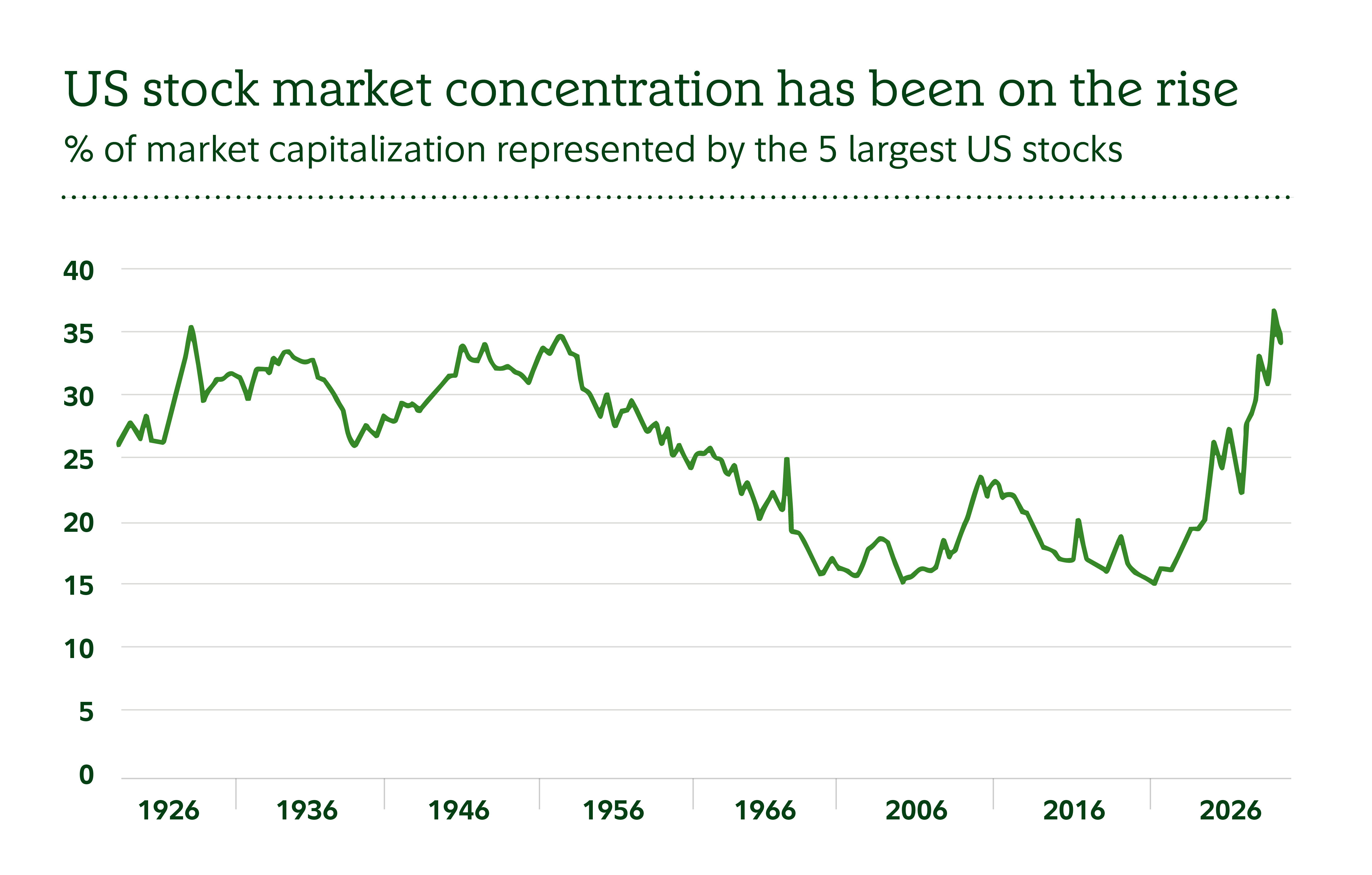
The rise of investment theme concentration
There are different forms of concentration risk. Most investors focus on single-stock exposure, such as accumulating a large position in their employer’s shares. If that company suffers any sort of setback, it can have an outsized impact on a portfolio.
Yet many might overlook their exposure to an economic sector, such as financial services or energy, or to a theme, such as the artificial intelligence (AI) boom. In these scenarios, investors can hold an array of stocks that may be exposed to the same economic driver.
Theme risk sometimes can be hidden by labels. Holdings that appear distinct on paper, whether they are part of different sectors or regions, can rise and fall together because they are ultimately driven by the same economic trends.
“Diversification by label is not the same as diversification by behavior,” says Pineault. "If the top 10 stocks all source their growth from the same investment theme, investors are more concentrated than they expected.”
Why today's market may pose new risks
What makes the current market environment different is AI's unusually broad influence, which has extended across market sectors, from basic materials and electricity to networking, semiconductors, and industrials.
“What has historically helped protect portfolios is not the number of positions but how many sources of return those positions represent,” Bullard says. “A portfolio with hundreds of names can still be a singular bet if those names all depend on the same earnings driver.”
Likewise, sector classifications among index managers may not always align with how many investors think about companies.
Some of the biggest names in technology, including the leading AI developers, are not found in the information technology sector. Amazon (
AI has also become an earnings driver around the world, not just within the US. Some emerging and developed international stock markets have become more dependent on a few AI-related companies, such as Taiwan Semiconductor Manufacturing (
Why cap-weighted indexes become concentrated
For decades, funds and ETFs that track these indexes have delivered strong long-term returns by “owning the market” rather than trying to beat the market by picking stocks. As winners increase in market value, they receive bigger index representation.
"Cap-weighted strategies don't involve any active discretion: You own what the market owns,” Bullard says. "Any money that goes into that investment will be disproportionately allocated to those top winners."
Sector dominance of the benchmark is hardly a new phenomenon. Bullard notes that the stock market’s leader board is always in flux, with top companies and sectors changing each decade. In previous decades, markets were led by energy producers, Japanese companies, and telecommunications giants.
Even so, previous market leaders have not dominated the index as much as AI-driven companies have in recent months.
Investors should take note because history suggests market leadership eventually changes, and yesterday's leaders often lose dominance. “Very few of the names in the top 10 have stayed on top over time," Bullard says.
What can investors do about index concentration?
Fidelity pros emphasize it’s important for investors to take a close look at their portfolios, assess their stock and fund exposures, and explore a range of possible strategies.
- Review your holdings: Fidelity pros say diversification still matters. It pays to revisit your portfolio, including your mutual fund and ETF holdings, and make sure you are comfortable with your asset allocation.
- Diversify across sectors: For investors looking to diversify beyond large-cap US stocks, consider shifting allocations to companies in less crowded sectors, such as industrials, utilities, energy, and financial services—particularly stocks paying dividends.
- Expand your horizons beyond US large-caps: Investors may want to explore increasing their exposure to non-US stocks as well as small- and mid-cap companies.
- Consider equal-weight index funds: Equal-weight indexes reduce the influence of the largest stocks by giving each company the same weight, so no individual stock has a greater impact on overall performance. Every company in the equal-weight S&P 500 index, for example, represents 0.2% of the index.
- Work with an advisor: You may also want to consult a professional for strategies to mitigate your exposure to the top companies.
"Concentration risk is a real issue, but it doesn't mean you should have no exposure to these companies,” Pineault says. “It also doesn't mean you should go all-in. As Peter Lynch would say, ‘Know what you own and know why you own it.’"
You can use Fidelity’s ETF and mutual fund screens to look for funds that meet your goals. Prefer to work with an investment professional? Connect with us.