


If you’ve been monitoring the private credit market lately, you may have noticed ripples in the water stirred by some in-the-news private credit firms. Here’s what investors should know about the state of this market today and key considerations when investing in private credit.
What is private credit?
Private credit is a way for companies to access debt financing outside of traditional borrowing channels, like banks or the bond market. These loans are usually highly customizable, privately negotiated, and do not trade on the open market.
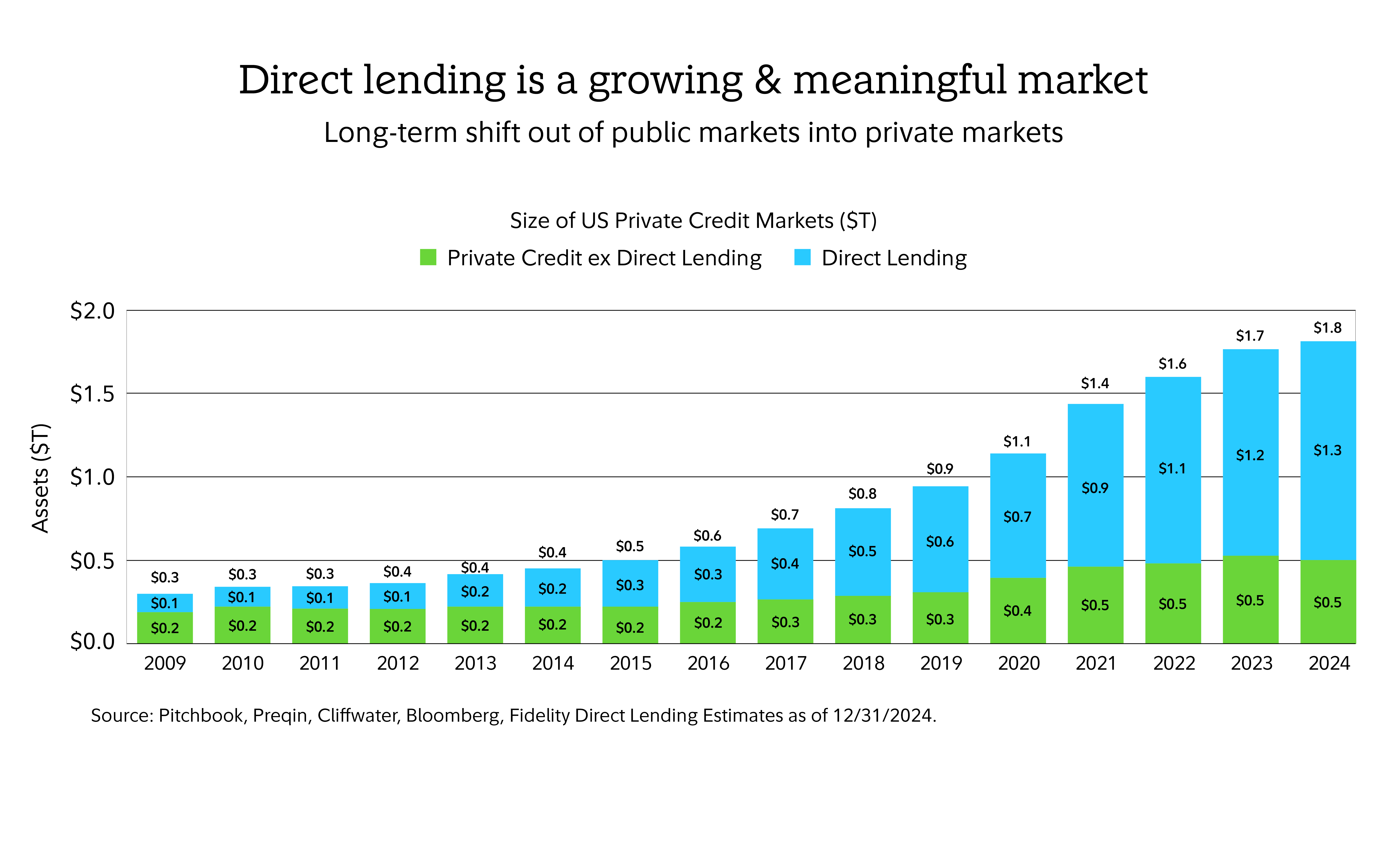
Over the past 16 years, the private credit asset class has grown to approximately $1.8 trillion. Following the Global Financial Crisis of the late 2000s, tighter regulation and economic conditions caused banks to shift away from traditional corporate lending.1 This created an opportunity for asset managers to lend capital. As a result, private credit has grown to become an increasingly significant funding source for many firms and an emerging asset class for institutional and individual investors.
Negotiating private loans with direct lenders can offer companies speed and reliability of loan execution, as well as more customization and flexibility. There is also value to borrowers in working with a firm that acts as a strategic partner, and not just a lender.
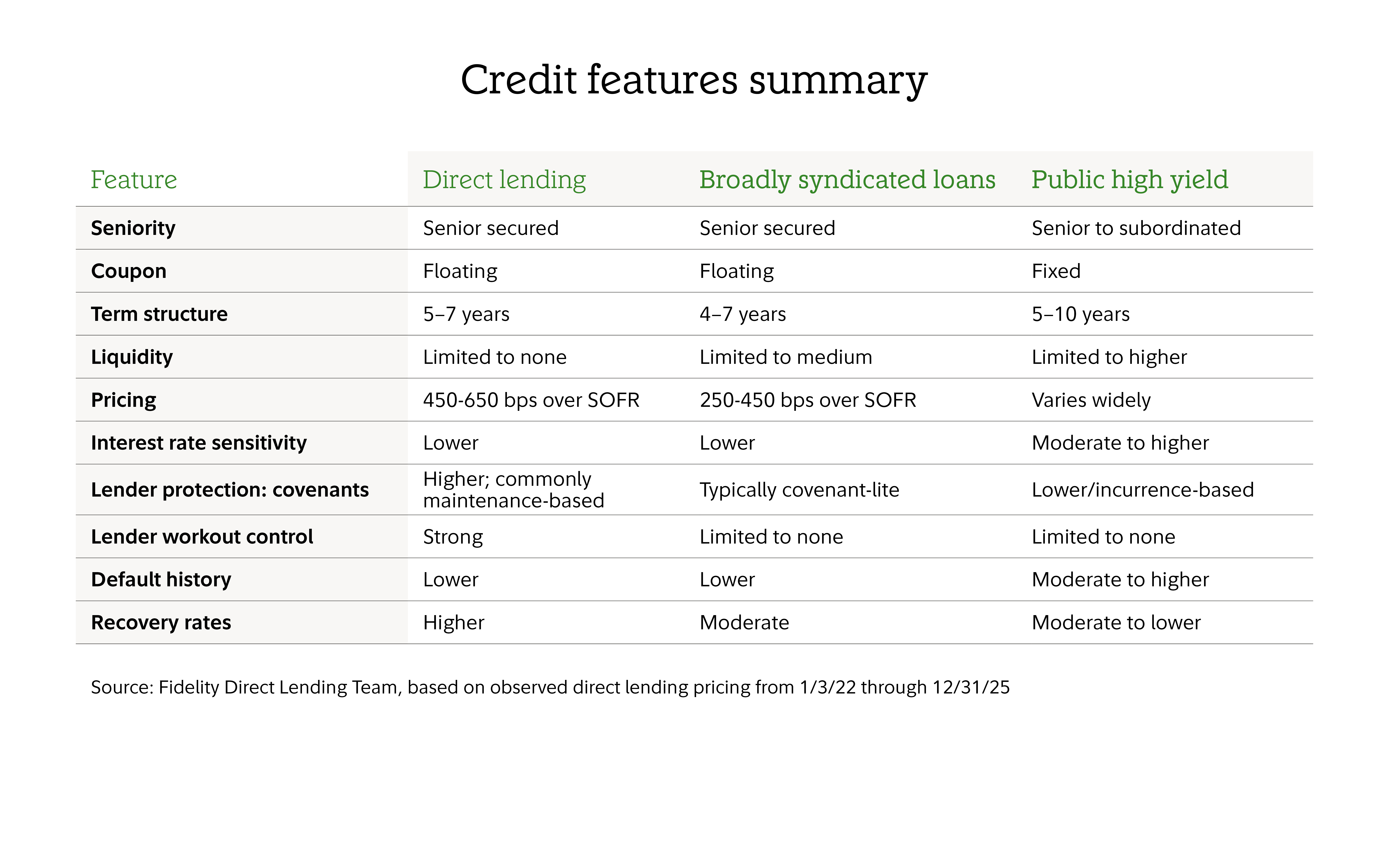
The loans in a direct lending portfolio generate contractual income in the form of interest payments, which can be based on fixed rates, floating rates, or a combination of both. These loans, which tend to have 5-to-7-year maturities, are highly negotiated, resulting in bespoke covenants tailored to each borrower. Compared to the off-the-shelf terms seen in many traditional bank loans, private credit terms may offer lender protection while still providing borrowers the flexibility to run their businesses.
Private credit investing
Private credit investments may provide investors with attractive yields, downside protection, and uncorrelated returns across market cycles compared to public market fixed income investments.
By combining complementary sources of public and private credit, eligible investors can potentially enhance return consistency, income durability, and compounding potential.
Publicly traded business development companies, or BDCs, offer daily liquidity through the stock market and function much like any other listed security. Public non-traded BDCs, by contrast, are typically designed for longer investment terms. Some operate as perpetual vehicles that offer periodic share repurchase programs—often quarterly—while others are structured as finite-life funds with defined investment and harvest periods. In either case, the liquidity features are intentionally limited to allow managers to hold privately negotiated loans to maturity rather than sell them in response to short-term outflows.
What’s happening in private credit markets today?
Recent headlines have focused on select situations where BDC redemption requests by investors have exceeded stated periodic limits, sometimes described as "gates." When requests exceed the available repurchase capacity of a fund in a given period, the manager fulfills the permitted amount and carries the remainder forward.
These limits exist for a reason: Private credit portfolios consist of loans that are designed to be held over multiple years. Forcing asset sales to meet short-term liquidity demands would ultimately disadvantage long-term investors.
In one widely reported example, a large private credit platform limited repurchases within a finite-life private BDC after requests exceeded the vehicle's liquidity framework. Unlike perpetual vehicles, these funds are designed with defined investment and realization periods and include pre-established mechanisms for returning capital over time. As a result, headlines referring to "gates" may overstate the issue when, in fact, the structure is functioning largely as intended.
Given the nature of these private BDCs—which often serve a more institutional investor base—the situation is better understood as the orderly management of a closed-end structure rather than a signal of broader stress in the private credit market.
Another area of renewed investor focus is on the valuation of software companies in private credit portfolios. After underperforming the broader market in 2025, software equities began this year with a sharp drawdown, declining about 20% from the start of the year through February 5, according to MSCI. Valuations abruptly reset amid growing concerns that artificial intelligence (AI) is disrupting traditional software business models more rapidly than anticipated.
David Gaito, head of Fidelity Direct Lending, acknowledges that the speed of the sell-off in software stocks has been notable, even by the standards of historically volatile technology markets. “But I don’t think the software industry is disappearing, and several areas of software appear particularly resilient,” Gaito says. “Moreover, the current reset in software may ultimately create a healthier lending environment than what has prevailed in periods where assets were overvalued and financed with aggressive leverage.”
Level-setting on public BDCs
What should private credit investors consider now?
It’s important for investors to recognize that private credit is a long-term, illiquid strategy with inherent risk. And while short-term disruptions can be cause for some concern, they are not necessarily indicative of larger structural problems with the asset class. The situations described in the headlines appear to be isolated and idiosyncratic.
A private credit manager cannot always predict which path the market will take. As a credit portfolio matures, it is natural for some companies to face headwinds. Unlike liquid credit managers who can trade in and out of challenging positions, private credit managers will need to use their workout tools to determine the path to recovery.
It seems the market is moving toward an inflection point ahead, where resilient portfolios focused on robust underwriting processes, clear valuation policies, and liquidity management may have an advantage. The breadth of resources, insights from decades of investment experience in public and private companies across cycles as well as sector-specialist research analysts position Fidelity to be well prepared for what may lie ahead.