

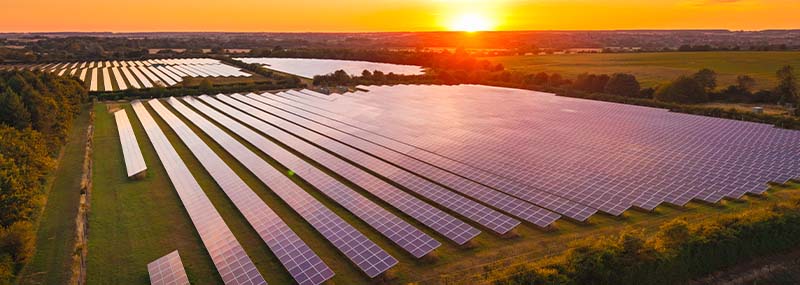
The economics of solar energy have transformed dramatically, according to Fidelity Portfolio Manager Preeti Sayana, who believes generating power from the sun is no longer just an environmentally conscious choice, it is now a cost-competitive alternative to traditional fossil fuels in a world starved for reliable, affordable power sources.
“The sun is rising on a new era of energy, and with it may come a meaningful investment opportunity,” says Sayana, who manages Fidelity® Women’s Leadership Fund (FWOMX). “Capital typically flows to where potential returns are strongest, and solar-related stocks have demonstrated significant strength of late.”
Launched in 2019, the fund is a thematic equity strategy dedicated to advancing women's leadership and gender diversity. Accordingly, Sayana seeks companies with women in key roles in the C-suite, firms with at least one-third of their board seats held by women, and businesses with best-in-class gender-diversity initiatives.
Sayana points out that solar energy has shone bright in recent months, with several indicators seemingly overshadowing negative political rhetoric and a general lack of enthusiasm for renewable energy and sustainability trends.
“China now generates roughly 25% of its power from solar, gaining independence from foreign oil and securing access to cheap, reliable energy,” explains Sayana. “Meanwhile, demand has surged in the U.S., with backlogs in gas turbine production stretching into 2030, putting solar power in what I see as a potentially unique position to fill that gap.”
Learn More
She adds that the growing urgency for power may be too big to be ignored, especially given the proliferation of energy-intensive data centers supporting artificial intelligence, along with mounting political pressure stemming from rising household power bills that Sayana believes will only continue to intensify.
“Where will the additional power come from?” Sayana asks. “I believe solar energy offers a faster path to deployment than alternatives that take years to develop and bring online,” she adds.
For context, more than 80% of the U.S. interconnection queue – a waitlist of new power generation and storage projects seeking to connect to the electric grid – is solar and storage, comprising a significant share of what is expected to come online over the next couple of years.
Furthermore, Sayana notes that in the third quarter of 2025, solar accounted for 58% of all new electricity generating capacity added to the U.S. grid. Coupled with storage, that figure rises to 85%.
Fidelity’s research suggests that even without tax incentives, the potential opportunity for utility-scale solar power is considerable, Sayana says. Even though storage solutions remain an open question, ongoing innovation in battery technology continues to evolve and help address this challenge.
Seeking to benefit from the trend, she has positioned the fund accordingly, including an investment (as of February 28) in First Solar (FSLR), a solar panel maker that exemplifies how the theme is unfolding amid what she views as a structural shift in U.S. trade policy favoring the company. Recent “anti-dumping” tariffs, she believes, could create some pricing upside and present opportunities to gain market share in the coming years.
“At the end of the day, I believe solar stocks aren’t just about capitalizing on a growing market; they reflect a broader alignment with transformative trends that may shape a future emphasizing sustainability, innovation and resilience,” Sayana concludes.
For specific fund information, including full holdings, please click on the fund trading symbol above.

Preeti Sayana is a portfolio manager and research analyst in the Equity division at Fidelity Investments.
In this role, Ms. Sayana is responsible for researching international small cap companies. She is also the portfolio manager of Fidelity Series International Small Cap Fund and manages Sustainable U.S. Equity and Women’s Leadership strategies across various investment vehicles.
Prior to assuming her current responsibilities, Ms. Sayana was an analyst researching international small cap consumer companies focused on the Europe, Japan, and Australia markets. She was also on the emerging markets and core research teams for 12 years. She covered emerging-market consumer companies globally and focused on U.S. large cap consumer stocks. Additionally, she worked as the small and mid cap generalist for India.
Before joining Fidelity in 2005, Ms. Sayana was, from 1998 to 2005, an analyst at Putnam Investments, where she held various research roles in the consumer, telecom, and technology sectors. She has been in the financial industry since 1993.
Ms. Sayana earned her Bachelor of Commerce from Osmania University, her Master of Business Administration in finance from the University of Massachusetts, and her Master of Science in finance from Boston College. She also is a CFA® charterholder.