


Ever heard of prediction markets and wondered how they work? These markets let participants trade contracts tied to future events. Let’s dive into the basics of what prediction markets and event contracts are and how they work.
What are prediction markets?
Prediction markets are marketplaces where participants buy and sell contracts tied to the outcome of future events. These contracts, often called event contracts, gain or lose value based on whether a specific outcome occurs. A contract’s price reflects how likely market participants believe that outcome is.
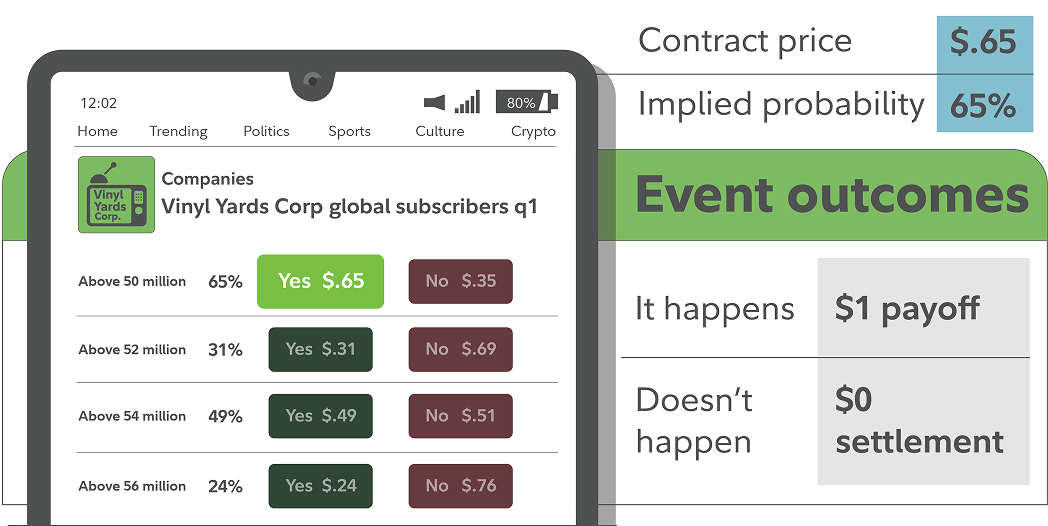
Prediction markets use changing prices to reflect how groups understand uncertain outcomes as new information becomes available. Event contracts in prediction markets can be created for many kinds of events, like sports, entertainment, economic news, or business goals. It’s important that the outcome is clearly defined and can be easily checked.
Even though prediction markets involve trading contracts like financial markets do, their goal is different, and they aren’t the same as more traditional investments like stocks, ETFs, or bonds.
How do prediction markets work?
Prediction markets are rather unique in how the event contracts are created, traded, and paid out. Here are the steps involved in how prediction markets normally work:
- An event is defined: A specific event is clearly defined, often with a yes‑or‑no outcome, so contracts can be settled (paid out) objectively.
- Contracts are listed: Each outcome is given a tradable event contract. These are often structured as a yes-or-no contract that pays a fixed amount if the outcome occurs.
- Participants trade contracts: Buyers and sellers transact based on their expectations. New trades shift prices as supply and demand change.
- The event resolves: Once the outcome is known, trading of the event contract stops and winning contracts are settled at their payout value, while losing contracts expire worthless.
- The event contract settles: Contracts tied to the winning outcome settle at their stated value, often $1 per contract. Conversely, contracts tied to the losing outcome expire worthless, settling at $0. This means the person who holds a losing contract to settlement loses their initial investment.
In prediction markets, participants trade event contracts directly with one another, while the platform simply facilitates trades and collects a transaction fee. Unlike traditional betting platforms, the platform does not take a position on the outcome.
Prediction market contracts also differ from traditional investments such as stocks or bonds. Their value does not depend on earnings, dividends, or long‑term growth. Instead, a contract’s value is determined entirely by whether a specific event occurs. Event contracts end up paying out at a fixed amount or expiring worthless once the outcome is known.
How do prices in prediction markets work?
Prediction market prices are commonly displayed in terms of probabilities. If a contract trades for $0.40, that price can be viewed as implying a 40% chance of success. If the price later moves to $0.70, the implied probability rises to 70%. This dynamic pricing reflects:
- New information (such as data releases or announcements)
- Shifts in sentiment
- Changes in perceived risk or uncertainty
As a result, prediction markets are constantly updating their outlook, sometimes in real time. These probabilities show what the market thinks at a given moment. They aren’t guaranteed and can shift as trading activity changes.
Event contract example:
Say there’s a prediction market asking: Will Team A win the game? There are 2 contracts:
- Yes (Team A wins)
- No (Team A does not win)
Suppose the Yes contract is trading at $0.60. This price implies that the market believes Team A has about a 60% chance of winning. The $0.60 paid upfront for this contract is the most the buyer can lose on one contract, while the most the contract can pay at settlement is $1.
When the game ends, trading stops:
- If Team A wins, Yes contracts settle at $1 and No contracts settle at $0.
- If Team A loses, No contracts settle at $1 and Yes contracts settle at $0.
Assuming Team A wins, the Yes contract purchased for $0.60 would settle for $1, resulting in a profit (payout above the purchase price).
What kinds of events are used in prediction markets?
Prediction markets have been applied to a broad set of topics, including:
- Sports and entertainment: Game winners, game scores, and award recipients
- Economics: Inflation reports, interest rate decisions, and GDP growth thresholds
- Politics: Election outcomes or legislative actions
- Business and technology: Product launches, mergers, or adoption milestones
The common thread is that each event must have a clearly defined outcome that can be verified by an agreed‑upon source. This source is typically specified in advance by the exchange. Sources may include league records, certified election results, or statements from recognized authorities responsible for reporting on the event.
Clearly defining both the event and the source helps reduce ambiguity and allows contracts to be settled objectively. As regulations continue to evolve, the types of events and sources used for event contracts have also changed over time.
Prediction markets vs. traditional financial markets
Prediction markets and traditional financial markets may look similar on the surface, since both involve tradeable products and changing prices, but they are designed for very different purposes.
Traditional financial markets
Traditional financial markets are places where people invest in assets such as stocks, ETFs, and bonds, often with the goal of long‑term growth or income. Key features include:
- Ownership and investment exposure: Buying a stock typically represents partial ownership in a company. ETFs provide exposure to a group of investments, such as multiple stocks or bonds. Bonds represent loans made to governments or corporations.
- Established markets and regulations: Trading takes place on regulated markets, such as major stock exchanges. Companies can raise capital by listing shares through processes like initial public offerings (IPOs) or using special purpose acquisition companies (SPACs).
- Value tied to future performance: Prices are generally influenced by future earnings, cash flows, company growth, and broader economic condition expectations.
Prediction markets
Prediction markets are designed to reflect how likely a specific event is to occur. They do not provide ownership or long‑term investment exposure. Some key differences include:
- Contracts tied to defined outcomes: Event contracts are linked to specific outcomes, often structured as yes‑or‑no questions.
- No ownership or ongoing value: Holding an event contract does not represent ownership in a company or asset. It also does not provide access to earnings or dividends.
- Value based on event resolution: A contract’s value depends entirely on whether the defined event occurs. Once the outcome is known, contracts settle at a fixed amount or expire worthless.
How are prediction markets regulated?
Federal regulation of prediction markets
US prediction markets are primarily regulated at the federal level by the Commodity Futures Trading Commission (CFTC). This agency oversees the trading of futures, options, and other derivatives markets. The CFTC currently views prediction markets as trading venues for event contracts. In other words, they’re regulated like a derivative whose value depends on the outcome of a specified future event.
Prediction markets as Designated Contract Markets (DCMs)
A DCM is a CFTC‑regulated exchange that must meet specific requirements related to:
- Market ethics and integrity
- Reporting transparency
- Trade monitoring
- Trading participant protections
Prediction markets that are approved or registered as DCMs are required to follow rules governing how contracts are handled. This includes how they are listed, traded, and settled. These policies can help to act as safeguards intended to reduce the risk of manipulation or abusive trading practices.
State regulation and oversight of prediction markets
In addition to federal oversight, state laws may also affect how prediction markets operate and who can access them. Some states evaluate event-based contracts under existing laws related to gaming, wagering, or consumer protection. As a result, availability and participation rules can vary by state. State‑level considerations may include:
- Access by state: Platforms may restrict participation for residents of certain states based on local laws or interpretations.
- How event contracts are classified: States may differ on whether these contracts are treated as financial products, gaming activity, or something else.
- Consumer protection requirements: Disclosure standards and platform obligations can vary by state.
- Enforcement: States may differ in how actively they monitor or enforce prediction market activity.
- Evolving interpretations: State guidance can change as prediction markets continue to develop.
Since state rules can differ and evolve, participants may need to consider both federal and state regulations when evaluating the availability of prediction markets.
Evolving regulatory landscape
The rules and regulations for prediction markets continue to evolve. Lawmakers and regulators have been actively debating how these markets should be overseen. There have been debates around higher profile topics such as:
- Political elections
- Sports events
- Military actions
- Other matters of significant public interest
As a result, the rules governing prediction markets, and the types of events they may legally offer, remain subject to ongoing discussion and potential change.
Risks and limitations of prediction markets
While prediction markets can be informative, they have significant risks and limitations which include:
- Risk of loss: Participants may lose the full amount paid for an event contract if the outcome they selected does not occur. Because event contracts typically settle at either a fixed value of $1 or $0, contracts tied to the losing outcome expire worthless. This means there is no partial recovery of the initial investment once the event has resolved.
- Potential market manipulation: A number of high-profile cases have highlighted the possibility of event contracts being manipulated to engineer a desired outcome. While there are laws and regulations prohibiting prediction market tampering, systems for monitoring these activities may not be sufficient to prevent all instances of market manipulation.
- Liquidity constraints: When a market isn’t very active, it may be harder to trade at expected prices, which can affect both pricing and how easily participants can exit a position.
- Potential for small sample sizes: In markets with fewer participants, prices can be driven by a small group of traders, which may lead to bigger swings or less dependable signals.
- Information gaps: Prediction market prices reflect only what participating traders know and believe, so missing information can affect how accurate those prices are.
- Behavioral influences: Following the crowd (known as herding), overconfidence, or other emotional biases can distort prices and probabilities.
- Event uncertainty: Some outcomes depend on complex or rapidly changing factors that are difficult to model accurately.
Because of these factors, prediction markets are generally discussed as informational, research, and trading products rather than traditional investment vehicles.
Considering prediction markets?
Individuals considering prediction markets have recognized that these have recently grown in adoption and are evolving products, and both their design and regulation continue to develop. Market rules, permitted contract types, and regulations can change over time and may vary by jurisdiction.
While prediction markets focus on whether a specific outcome will occur, some investors may choose to express their views on future uncertainty through products like options. Both types of trading products translate expectations into market prices. However, options can offer added flexibility by allowing traders to consider price movement, volatility, and time to expiration, rather than a single yes‑or‑no result.
Additionally, investors curious about the growth of prediction markets may be able to obtain indirect exposure through investing in publicly traded companies that platform or support prediction markets. As with any financial decision, it’s important to think about your goals, how much risk you’re comfortable with, and your level of experience when deciding which products may be right for you.