


After a long period of strong stock market performance, you might find yourself with a highly concentrated position (i.e., a stock that accounts for a disproportionately large percentage of your overall holdings). Indeed, a handful of fast-growing companies have driven much of the US stock market’s gains in recent years and, as a result, your portfolio may now largely hinge on just a few stocks—rather than being more appropriately diversified.
Among the solutions to diversify such a position would be to sell some of those appreciated shares. But if those shares are held in a taxable account, realizing the gains and triggering a taxable event may not be optimal for your objectives.
If you have a large, concentrated position, a long-term investing horizon, and are interested in exploring opportunities to diversify that position without realizing the capital gains, you may want to consider exchange funds.
What are exchange funds?
Exchange funds are a type of pooled investment vehicle where multiple investors contribute different equities (e.g., stocks) to the fund. For example, Investor 1 contributes Stock A, Investor 2 contributes Stock B, Investor 3 contributes Stock C, etc. In exchange, each investor receives shares of the exchange fund which contain all of the contributed stocks.
The exchange fund’s manager decides which equities they will accept into the fund (and how much) to create a diversified portfolio. Oftentimes, the exchange fund attempts to mimic the risk profile of a broad index, like the S&P 500 Index.
Exchange funds are also required to hold at least 20% of their assets in non-securities, which is typically satisfied by real estate because of the relative ease to finance this position and to pay for financing costs.
When investors are ready to redeem from the fund, they will do so in stock. If it has been 7 years or longer, investors have the option to redeem these shares for a basket of diversified securities. Generally, an investor will receive a diversified basket of securities, with a minimum number of securities across industries. The exact distribution process will vary by fund, and thus it’s important to understand an exchange fund’s redemption policy.
An exchange fund in action
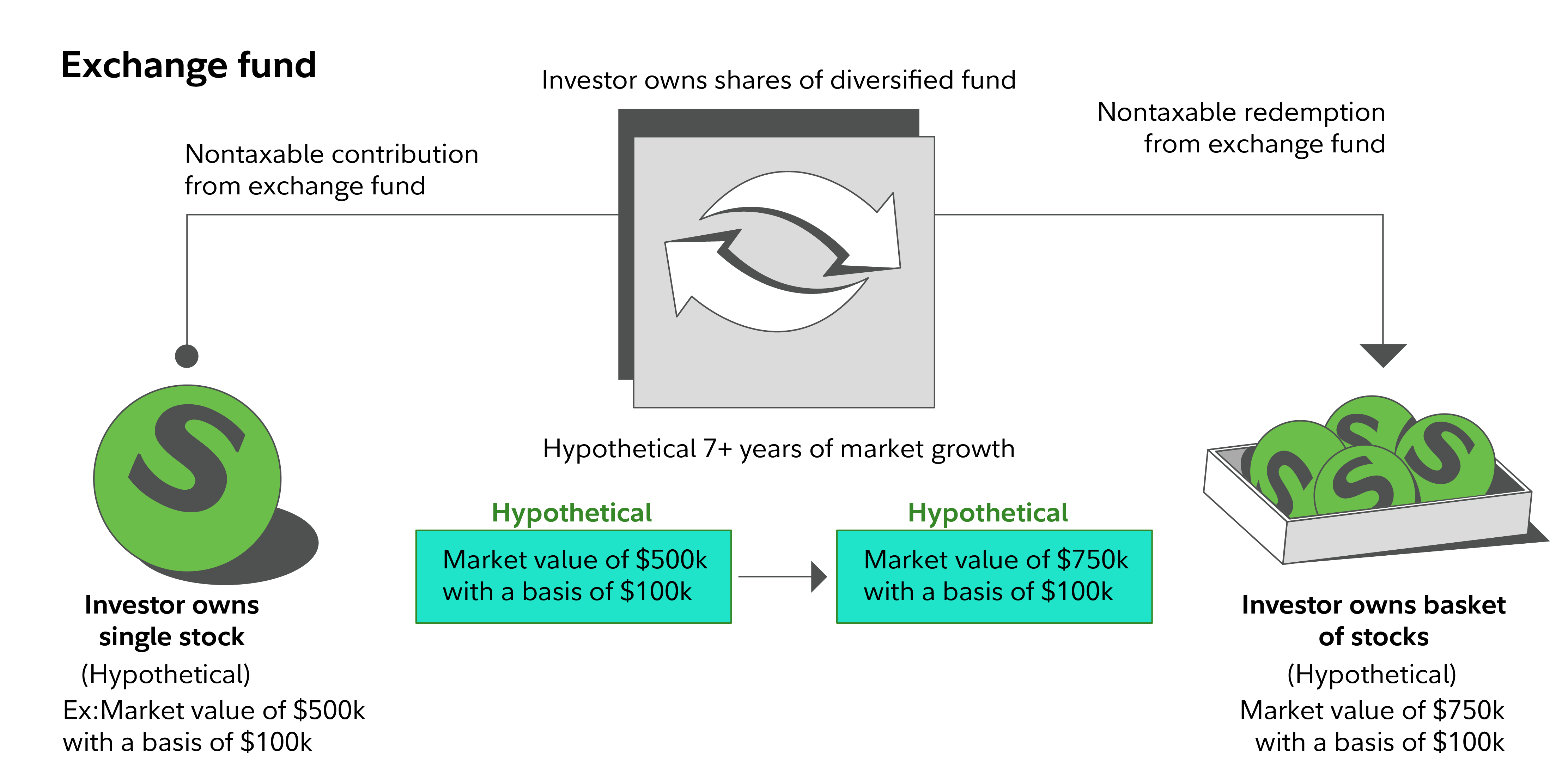
Both the investor’s initial contribution as well as this redemption do not trigger realization of embedded capital gains. Of course, investors will trigger the realization of gains if they subsequently sell any of their redeemed basket of stocks. Redemptions prior to the 7-year holding period may experience more limited options, including that the redemption may not be met with a diversified basket. Rather, the investor may receive a single stock or small basket of stocks, and in some cases the investor may not be able to redeem their entire investment in the fund prior to 7 years. Also, fees could apply (especially for shorter holding periods).
The investor’s cost basis from the original contribution will transfer to the shares of the fund. At the time of redemption, the cost basis of the fund shares will transfer to the withdrawn securities.
Benefits of an exchange fund
Since investors don’t pay capital gains taxes when contributing their concentrated securities to the fund, they are able to invest the full value of their holdings in the diversified portfolio. This gives the entire value of the holdings contributed to the fund the potential to grow over time. Of course, performance of an actual investment will vary and unit holders could have a gain or loss when they redeem their shares.
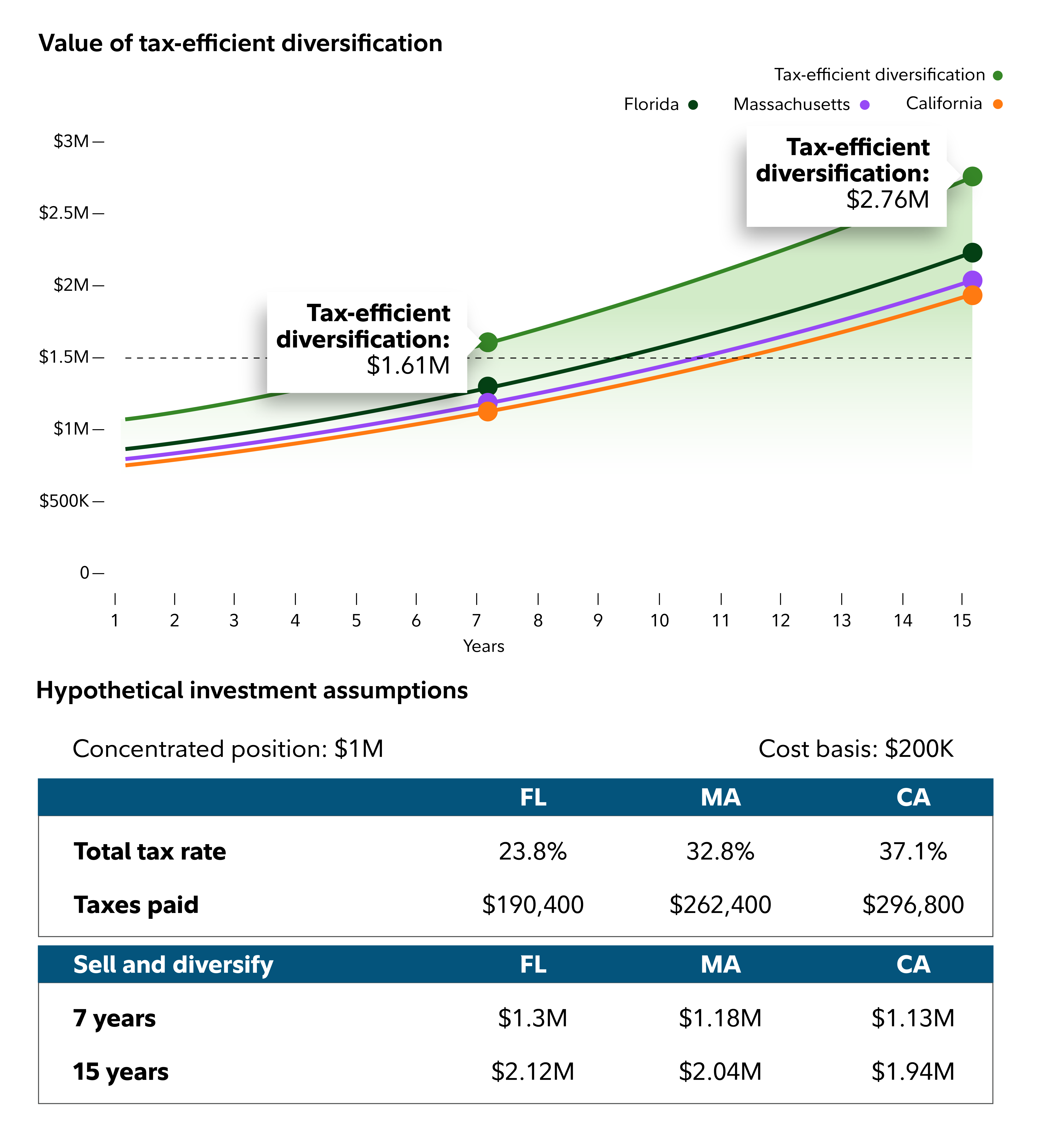
As demonstrated in the table below, the difference gained through tax-deferred diversification can be significant. Investing the full $1,000,000 at 7% for 15 years results in a value of over $2,700,000. If the embedded gain is realized and the top federal rate of 23.8% is due, the remaining $809,600 invested at the same rate for the same period results in only $2,200,000. Additional scenarios illustrate an even bigger impact if state capital gains are incorporated (examples include the top rate of 9% in Massachusetts and 13.3% in California).
Hypothetical example of tax-deferred growth
An added benefit for some investors is that their contributed stock won’t generally be sold in public markets, eliminating concerns around impacting the price of a stock by selling out of a significant position.
Risks of an exchange fund
As you might expect, there are risks to consider when investing in exchange funds. Among them:
- Performance isn’t guaranteed. The fund provides diversification, so some contributed securities will outperform the fund and some will underperform the fund. Also, exchange funds don’t generally track the index perfectly and may outperform or underperform the index.
- Liquidity is restricted. To achieve the tax advantages of participating in an exchange fund, there are often limitations on liquidity. Funds may have varying lock-up periods, redemption fees, and redemption rules, both before the 7-year holding period and after. It is important to understand your time horizon and how fund liquidity will align with it, as well as your long-term plan and how redemption options will play into your plan.
- Tax laws could change. Although any change to the favorable treatment exchange funds receive could be grandfathered in for current investors, retroactive treatment cannot be ruled out.
- Fees can impact returns. Exchange funds charge fees. It is important to understand all the fees that an investor may pay, which can have a material impact on performance.
- Non-security assets are included. As mentioned, exchange funds generally need to invest at least 20% of fund assets in certain non-security investments—usually satisfied by purchasing real estate. These assets are usually acquired with leverage, which has its own unique risks.
Should you consider exchange funds?
Exchange funds are typically available only to Qualified Purchasers (defined as individuals or entities with at least $5 million in investable assets). For those eligible, long-term investors who are looking for diversification, tax-deferral strategies, and estate planning, an exchange fund might be a solution for concentrated stock positions.