

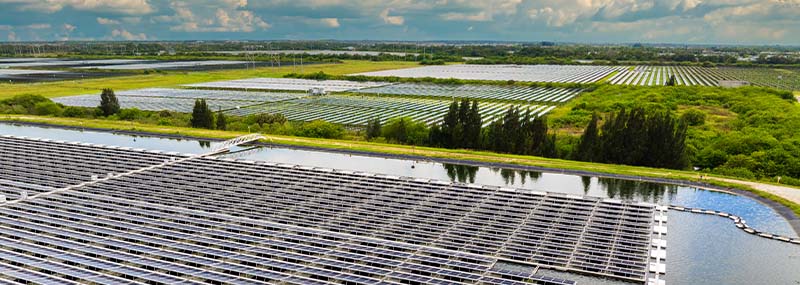
The stocks of companies focused on renewable energy have renewed appeal, according to Fidelity Portfolio Manager Allyson Ke, citing the growing importance of energy security, the rise of data centers to power artificial intelligence and surprisingly flexible policies shaping the energy landscape.
“These powerful drivers are converging in support of renewables, paving the way for what I think could be compelling long-term investments,” says Ke, who co-manages Fidelity® Healthy Future Fund (FAPHX) with Paul McElroy.
Launched in 2022, the fund is a thematic equity strategy that primarily invests in global companies dedicated to health and wellness and improving life expectancy. Ke and McElroy favor firms with strong business fundamentals and an attractive environmental, social and governance profile.
Energy security has grown in importance since Russia’s early-2022 invasion of Ukraine – and more recently given the conflict in the Middle East – according to Ke, underscoring that the risk of a dependence on fossil fuels has spurred many countries to prioritize domestic energy. This has driven a surge in renewables-focused projects, ranging from major U.K. offshore wind auctions to large-scale solar-storage developments, she adds.
“Governments in the U.S. and globally are committing substantial capital to power-grid infrastructure, helping to ensure long-term visibility for the expansion of renewable energy,” Ke explains.
Learn More
Seeking to capitalize, Ke and McElroy established a position last fall in Scotland-based SSE (SSEZY), which she says typically earns a steady, inflation-protected revenue stream from managing the U.K. electricity grid. Additionally, U.K. nations are spending big to upgrade the grid for more renewable power sources, earmarking billions to SSE and helping to position the company for long-term growth potential, in Ke’s view.
“And while grid volatility remains a challenge, ongoing investments in battery storage and transmission upgrades can be a mitigating factor,” she says.
Ke also highlights a surge in electricity demand to power growing AI-focused data centers and hyperscalers in the U.S., Europe and the U.K., believing solar and wind are the quickest way to add capacity.
“Renewable energy generation generally offers a low, levelized cost of electricity compared with traditional sources,” she says, noting the fund’s holdings in Vestas Wind Systems (VWSYF), a maker of wind turbines, and NextEra Energy (NEE), a U.S.-based utility.
Ke explains that wind and solar installations often take about two years, versus five to seven years for gas turbines, making them a potentially attractive solution for meeting near-term capacity needs while other energy sources are built out over longer time horizons.
Lastly, Ke’s optimism for renewable energy is reinforced by ongoing supportive regulatory policy, particularly with incentives and accelerated permitting in Germany and Europe. She also acknowledges that there has been increased clarity around renewable incentives in the U.S. following the passage of the One Big Beautiful Bill Act.
For specific fund information, including full holdings, please click on the fund trading symbol above. Securities mentioned were fund investments as of January 31, 2026.

Allyson Ke is a portfolio manager and analyst in the Equity division at Fidelity Investments.
In this role, Ms. Ke manages Fidelity and Fidelity Advisor Healthy Future Fund and Fidelity Nordic Fund. Additionally, in her responsibilities as an analyst, she covers the European consumer staples sector.
Previously, she managed Fidelity and Fidelity Advisor Europe Fund. She also covered the European consumer discretionary sector and managed a European consumer discretionary pilot fund.
Prior to joining Fidelity in 2011, Ms. Ke worked in investment banking at Goldman Sachs. She has been in the financial industry since 2006.
Ms. Ke earned her Bachelor of Arts in philosophy from Cambridge University and her Master of Business Administration from Harvard Business School. She is also a CFA® charterholder.