


Investors have plenty on their minds heading into the home stretch of 2026. Inflation has accelerated, the Federal Reserve has started raising interest rates, Treasury yields recently reached their highest levels in 2 decades, and the sustainability of technology earnings growth is uncertain.
Yet some of these warning signs have historically been followed by favorable stock market performance. Looking ahead, I believe there are 3 themes that could influence stock market performance over the coming months.
- The short-term federal funds rate, set by the Federal Reserve, remains low relative to nominal US economic growth, a backdrop that historically has supported stocks.
- Technology and other cyclical sectors have tended to outperform defensive sectors after similar economic and sentiment readings.
- A crowded trade that bets 10-year Treasury bond prices will fall has typically preceded falling yields, which could support higher stock and bond prices.
History cannot tell us exactly what markets will do next, but it can provide useful context for assessing whether today’s most prominent risks may already be reflected in market prices.
Higher interest rates don’t necessarily derail stocks
Higher interest rates are not necessarily a bad signal for stocks, particularly when rates remain low relative to nominal economic growth.
Concerns about inflation and interest rates have dominated markets since September, when the Consumer Price Index (CPI) rose 3.7% from a year earlier, and the Federal Reserve raised its target range for the federal funds rate for the first time since 2023. Bond yields surged, with the benchmark 10-year Treasury yield reaching its highest level in about 2 decades.
Some investors worry that the September increase could mark the beginning of a series of rate hikes, which could slow economic growth and halt a bull market that just turned 4 years old. Based on historical data, I believe the Fed may be closer to the end of a rate-hiking cycle than many investors may think.
The federal funds rate has generally been higher when the economy has experienced stronger nominal growth, which includes both real economic growth and inflation. Lately, this rate has appeared slightly low relative to the pace of nominal growth in US gross domestic product (GDP). In September 2026, for example, year-over-year nominal GDP growth was 5.87%, while the effective fed funds rate was 3.88%.
In my view, based on past market data, the gap between those 2 numbers is minimal. Historically, that would suggest the Fed won't feel compelled to change rates significantly. In such scenarios, the stock market has been better able to discount those changes in advance.
That relationship could have important implications for US monetary policy. When rates have been at similar levels relative to nominal GDP growth in the past—low, but only slightly low by historical standards—the Fed has raised the fed funds rate during the next 12 months only about half the time.
And if target rates are unchanged or modestly higher, that could be a positive for stocks. Historically, when the Fed has held rates steady or raised them no more than 1.25 percentage points over a 1-year period, the stock market has advanced about 83% of the time. The S&P 500® Index has gained an average of 11% during such periods of flat or modestly rising rates.
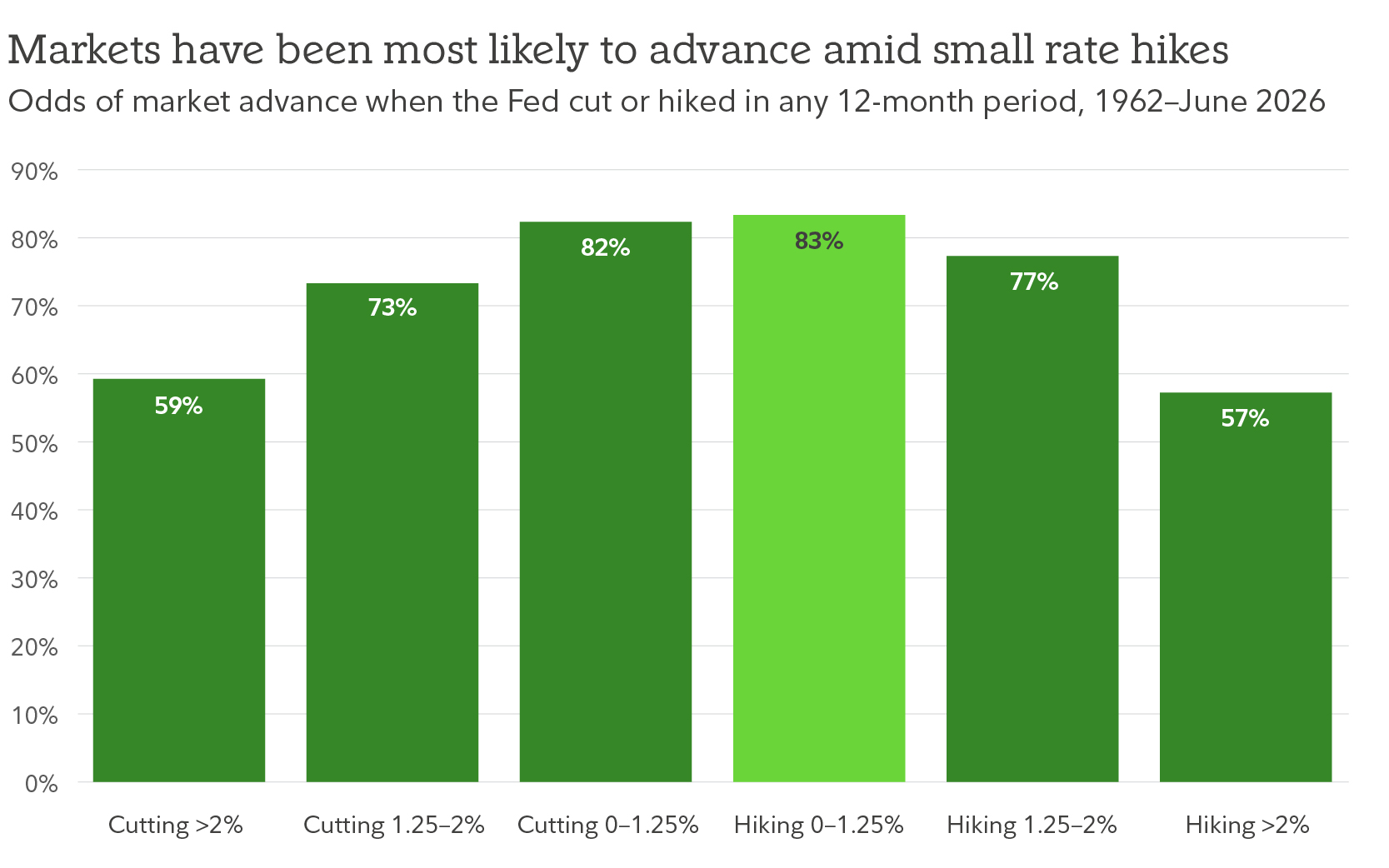
On the other hand, while rate cuts may sound inherently positive for stocks, the Fed often lowers rates in response to weakening economic conditions. This is why investors should understand the circumstances driving a policy change as much as the direction of the change itself.
The current combination of solid nominal economic growth and relatively low interest rates does not eliminate the risks facing stocks. Based on history, though, it is not the kind of backdrop that has consistently ended market advances.
Cyclical stock sectors may have an edge over defensive sectors
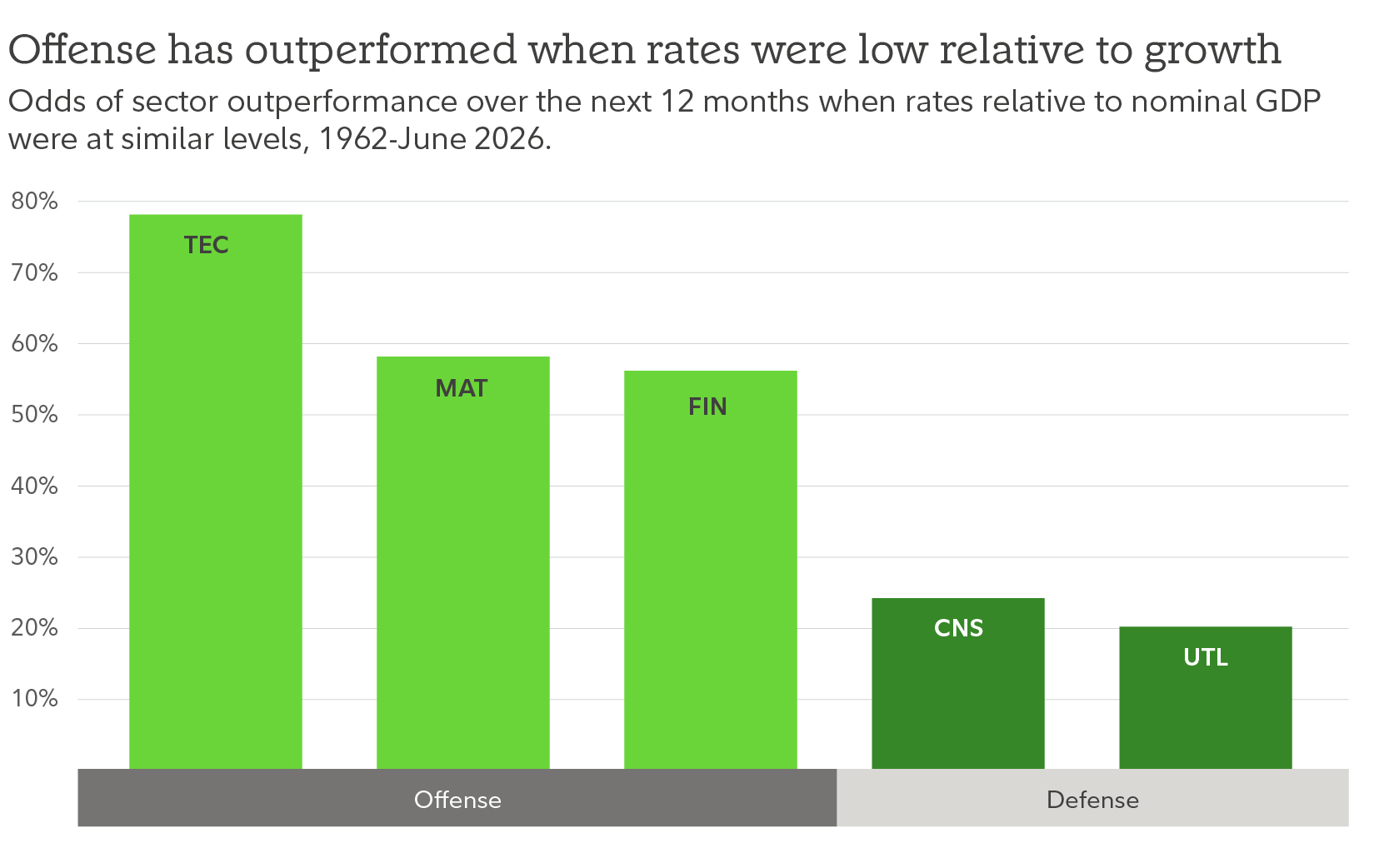
In my opinion, the current environment appears more conducive to cyclical sectors, particularly technology, than defensive sectors. Cyclical sectors, including information technology, materials, and financial services, tend to be more sensitive to ups and downs of economic growth. Defensive sectors, such as consumer staples and utilities, have historically held up better when the economy weakens.
When interest rates were low relative to economic growth in the past, cyclical sectors were among those most likely to outperform during the following 12 months. On average, cyclical sectors outperformed the broader market by 2 percentage points during those periods, while defensive sectors trailed by 5 percentage points.
The historical case for cyclical sectors may seem difficult to reconcile with today’s pessimism. Nearly half (46%) of respondents in the most recent American Association of Individual Investors sentiment survey described themselves as bearish. That bearish sentiment reached 53% in mid-September, among the highest levels in the survey’s history.1
Yet such levels of pessimism could be a contrarian signal favoring cyclical stocks. When bearish sentiment was in the top 3% of its historical range, cyclical sectors generally outperformed during the following 12 months while defensive sectors struggled.
The technology sector, which has powered the US stock market to record highs in 2026, remains particularly compelling, in my view. Some investors worry that slowing technology investment spending could hurt economic growth and weigh on technology stocks. That concern is understandable because technology spending appears to have decelerated from its recent, exceptionally strong pace.
Corporate technology investment increased 16% during the 12 months through March 2026 before slowing to about 15% during the 12 months through June 2026, according to Fidelity analysis. Yet, a slowdown from elevated growth rates does not necessarily mean that technology spending is contracting or that the broader investment cycle is ending.
The economy and technology stocks have historically performed well after technology investment growth has peaked. Following previous periods when technology investment growth was unusually strong but began to slow, inflation-adjusted GDP expanded by more than 3.5% over the next year, on average. Technology stocks outperformed the broader market by more than 4 percentage points during those periods.
Valuations could provide another source of support. The technology sector’s average price-to-earnings ratio was 30% lower in July 2026 than a year earlier as companies' earnings grew faster than their stock prices. After similar valuation declines in the past, technology stocks gained about 10% during the following 12 months, on average.
None of this means every technology or cyclical stock looks attractive. Valuations, earnings trends, competitive positions, and sensitivity to economic growth vary significantly across companies. In my view, the historical backdrop continues to favor technology and select cyclical sectors over defensive sectors.
Read the full report
Get Fidelity’s complete Q4 2026 Quarterly Sector and Investment Research Update, from the desk of Denise Chisholm, director of quantitative market strategy.
Treasury yields may be more likely to fall than rise
A crowded bet recently in the marketplace that the price of 10-year Treasury bonds would fall suggests, based on my analysis, that yields are instead more likely to fall than rise. Falling rates could in turn ease pressure on stock valuations.
Some investors assume that higher inflation and a hawkish Fed must lead to higher long-term Treasury yields. The relationship is not that simple. The Fed exerts significant influence over short-term interest rates, while long-term Treasury yields also reflect investors’ expectations for inflation, economic growth, and future monetary policy.
It isn't a foregone conclusion that the 10-year will be meaningfully higher, so a sharp spike in long rates—a worry for stocks—might be less likely than investors think.
Investors have nevertheless built substantial short positions against long-term Treasurys, meaning they are betting Treasury prices will fall. Bearish positioning in 10-year Treasurys recently entered the top 10% of its range since 1986.
Bearish positioning in the market may sound negative for bonds, but history suggests the opposite. After positioning against 10-year Treasurys reached similarly elevated levels, the 10-year yield typically declined over the following 12 months.
Any trade can become vulnerable when a crowd of investors acts on the same expectation. If yields stop rising, investors who bet against Treasurys may begin closing their short-sale positions. That buying can contribute to lower yields and higher bond prices.
Declining Treasury yields could also support stocks, most notably by reducing competition from bonds and increasing the present value of companies' future earnings. That effect can be especially meaningful for growth-oriented sectors such as technology.
Investors should understand that economic growth could slow. Still, in my view, the current backdrop continues to favor technology and other select cyclical sectors for investors willing to tolerate stock market volatility.
Researching potential opportunities
Fidelity offers a range of mutual funds and ETFs that provide exposure to the themes mentioned above, including:
- Fidelity® Disruptive Technology ETF (
) - Fidelity® Select Financials Portfolio (
) - Fidelity® Select Materials Portfolio (
) - Fidelity® Select Semiconductors Portfolio (
) - Fidelity® Select Tech Hardware Portfolio (
) - Fidelity® Select Technology Portfolio (
)

Denise Chisholm is director of quantitative market strategy in the Quantitative Research and Investments (QRI) division at Fidelity Investments. Fidelity Investments is a leading provider of investment management, retirement planning, portfolio guidance, brokerage, benefits outsourcing, and other financial products and services to institutions, financial intermediaries, and individuals.
In this role, Ms. Chisholm is focused on historical analysis, its application in diversified portfolio strategies, and ways to combine investment building blocks, such as factors, sectors, and themes. In addition to her research responsibilities, Ms. Chisholm is a popular contributor at various Fidelity client forums, is a LinkedIn 2020 Top Voice, and frequently appears in the media.
Prior to assuming her current position, Ms. Chisholm was a sector strategist focused on sector strategy research, its application in diversified portfolio strategies, and ways to combine sector-based investment vehicles. Ms. Chisholm also held multiple roles within Fidelity, including research analyst on the mega cap research team, research analyst on the international team, and sector specialist.
Previously, Ms. Chisholm performed dual roles as an equity research analyst and director of Independent Research at Ameriprise Financial. In this capacity, she focused on the integration of differentiated research platforms and methodologies. Before joining Fidelity in 1999, Ms. Chisholm served as a cost-of-living consultant for ARINC and as a Department of Defense statistical consultant at MCR Federal. She has been in the financial industry since 1999.
Ms. Chisholm earned her bachelor of arts degree in economics from Boston University.