

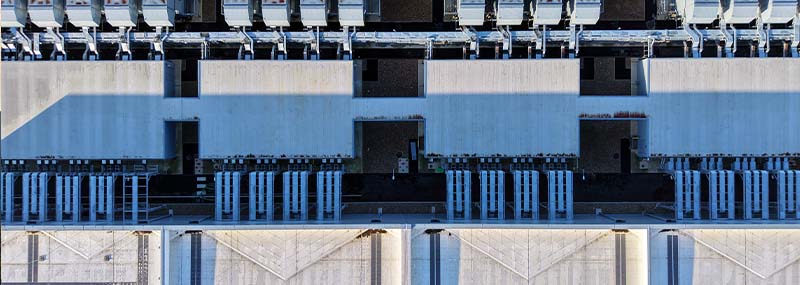
In his discussions with corporate management teams and Fidelity technology analysts around the world, Fidelity Portfolio Manager Bill Bower continues to hear that companies are spending heavily on artificial-intelligence capabilities, leading to a focus on firms involved in manufacturing the semiconductors, memory and power infrastructure needed to integrate AI into their businesses.
“There’s a fear factor in the corporate world along the lines of: ‘We have to do this or else we may be out of business,’” says Bower, portfolio manager of Fidelity® Diversified International Fund (FDIVX). “The stakes are high, so most companies have allocated significant capital to AI because they don’t want to be left behind by competitors.”
In managing the diversified international equity strategy, Bower invests with a long-term perspective, focusing on high-quality businesses with durable or improving growth prospects that benefit from competitive advantages and are structured to achieve consistent profitability. He also values a strong balance sheet, a proven track record, high returns on capital and a solid management team whose interests are aligned with those of shareholders.
Seeking to capitalize on AI and its growth potential, Bower has favored what he believes are the most strategically positioned companies, such as Taiwan Semiconductor Manufacturing, Netherlands-based ASML Holding and Japan-based Renesas Electronics, as well as SK Hynix and Samsung Electronics, both headquartered in South Korea.
“In the tech sector, these companies represent my focus on the critical semiconductor supply chain, including key leaders in equipment and production,” he says.
Learn More
SK Hynix and Samsung Electronics, two semiconductor manufacturers, have stood out among the fund’s biggest contributors year-to-date through July 2026. Each is among the world’s largest producers of DRAM and NAND flash memory for a wide range of technology applications.
“When I bought these stocks for the fund, I believed their valuations were attractive, their product pricing was strong and they were generating robust free cash flow,” Bower says. “Importantly, amid strong demand, their customers were signing long-term contracts, something I don’t believe had happened before. The stock price of each company soared as more investors recognized that demand for memory would increase exponentially alongside spending on new AI capabilities, and that this strong demand cycle was likely to last longer than previously expected.”
Bower also has invested in companies at the center of providing the power infrastructure needed to build and manage the massive data centers that support AI, including France-based Schneider Electric and Germany-based Siemens Energy.
Elsewhere within this power demand theme, he cites Antofagasta, a Chilean copper mining group. Demand for copper continues to soar due to the metal’s conductivity and its role in the build-out of data centers. Antofagasta’s copper production has been largely flat, but the company’s revenue and earnings have surged on improved pricing.
“There were some rumblings earlier this year that there could be a bubble in AI-related stocks because many valuations have risen exponentially,” Bower says. “But I’ll note that funding for the recent AI-driven growth has largely come through the private-equity market, which tends to be much more patient with outcomes than public equity markets, the dominant source of funding in the early days of the internet expansion roughly 26 years ago.”
For specific fund information, including full holdings, please click on the fund trading symbol above. Securities mentioned were fund investments as of July 31, 2026.

Bill Bower is a portfolio manager in the Equity division at Fidelity Investments.
In this role, Mr. Bower manages Fidelity and Fidelity Advisor Diversified International Fund and Fidelity Advisor Global Capital Appreciation Fund.
Prior to assuming his current responsibilities, Mr. Bower managed various other Fidelity funds, including Fidelity International Discovery Fund and Fidelity Select Construction and Housing Portfolio. He also co-managed Fidelity Overseas Fund.
Before joining Fidelity in 1993, Mr. Bower was a commercial real estate loan officer at Michigan National Bank. He has been in the financial industry since 1989.
Mr. Bower earned his bachelor of science degree from Western Michigan University and his master of business administration degree from the University of Michigan.